A director’s condition for adapting his own manga
Nausicaä of the Valley of the Wind is set a thousand years after an industrial civilisation destroyed itself, in a world where a spreading toxic jungle and its giant insect inhabitants are slowly reclaiming what’s left of human land. Princess Nausicaä of the small, wind-protected Valley kingdom tries to keep her people out of a war between the militaristic Tolmekian empire, which wants to use an ancient superweapon to burn the jungle away, and the insects defending it. Hayao Miyazaki wrote and directed the film based on his own manga, which he had begun serialising in the magazine Animage in 1981 under an agreement with publisher Tokuma Shoten that the story would never be adapted into film — a condition he agreed to break only if he could direct the adaptation himself.
A film written ahead of its own source material
Because the manga was still ongoing when production began in 1983, Miyazaki had only sixteen chapters of story to work from, and had to construct a complete narrative arc, including an ending, well ahead of where his own comic had reached. He refocused the film specifically around the Tolmekian invasion of Nausicaä’s valley to give the adaptation a contained shape the open-ended manga didn’t yet have. Isao Takahata, who had worked with Miyazaki as a fellow director on television, joined reluctantly as executive producer, and the production went to Topcraft, a smaller studio Tokuma Shoten didn’t own outright but chose because its artistic team could translate the manga’s atmosphere convincingly to screen.
Nine months, a minor studio, a first collaboration
The entire film was completed in about nine months on a budget under a million dollars, with animators paid by the frame — modest resources for a film with this much invented ecology and machinery to design and animate consistently. Composer Joe Hisaishi, then working in an experimental, minimalist style, scored the film in what became his first of many collaborations with Miyazaki, establishing a working relationship that would shape the tone of most of the director’s subsequent work. Among the animators on the production was a young Hideaki Anno, later the creator of Neon Genesis Evangelion, who was assigned the technically demanding sequence depicting the Giant Warrior’s attack — widely regarded, even at the time, as one of the film’s most striking passages.
A giant weapon sequence built by a future star
Nausicaä herself is defined less by combat ability than by her insistence on understanding the insects and the jungle rather than simply fighting them, a stance the film treats as considerably harder to maintain than open warfare would be. The Tolmekian commander Kushana, by contrast, represents a more straightforwardly militaristic response to the same ecological crisis, and the film’s real tension comes from watching Nausicaä try to hold a middle position between two sides that have each already decided force is the only workable answer. That refusal to let the story resolve into a simple good-versus-evil military conflict is what gives the film its distinct political shape compared to more conventional science-fiction adventures of the period.
An empire, a jungle, and a princess caught between them
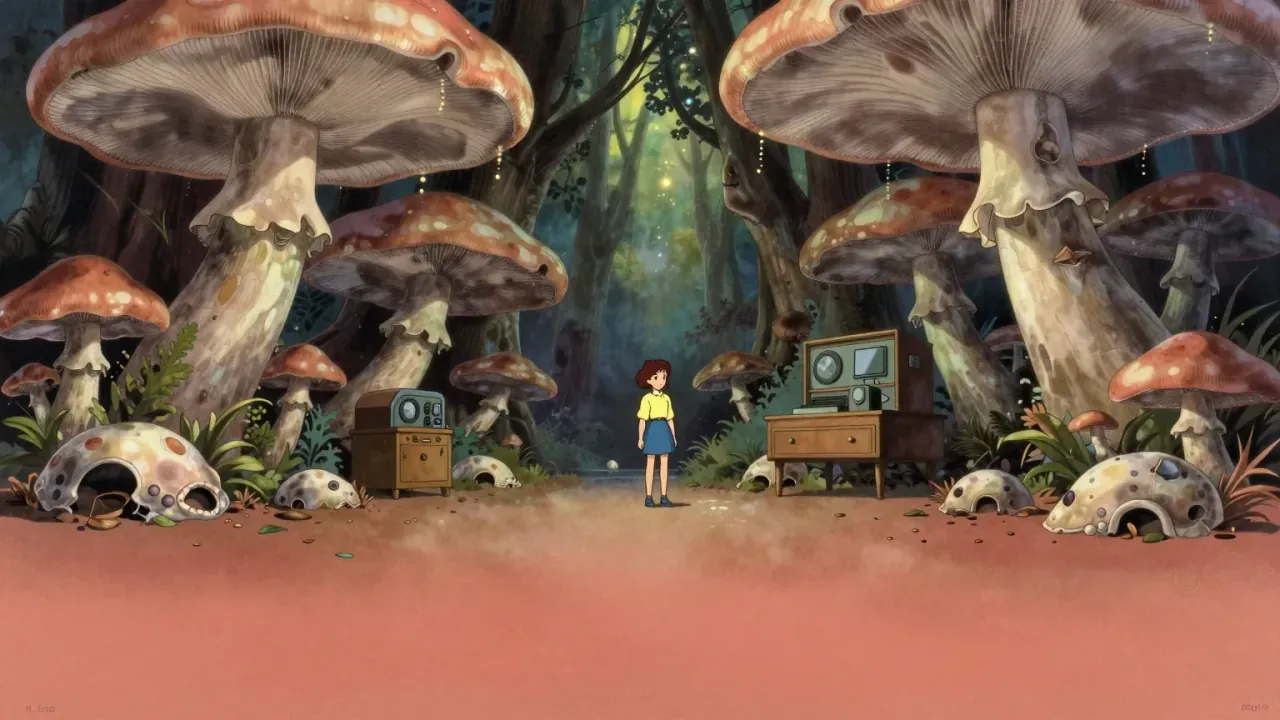
The film’s worldbuilding — a toxic jungle whose spores are actually purifying poisoned soil, insects acting as an ecosystem’s immune response rather than simple monsters — treats environmental collapse as a system with its own internal logic rather than a backdrop for adventure. That approach was ahead of much of the genre at the time, and it’s the throughline connecting Nausicaä’s insistence on understanding the jungle to the film’s broader scepticism about weapons built to solve ecological problems through force. The film received a recommendation from the World Wide Fund for Nature on release, an unusual endorsement for an animated feature that signals how seriously its environmental content was taken even outside animation circles.
Who this is for
This rewards viewers drawn to detailed, ecologically grounded science fiction and to worldbuilding that holds together under scrutiny rather than existing purely as backdrop. Anyone interested in tracing Miyazaki’s development as a director, or in Joe Hisaishi’s scoring before it became a signature style, will find both in an early, formative state here. It’s a slower watch for viewers expecting the pacing of a conventional action film, since long stretches are given over to worldbuilding and political tension rather than combat, and it lacks the gentler, more whimsical tone of some of Miyazaki’s later, more family-oriented work.
Is it worth the evening
The film won the Ōfuji Noburō Award and currently holds a 91% score on Rotten Tomatoes and 86 on Metacritic, both reasonable reflections of a film whose reputation has only grown as Miyazaki’s later career made its early ambitions look more prescient. Made before Studio Ghibli existed, it’s often treated as part of that studio’s body of work anyway, since virtually everything Miyazaki became known for — ecological anxiety, morally complex antagonists, meticulous invented worlds — is already present here in a more compressed, hurried form. Worth the evening both as a strong film in its own right and as the clearest sense of where the rest of his career was headed.