Not an ending
Lone Wolf and Cub: White Heaven in Hell is the sixth and final film in the Japanese martial arts series adapted from Kazuo Koike’s manga. It does not conclude the narrative arc of Ogami Ittō or his son Daigoro, nor does it attempt closure; instead, it pushes the cycle of vengeance to its most extreme physical and symbolic register — snow, steel, slaughter, and the baby cart reforged as weaponised sled. The film tries to escalate the series’ core proposition: that ritualised violence can be both unrelenting and ceremonial, that fatherhood and assassination are not opposites but co-ordinates on the same path. It sustains this by refusing psychological exposition, rejecting moral ambiguity, and treating every confrontation as a formal variation on the same question — how many men will fall before one man and a child reach the next ridge? Its ambition is not thematic expansion but intensification: more terrain, more bodies, more snow, more blades, more repetition until exhaustion becomes rhythm. It is less an ending than a terminal velocity. (148 words)
The look of it
The story follows a strict escalation logic: Yagyū Retsudo deploys Kaori, then Hyouei, then the Tsuchigumo, then his full clan — each wave more grotesque and less human than the last. Tomisaburō Wakayama’s Ittō remains immovable, his face half-shadowed, his movements economical, his silence absolute. Isao Kimura gives Hyouei a brittle, wounded pride; Junko Hitomi’s Kaori is brief but precise in her lethal grace. Yoshiyuki Kuroda directs with tight framing and long takes on location in northern Japan, using real snow and steep slopes to ground the absurdity. The baby cart’s Gatling gun is not a joke but a logical extension: if the cart must carry Daigoro, it must also carry everything needed to kill. Gordon Willis did not shoot this film — Kuroda works with natural light and overcast skies, letting the white landscape mute contrast and sharpen silhouette. Editing is functional, not lyrical; cuts land like sword strikes — abrupt, decisive, without flourish. There is no score beyond diegetic wind and clanging metal. (152 words)
How it moves
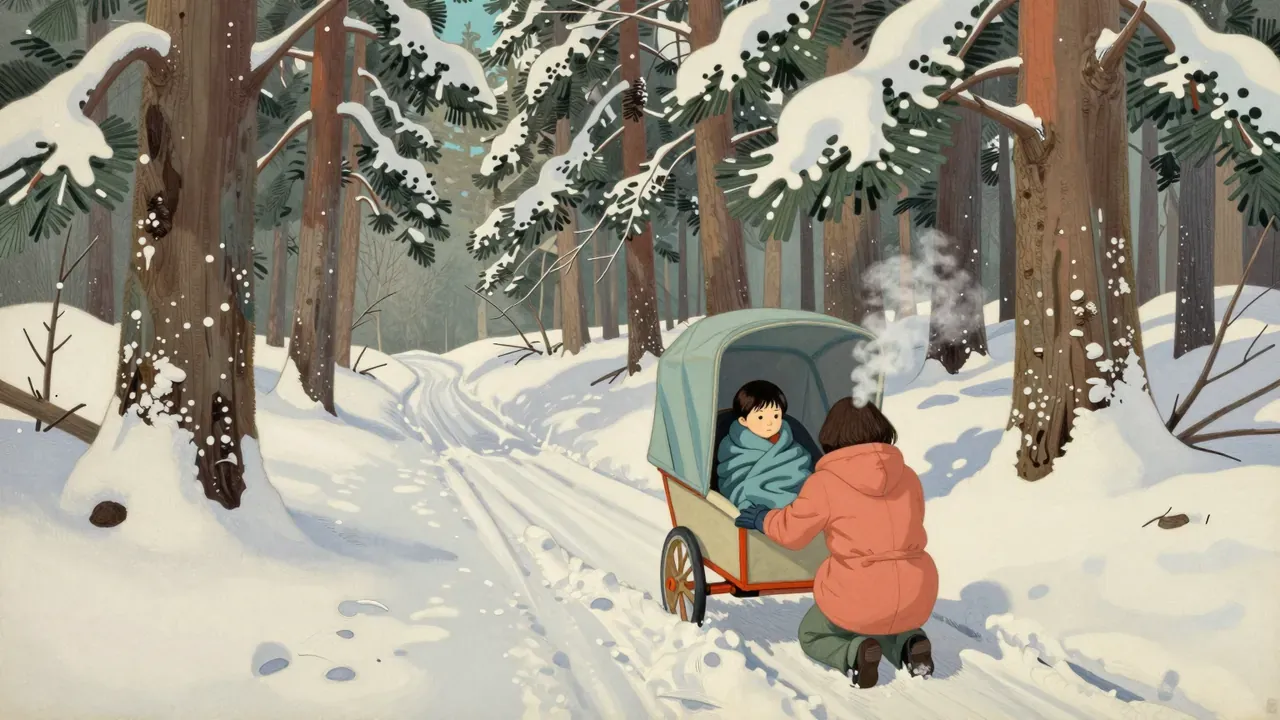
What lands is the sheer physical insistence of the film’s central image: a man dragging a child across frozen mountains while hundreds pursue him, and he kills them all. The snow does not soften the violence — it clarifies it. Bodies pile up in stark relief against white slopes; blood spreads slowly, thickly, then freezes. The baby cart’s transformation into sled and armoured platform feels earned because the film treats mechanics seriously: wheels lock, runners bite, weapons deploy with audible clicks and recoil. Wakayama’s performance lands because he never winks — his grief is buried so deep it has fossilised into posture. The final battle is not cathartic but cumulative: each kill is smaller, faster, more automatic, until the slaughter becomes a kind of breathing. The geography matters — this is not studio-bound samurai theatre but a punishing, wind-scoured landscape where exhaustion is visible in the actor’s shoulders and the camera’s slight tremor. Even the Tsuchigumo’s earth-burrowing gimmick gains weight because it fails under snow — the film obeys its own rules, however fantastical. (156 words)
What stays silent
What does not land is the emotional weight of Daigoro’s presence. Akihiro Tomikawa was three years old during filming, and while he is never sentimentalised, neither is he integrated as anything but prop or pivot — the cart’s occupant, not its companion. The film assumes familiarity with the earlier entries, so new viewers lack context for Ittō’s code or the Yagyū’s history, making motivations opaque rather than austere. The Tsuchigumo, though visually distinct, blur into a single threat — their individual traits vanish beneath identical masks and choreographed lunges. The black magic element sits uneasily alongside the otherwise grounded brutality; it introduces a supernatural register the rest of the film rejects, and the resolution — they simply cannot burrow in snow — feels like a narrative convenience rather than a thematic payoff. The final escape of Retsudo, while faithful to the manga’s open structure, leaves the film suspended rather than resolved, which may read as evasion rather than discipline to some. The runtime is short, but the pacing grows monotonous in the third act, trading momentum for repetition without variation. (154 words)
What the snow says
The themes that matter are endurance as ethics, lineage as burden, and violence as grammar. Ittō does not choose revenge — he enacts it as syntax, each kill a necessary clause in a sentence begun long before the film starts. Fatherhood here is not tenderness but transmission: Daigoro watches, learns, waits — his silence is pedagogy. The snow is not setting but principle: it equalises, erases, exposes. Every surface reflects; every footprint is temporary but legible. The Yagyū represent institutional rot — power clinging to form while losing meaning — whereas Ittō’s path is stripped bare, reduced to motion, blade, and cart. There is no redemption, only adherence. The film treats honour not as virtue but as physics: a fixed vector, unalterable once set. Ritual is not ornament but function — the way Ittō cleans his sword, the way he positions Daigoro before combat, the way he reloads the cart’s weapons — these are not flourishes but calibration. The mountain is not metaphor but test: cold does not ask permission, snow does not negotiate, and neither does the film. (149 words)
Who it waits for
This film is for viewers who value formal rigour over exposition, who find clarity in repetition, and who accept that a story can be about stamina rather than change. It suits those already familiar with the series or with Japanese chambara conventions — the shorthand of posture, the weight of silence, the economy of gesture. It is not for viewers seeking character development, moral reckoning, or narrative closure. Those who require psychological motivation, tonal variety, or thematic explanation will find it withholding, even alienating. Fans of stylised action cinema who expect inventive choreography or spatial wit may be disappointed: the fights are brutal but functional, not balletic. Anyone put off by sustained, unsentimental violence — particularly involving a child as passive witness — should avoid it. The film makes no apology, offers no guide. Its audience is narrow by design: people who understand that ‘white heaven’ is not peace but exposure, and ‘hell’ is not fire but the unbroken line of pursuit across a frozen world. (150 words)
What it asks of you
Yes, it is worth your evening — but only if you arrive prepared to meet it on its terms: as a physical object, not a story to be parsed. Its eighty-three minutes pass with the inevitability of a landslide. You do not watch it for insight but for immersion in a system — of weather, weaponry, and will. Those who dislike it tend to cite its refusal to explain itself or its emotional austerity; they would prefer a different film — one with dialogue, doubt, or denouement. What would change the verdict? A longer runtime allowing Daigoro’s presence to accrue meaning beyond symbolism, or a shift in emphasis from mass slaughter to the quiet moments between — the breath before the cut, the stillness after. But that would be another film. This one holds its shape. It is not generous. It is exact. (147 words)