What It Is
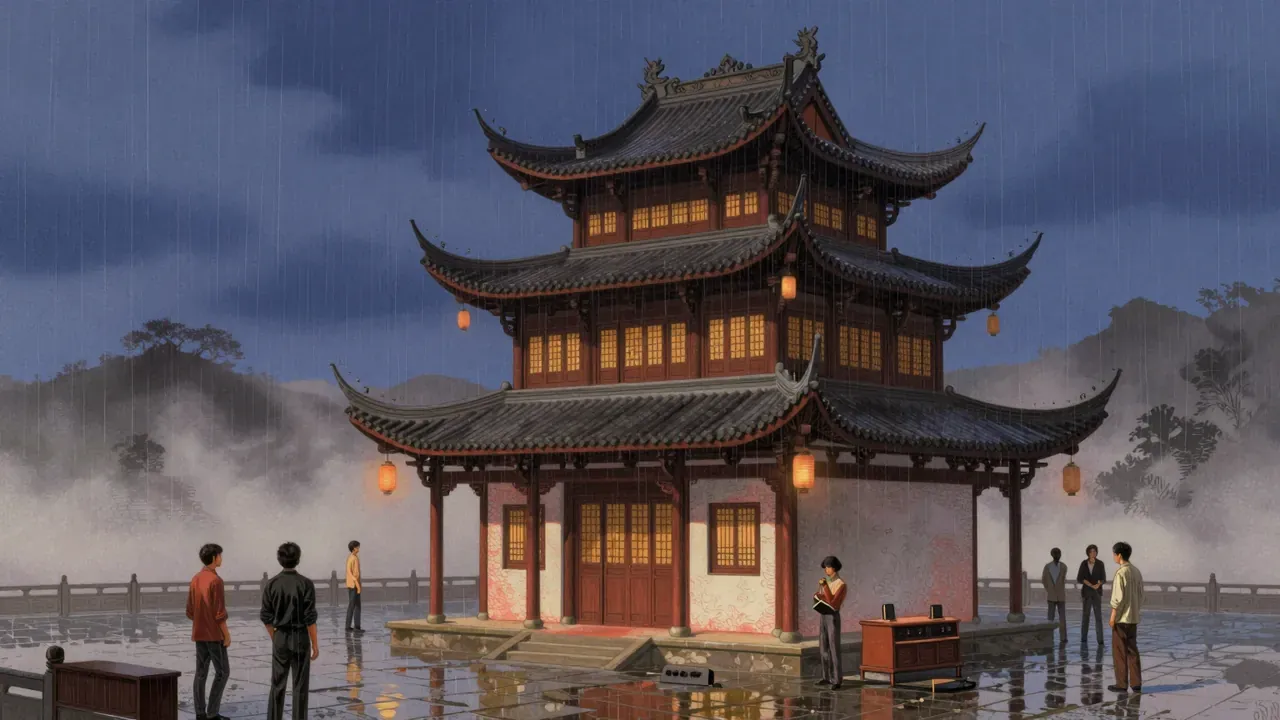
Game of Death is a posthumous assembly of Bruce Lee’s unfinished 1972 project, reconfigured in 1978 by Robert Clouse and Sammo Hung around surviving footage shot by Lee himself. It is not a completed film in the conventional sense, but a hybrid: part archival fragment, part studio-concocted revenge thriller grafted onto Lee’s original pagoda ascent structure. The film attempts two things at once — to honour Lee’s conceptual framework (a five-level martial-arts trial exposing stylistic limitations) while delivering a commercially viable narrative for international audiences in the wake of Enter the Dragon’s success. Its ambition lies less in coherence than in preservation: to place Lee’s choreographed fights — with Dan Inosanto, Ji Han-jae, and Kareem Abdul-Jabbar — into a functional story frame. That frame is built from new scenes, doubles (Kim Tai-chung and Yuen Biao), and a rewritten plot involving syndicate violence and plastic-surgery disguise. The result is neither documentary nor fiction, but a compromise between reverence and recoupment. (158 words)
How It Holds Together
The 1978 version stitches together three intact fight sequences from Lee’s 1972 shoot — the Temple of the Tiger, Temple of the Dragon, and Temple of the Unknown — and inserts them into a new storyline about Billy Lo, a martial artist faking his death after an assassination attempt. James Tien and Chieh Yuan appear both in original footage and newly shot scenes, their continuity disrupted by shifts in lighting, framing, and costume. John Barry’s score is lush and orchestral, but tonally dissonant with the rawness of Lee’s action; it swells where the fights demand silence or breath. Sammo Hung’s action choreography on the new material is competent but lacks Lee’s rhythmic precision and spatial logic. Performances outside the fight scenes are functional: Gig Young’s final role as a cynical producer feels underwritten, Dean Jagger’s villain lacks motive, and Colleen Camp’s Ann Morris exists only as a plot device. The editing avoids acknowledging the seams — no fade-outs, no title cards — treating archival and new footage as interchangeable. This refusal to mark the rupture is its most consistent formal choice. (159 words)
What Moves
What lands is the physical authority of Lee’s movement: the economy of his footwork, the way he holds space before striking, the way his eyes track an opponent’s weight shift before the first blow. The fight with Ji Han-jae retains its structural clarity — two masters exchanging principles, not just punches — and the Abdul-Jabbar sequence remains potent not for spectacle but for its asymmetry: height versus agility, rigidity versus adaptability. Lee’s yellow-and-black jumpsuit, though anachronistic in the 1978 context, anchors the film visually and culturally; it has outlived the plot that contains it. The pagoda’s architectural logic — floors as escalating tests — survives as a silent grammar beneath the restaurant-set climax, legible even when misapplied. These elements land because they are unmediated: shot by Lee, edited by him in rough form, and preserved without interpolation. They do not require the new plot to make sense; they operate on kinetic and philosophical terms older than narrative. Even the dubbing — Lee’s voice replaced in some new scenes — cannot erase the certainty in his posture, the stillness in his readiness. That physical intelligence is the film’s sole unbroken throughline. (156 words)
Where It Frays
What does not land is the 1978 plot’s internal logic. Billy Lo’s transformation from movie star to avenging phantom is narratively inert: no scene establishes his moral stakes, no line clarifies why he chooses vengeance over justice, and no moment conveys cost or consequence. The syndicate is faceless, its hierarchy undefined, its motives reduced to ‘intimidation’. The plastic-surgery ruse collapses under scrutiny — if Billy can alter his face, why not his voice, gait, or mannerisms? Why does no one recognise his fighting style? The new characters — Steiner, Dr Land, Stick — are placeholders, not people. The dialogue is expository and flat, often repeating information already shown. Worse, the film misuses Lee’s original thematic intent: where Lee planned to dissect martial-arts dogma floor by floor, the 1978 edit reduces each guardian to a generic obstacle, stripping away the commentary on technique that gave the fights intellectual weight. The climactic restaurant fight, shot on a cramped set with mismatched lighting, visually contradicts the pagoda’s vertical grandeur — not as reinterpretation, but as diminishment. (158 words)
What It Thinks
The themes that matter are inheritance and incompleteness. Not the clichéd ‘legacy’ of tribute films, but the material fact of a work halted mid-thought — ideas sketched in movement, not script. Lee’s original concept treated the pagoda as a pedagogical device: each floor a lesson in limitation, each defeat a demonstration of what fixed systems cannot absorb. That idea persists in the surviving fights, even when divorced from context. Also present, unintentionally, is the theme of cinematic authorship under erasure — how much of a director’s vision can survive when others finish what he began, and whether fidelity to form (Lee’s choreography) can compensate for fidelity to intent (his critique of martial-arts orthodoxy). The film also engages with authenticity as performance: Billy Lo’s disguise mirrors Lee’s own doubling — Kim Tai-chung mimicking his stance, the editors masking gaps with music and cuts. There is no resolution to these tensions. The film does not argue them; it embodies them, uneasily, across its seams. Its seriousness lies not in what it says, but in how it bears the weight of what was left unsaid. (157 words)
Who It Serves
This film is for viewers who approach cinema as archaeology: those willing to read frames for evidence, to sit with discontinuity, to value gesture over exposition. It rewards attention to Lee’s body as text — the tilt of his head before a feint, the pause after a block, the way he resets balance mid-combo. It is not for those seeking narrative cohesion, psychological realism, or moral closure. Anyone expecting a conventional revenge thriller will find its pacing arbitrary, its stakes hollow, its character work thin. Critics who judge it solely against finished works like Enter the Dragon or The Way of the Dragon will dismiss it as compromised; historians who treat it as primary evidence of Lee’s thinking will find its contradictions instructive. A viewer who watches it once for plot, then again for rhythm, then again for light — that viewer may find more in it than the film itself intended. But that requires patience with absence, not hunger for completion. (159 words)
Whether It Stays
It is worth your evening if you accept it as a palimpsest — a film written over itself, where the erased lines remain legible beneath the new ink. Its value lies in the three intact fight sequences, not the plot that links them. To watch it as entertainment alone is to miss its quiet insistence on process over product. Those who prefer tightly constructed narratives, or who dislike films that foreground their own construction, will feel stranded. A viewer who watches it expecting a Bruce Lee ‘masterpiece’ will leave disappointed; one who watches it as a record of what Lee began — and how others completed it — may find it haunting. The verdict changes only if you shift your question from ‘Is this good?’ to ‘What does this tell us about how films are made, broken, and remade?’ That shift is the film’s only demand — and its only gift. (159 words)