The shape of the story
Life of Pi is a 2012 adaptation of Yann Martel’s 2001 novel, directed by Ang Lee and written by David Magee. It attempts to translate a philosophical, structurally bifurcated narrative — one that pivots on an ambiguous, faith-testing choice between two versions of survival — into a visually immersive, emotionally sustained cinematic experience. The film centres on Pi Patel, a sixteen-year-old Indian boy adrift in the Pacific with a Bengal tiger after a shipwreck kills his family and the crew. Its ambition lies not in realism but in calibrated perception: it asks the viewer to hold two incompatible truths — one literal, one symbolic — without resolving them. Lee frames this as a story told in retrospect, bookended by scenes in Canada where an adult Pi recounts his ordeal to a writer. The film’s formal project is to make metaphysics tactile: belief as embodied habit, doubt as physical exhaustion, transcendence as light refracting through water. It does not seek to explain religion or rationalism but to stage their coexistence in a single body, a single frame, a single breath held underwater. (158 words)
The look of it
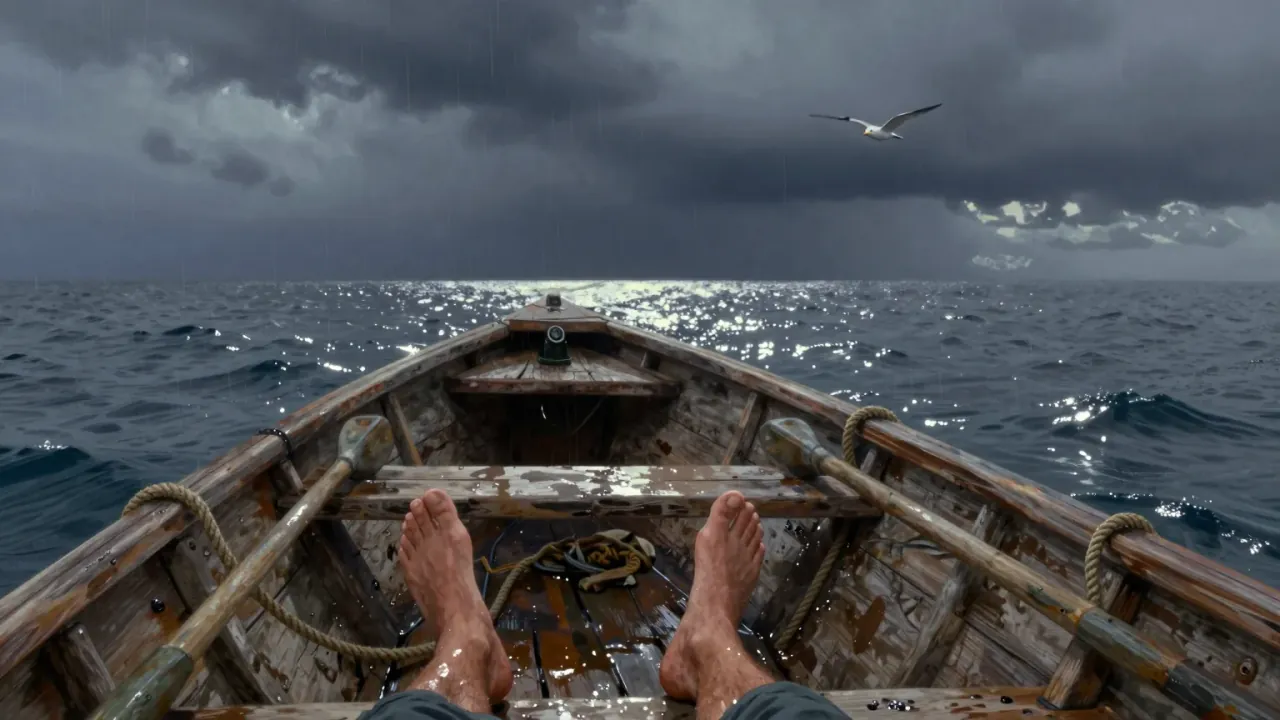
The story unfolds in three distinct registers: the grounded domesticity of Pondicherry, the hallucinatory monotony of the lifeboat, and the quiet, weathered gravity of the Canadian framing device. Suraj Sharma carries the middle section with unshowy physical discipline — his performance is less about expression than endurance, measured in flinches, blinks, and the slow erosion of posture. Irrfan Khan, as adult Pi, delivers restrained exposition without rhetorical flourish. Claudio Miranda’s cinematography avoids pictorial excess; he keeps the ocean restless but legible, the tiger’s fur wet and coarse, the lifeboat’s wood grain visible even in twilight. Tim Squyres’ editing sustains rhythm without urgency, allowing long stretches where nothing changes except light and hunger. Mychael Danna’s score uses sitar, choir, and glass harmonica to suggest ritual rather than emotion. The visual effects — chiefly by Rhythm & Hues — treat Richard Parker as a biological presence, not a spectacle: his breathing, weight shift, and eye movement anchor each shot in cause and consequence. There are no digital shortcuts; every interaction obeys physics, even when the physics serve metaphor. (159 words)
What holds the eye
What lands is the film’s fidelity to sensation: the sting of salt on cracked lips, the way sunlight fractures across a wave’s crest, the low-frequency thrum of a tiger’s purr vibrating through plywood. These are not decorative details but structural ones — they build the world so thoroughly that the later metaphysical pivot feels earned, not imposed. The lifeboat sequence works because its duration is felt, not counted: 227 days become a texture, not a statistic. The tiger never becomes allegory first; he remains animal long enough for the allegory to acquire weight. Lee’s decision to shoot much of the ocean footage in a custom-built wave tank — and to light it with movable curtains and timed sun exposure — gives the water a material consistency rare in digital-heavy films. Even the 3D, often deployed as gimmick, here serves depth of field and immersion: raindrops hover, horizon lines tilt, reflections double reality without obscuring it. The framing device, though sparse, grounds the whole enterprise — Rafe Spall’s quiet disbelief mirrors the audience’s, making Pi’s final question land not as sermon but as invitation. (156 words)
Where the frame slips
What does not land is the Pondicherry prologue. Its exposition — Pi’s childhood religious syncretism, his father’s zoo, the family’s departure — moves with dutiful pace but lacks dramatic friction. Characters like Pi’s mother (Tabu) and father (Adil Hussain) remain sketches, their motivations implied rather than dramatised. The theological dialogue feels pedagogical, not urgent: it names ideas but rarely tests them in action before the storm hits. Later, the second story — the one without the tiger — is delivered too abruptly, stripped of the sensory richness that makes the first version persuasive. Its plausibility hinges on tone, not detail, and the film does not linger long enough in that register to make it resonate with equal force. Some viewers will find the central ambiguity unsatisfying not because it is unclear, but because the film’s visual conviction in the tiger’s reality makes the alternative feel like a retreat. The film’s restraint becomes a liability in these moments: it refuses to dramatise doubt, and so doubt remains intellectual, not visceral. (154 words)
What stays after
The themes that matter are not faith versus reason, but the architecture of meaning-making itself: how narrative order emerges from chaos, how memory edits trauma into coherence, how survival depends on sustaining attention — to the tiger, to the horizon, to one’s own pulse. Water functions as both setting and principle: it erodes, reflects, conceals, reveals, sustains, and drowns — never neutral, always active. The tiger is not God, nor instinct, nor id; he is the irreducible otherness that forces Pi out of abstraction and into daily negotiation. The film treats storytelling not as consolation but as physiological necessity — the mind’s way of metabolising horror. Its quietest theme is patience: the patience required to wait for dawn, to train a wild animal, to listen to a stranger’s story twice. There is no triumphal conversion, no doctrinal resolution — only the slow accrual of habits that allow a person to live with uncertainty without collapsing into nihilism or dogma. That patience extends to the viewer: the film asks for time, not assent. (152 words)
Who it meets
It is for viewers who tolerate extended stillness, who find resonance in physical detail over plot velocity, and who accept ambiguity as a condition rather than a failure. It rewards attention to light, texture, and silence — not just what is said, but how breath sounds in a confined space. It is not for those who require clear moral binaries, rapid narrative escalation, or character arcs defined by decision rather than endurance. Anyone expecting a conventional survival thriller or a didactic religious parable will be frustrated: the film resists both categorisation and closure. Those who disliked the novel’s ending may find the film’s visual insistence on the tiger’s reality undermines the very question it poses. A viewer who values thematic clarity over atmospheric fidelity would likely prefer the book — or a different film altogether. Nothing in the execution changes that divide; it is baked into the adaptation’s priorities. (150 words)
When to watch
Yes, it is worth your evening — provided you watch it on a screen large enough for the water to feel immersive, and in a room quiet enough for the subtle shifts in Danna’s score to register. Its 127 minutes pass without hurry, but also without dead air: every shot has weight, every pause has purpose. It is not entertainment in the transactional sense, but an act of shared attention — one that lingers not because it shouts, but because it refuses to simplify. Those who dismiss it as ‘pretty but empty’ mistake craft for ornament; those who call it ‘profound’ mistake atmosphere for argument. Its value lies precisely in the space between those judgements. It earns its runtime by making time itself palpable — the drag of hours, the shock of sudden calm, the slow return of light after storm. To skip it is to miss a rare instance where technical ambition serves philosophical modesty. (149 words)