The weight of blood
Lady Snowblood is a 1973 Japanese jidaigeki thriller that adapts Kazuo Kamimura’s manga into a tightly wound revenge narrative structured as a mythic cycle rather than a linear chronology. It sets out to dramatise vengeance not as catharsis but as inheritance — a duty passed from mother to daughter across prison walls and snowfields, encoded in blood, swordplay, and silence. The film avoids moral ambiguity by design: its world has no law but retribution, no justice but execution. Toshiya Fujita directs with formal rigour, treating the period setting not as historical realism but as a stylised stage for ritual violence — Edo-era costumes and Meiji-era politics serve atmosphere, not accuracy. The script, also by Kamimura, parcels exposition through flashbacks and voiceover, anchoring each kill in memory rather than motive. This is not a character study of trauma so much as a diagram of its transmission: Sayo’s dying breath becomes Yuki’s first command; Dōkai’s training is less pedagogy than consecration. The film’s ambition lies in its austerity — every frame, every cut, every note of Masaaki Hirao’s score serves the single axis of purpose. (158 words)
The shape of memory
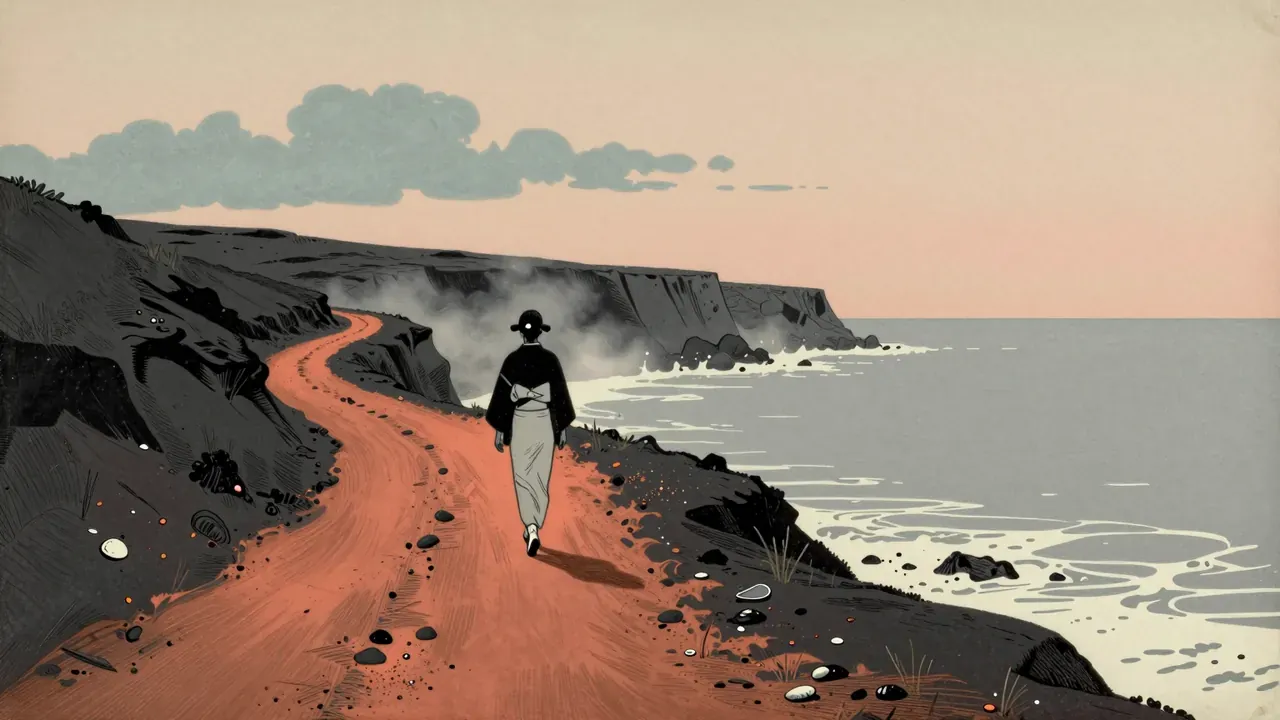
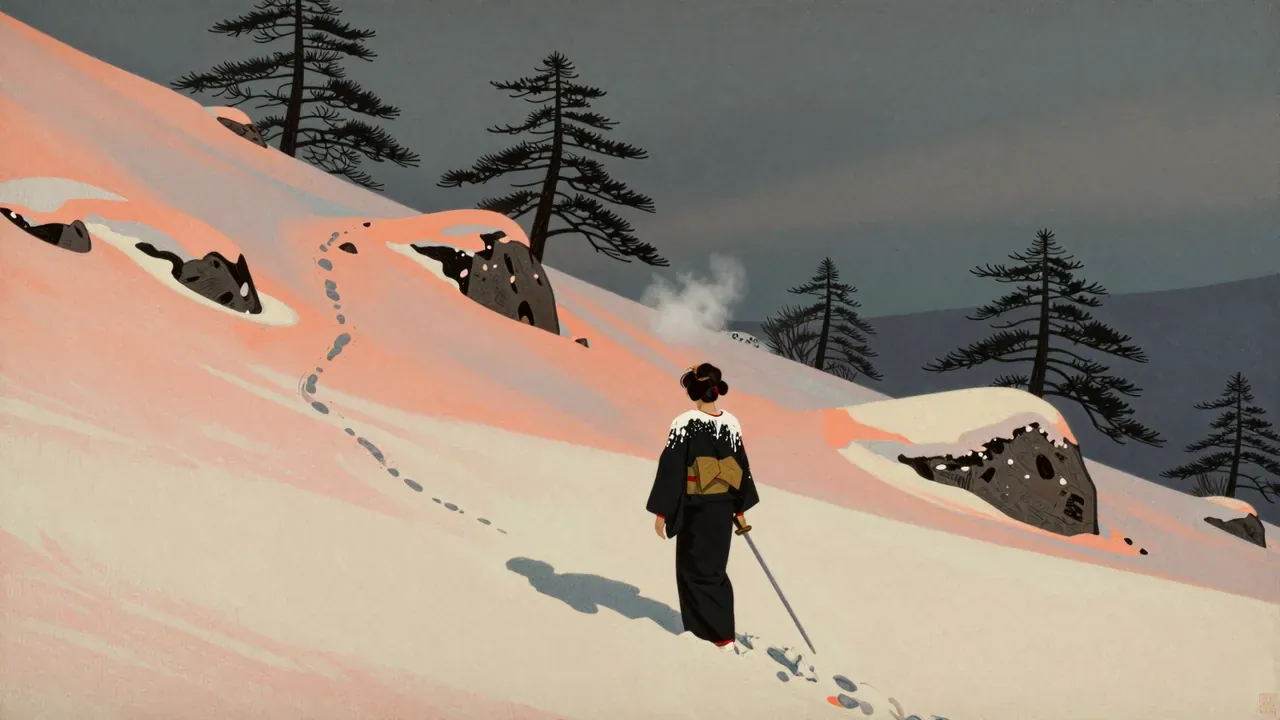
The story moves in jagged leaps between 1874 and 1882, using Osamu Inoue’s editing to fracture time without confusing it — past and present are distinguished by palette, pace, and posture, not title cards. Meiko Kaji’s performance is restrained, almost statuesque: Yuki speaks rarely, reacts minimally, and kills with economy. Her physicality carries weight — the duralumin sword visibly strains her shoulder in wide shots, and the blood squib incident (noted in production records) informs the rawness of her later stabbings. Masaki Tamura’s cinematography favours high-contrast compositions: snow glares white against black kimonos; interiors are lit like confessionals, faces half-drowned in shadow. Hirao’s score alternates between shamisen-led tension and choral lament, never underscoring action but punctuating aftermath. The fight choreography is functional, not flamboyant — thrusts are short, parries minimal, deaths abrupt. Supporting actors — Kō Nishimura as the broken Takemura, Miyoko Akaza as the vengeful Kobue — ground the myth in lived exhaustion. There is no comic relief, no romantic subplot, no digression. Every scene exists to narrow the path to the final snowfall. (159 words)
The look of it
What lands is the film’s unwavering tonal discipline. The opening prison birth — snow falling outside, Sayo bleeding inside, her voiceover recounting rape and murder — establishes a register of solemn fury that never wavers. Yuki’s emergence from the snow at the end does not feel triumphant but inevitable, like frost returning after thaw. The visual grammar holds: recurring motifs — red ink on white paper, falling snow, close-ups of eyes blinking once before killing — accrue meaning without explanation. Kaji’s stillness reads as power, not vacancy; her few lines land because they are rationed. The film’s structure, though non-linear, feels necessary: we understand Yuki’s resolve only after seeing what forged it, and the delayed revelation of Ashio’s paternity lands precisely because the film withholds it until the ballroom climax. Even minor details cohere — the reporter’s notebook, the beggar network’s coded signals, the way Yuki sheathes her sword only after finishing a kill — all reinforce a world governed by consequence, not chance. This consistency makes the film feel less like a story and more like a vow made visible. (156 words)
The cost of clarity
What does not land is the attempt to humanise the antagonists beyond function. Okono Kitahama’s hanged corpse sliced in two reads as spectacle, not reckoning; her motives remain opaque, her presence brief. Gishirō Tsukamoto’s masquerade-ball reveal lacks psychological texture — he is less a man who faked death than a plot device who arrives late. The film gives him no interiority, no hesitation, no history beyond his crime, making his final confrontation feel procedural rather than climactic. Similarly, Ashio Ryūrei’s role as witness and son is underdeveloped: his persuasion of Yuki to publish her story hinges on faith, not evidence, and his sacrifice reads as narrative convenience. The film’s refusal to linger on grief or doubt leaves little room for empathy outside Yuki’s line of sight — which is intentional, but narrows emotional range. Some viewers may find the pacing uneven: long stretches of travel and silence punctuated by sudden, brief violence can read as stilted rather than deliberate. The low budget shows in sparse sets and repeated locations, which suits the austerity but risks monotony for those expecting period richness. (157 words)
The sound of waiting
The themes that matter are lineage, embodiment, and silence as resistance. Vengeance here is not individual but generational — Sayo’s body is the site of violation and conception; Yuki’s body is the instrument of redress. The film treats flesh as archive: scars, wounds, childbirth, and sword-calluses all carry memory. Silence functions as both weapon and shield — Yuki speaks only when necessary, and her voiceover is absent; her story is told by others, recorded, published, then enacted. This positions storytelling itself as political: Dōkai commissions Ashio to write it not for truth but to draw out prey. Gender is structural, not symbolic — the prison, the brothel, the beggar network, the ballroom: each space enforces different forms of female containment or leverage. There is no redemption arc, no reformist impulse. Justice is not restored; it is executed. The snow is not metaphor but medium — it covers, preserves, reveals, and erases. The film refuses to separate violence from nurture: Sayo seduces guards to conceive Yuki; Dōkai trains her in blood rites. These are not contradictions but conditions. The film’s moral universe is closed, coherent, and unapologetic. (159 words)
Who it is for
This film is for viewers who value precision of tone over breadth of character, who respond to formal control as strongly as narrative momentum. It rewards attention to composition, rhythm, and restraint — those drawn to Mizoguchi’s framing or Suzuki’s timing will find kinship here. It is not for those who require psychological exposition, moral negotiation, or narrative comfort. Anyone needing motivation spelled out, villains given backstory, or protagonists allowed doubt will find it austere to the point of exclusion. Fans of Kill Bill may be surprised by how little Lady Snowblood indulges in stylistic play — Tarantino borrows the iconography but not the asceticism. Those expecting jidaigeki pageantry or Toei-style action will find its violence sparse and its settings stripped. A viewer who values thematic density over emotional variety, or who finds power in repetition and reduction, will connect deeply. Someone who prefers ambiguity, irony, or ensemble dynamics would likely leave unmoved — and that is not a flaw in the film, but a boundary in its design. (159 words)
What remains
Yes, it is worth your evening — provided you meet it on its terms. Ninety-seven minutes pass without filler, without apology, without deviation from its central proposition: vengeance as filial duty, rendered in monochrome logic and crimson punctuation. Its power lies in accumulation, not escalation — each kill tightens the coil, each flashback deepens the gravity. It does not ask for sympathy but for witness. Those who resist its severity will find it cold; those who accept its terms will feel its weight long after the final frame. It is not ‘entertaining’ in the conventional sense — TV Guide’s ‘unnecessarily distancing’ verdict is accurate, but misreads distance as failure rather than method. The film’s endurance comes from its refusal to soften, explain, or expand. If you value cinema as architecture — where every beam bears weight, every window admits light for a reason — then this is essential. To watch it otherwise is to mistake its discipline for deficiency. (159 words)