What it is trying to do
The Lady Vanishes is a 1938 British thriller produced by Edward Black and directed by Alfred Hitchcock for Gainsborough Pictures. It adapts Ethel Lina White’s 1936 novel The Wheel Spins, reshaped by Sidney Gilliat and Frank Launder into a tightly wound train-bound suspense narrative. The film sets out to sustain tension through misdirection, social satire, and the erosion of certainty — not via violence or spectacle, but by making the ordinary feel unstable: a missed connection, a dismissed witness, a polite refusal to believe. Its engine is epistemic — what can be known, by whom, and under what social pressure — and it uses the confined geography of a continental railway carriage to compress time, motive and credibility. It does not aim for realism in psychology or period detail, but for coherence in escalation: each scene tightens the knot between observation and authority, between individual perception and collective dismissal. It is a thriller that treats disbelief as a structural feature, not a plot hole. (142 words)
How it works
The story follows Iris Henderson, a young Englishwoman returning home from a holiday in the fictional Balkan state of Bandrika, who boards a train where her elderly travelling companion, Miss Froy, vanishes without trace — only for Iris to find no one else recalls her existence. Margaret Lockwood anchors the film with brisk, unflustered conviction; Michael Redgrave plays Gilbert, a folk-song-collecting Cambridge man whose initial irony gives way to methodical loyalty. Paul Lukas brings quiet menace as Dr. Hartz, while May Whitty’s Miss Froy is all brisk kindness before her disappearance. Jack E. Cox’s cinematography keeps interiors lit with functional clarity, favouring medium shots and shallow depth to maintain spatial legibility on cramped sets. Charles Williams’ score punctuates rather than underscores, using light orchestral flourishes to mark shifts in tone without melodrama. R.E. Dearing’s editing sustains rhythm through repetition — the same corridor, the same faces, the same dismissive shrugs — until repetition itself becomes unnerving. (157 words)
What lands
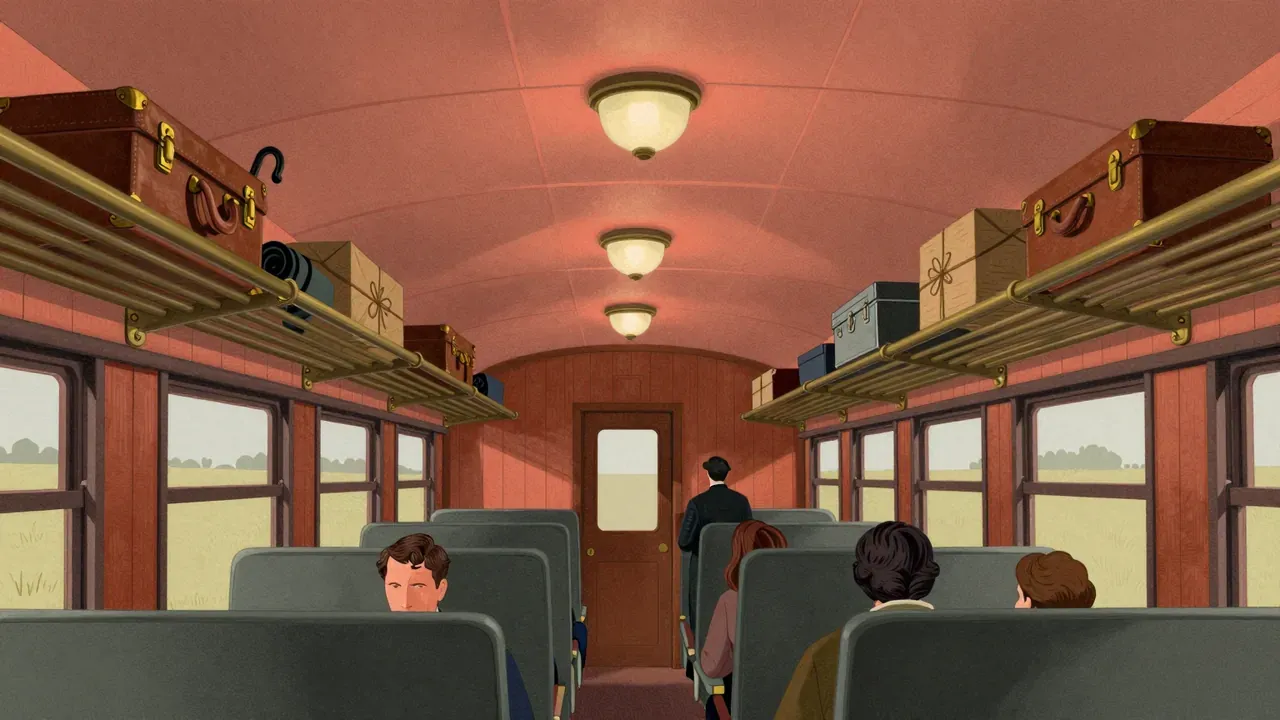
What lands most firmly is the film’s calibration of social comedy and mounting dread. The early scenes — Iris’s holiday mishaps, the hotel’s bureaucratic chaos, the train’s eccentric passengers — are not mere setup; they establish a world where competence is performative and consensus is fragile. Basil Radford and Naunton Wayne’s cricket-obsessed duo, Charters and Caldicott, land precisely because their obsession is both absurd and utterly credible: they embody a kind of national self-absorption that makes them blind to danger but also, eventually, useful. The train’s claustrophobic continuity — the repeated framing of doors, windows, overhead racks — turns architecture into evidence. Even Hitchcock’s cameo, stepping onto the platform with a guitar, works not as a wink but as a quiet reinforcement of the film’s theme: everyone has a role, and everyone is watching — or pretending not to. The final act’s shift into active pursuit feels earned because the earlier comedy has trained us to notice who looks away, who leans in, who speaks first and who waits to be prompted. (154 words)
What does not
What does not land consistently is the film’s handling of its Balkan setting, which remains a vague, vaguely menacing backdrop — a function of interwar British studio geography rather than intentional exoticism, but still flattening. The political context — hinted at through coded references to espionage and suppressed nationalism — stays ornamental, never integrated into character motivation or moral stakes. Some performances tip into caricature: Cecil Parker’s General Baxton is broad in a way that dilutes his potential threat, and Googie Withers’ flirtatious spinster lacks the ambiguity that might make her complicity unsettling. The resolution relies on a late-stage reversal that depends on audience memory more than on visual or narrative emphasis — a reliance on recall that risks feeling like a trick rather than a payoff. And while the film’s pacing is generally assured, the mid-section lags slightly when exposition overtakes movement: too many static conversations in the dining car, too few shifts in camera position to renew attention. These are not flaws in conception, but in execution — moments where craft serves convenience over precision. (150 words)
The themes that matter
The themes that matter are trust in institutions, the gendered weight of testimony, and the mechanics of collective denial. Iris is disbelieved not because she is hysterical, but because her account disrupts the train’s carefully maintained social order — a microcosm of pre-war Britain’s preference for plausible calm over inconvenient truth. Miss Froy’s erasure mirrors how marginal figures vanish from official record: elderly, female, foreign, unattached. The film treats memory not as a faculty but as a contested site — one that requires corroboration to become fact, and corroboration that is withheld along class and gender lines. There is also a quieter thread about cultural translation: Gilbert’s folk songs are presented as authentic artefacts, yet the film offers no real access to Bandrikan language or life beyond postcard tropes. This isn’t ignorance so much as structural omission — the film’s world assumes English as the default lens, and that assumption becomes part of its critique. The thriller form here is not just genre but method: suspense arises from watching someone try, and fail, to make reality legible to others. (147 words)
Who should watch it
This film is for viewers who value narrative economy, period-specific wit, and suspense built on psychology rather than shock. It rewards attention to dialogue rhythm, spatial continuity, and the slow accumulation of behavioural detail. It is not for those who require visceral stakes, moral clarity, or historical specificity — the politics are gestural, the villains lack interiority, and the ending resolves cleanly without reckoning with consequence. Anyone expecting the moral gravity of Shadow of a Doubt or the formal daring of Rear Window may find it lightweight; those who dismiss pre-war British cinema as quaint will miss its precise calibration of tone. A viewer who dislikes sustained verbal sparring, or who finds mid-Atlantic accents jarring in a UK production, may struggle with its texture. But its appeal is not nostalgic — it is structural. It remains watchable because its architecture holds: every line, every cut, every casting choice serves the central question — what happens when one person sees what no one else will admit? (152 words)
Is it worth your evening
Yes, it is worth your evening — not as a relic, but as a working model of how suspense can be generated through social friction rather than physical peril. Its ninety-six minutes move with purpose, its performances remain sharply drawn, and its central conceit retains its capacity to unsettle because it remains socially current: the difficulty of being believed when your evidence contradicts the group’s preferred version of events. Those who find its pacing too deliberate, or its politics too muted, would likely prefer Notorious or The 39 Steps, but that is a difference of emphasis, not deficiency. It is not diminished by age; it is clarified by it. To call it ‘quaint’ is to mistake restraint for absence. It earns its place not by scale, but by consistency — a thriller that trusts its audience to notice the pause before the lie, the glance that avoids contact, the silence that follows a question no one wants answered. (149 words)