A director stalling on a film with no script
8½ follows Guido Anselmi, a celebrated film director, as he retreats to a spa town supposedly to rest before shooting his next production, while producers, actors and journalists gather around him expecting a script that does not exist. Fellini structures the film as Guido’s evasions, meetings he dodges, questions he deflects, and memories and fantasies he escapes into instead of doing the work in front of him. It is a film explicitly about the difficulty of making the film it is itself in the process of becoming, drawing openly on Fellini’s own stalled position after the success of La Dolce Vita. Rather than resolve Guido’s block with a breakthrough, the film treats the block itself, and everything a person does to avoid facing it, as the actual subject.
No border between memory and daydream
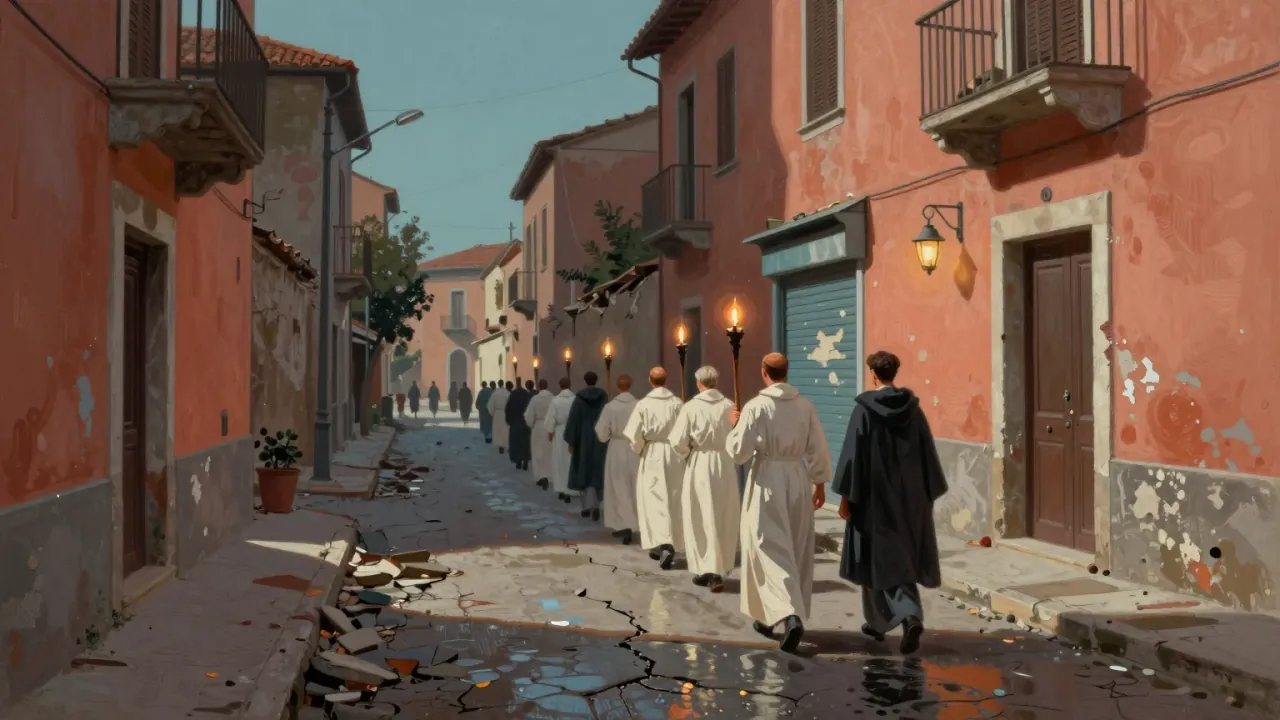
Gianni Di Venanzo’s black-and-white cinematography moves fluidly between Guido’s waking life, his childhood memories of Catholic school and a seaside encounter with a prostitute, and outright fantasy sequences, with no visual cue distinguishing one register from another until context catches up. Nino Rota’s score, alternating a circus-like march with more wistful themes, keeps the tone buoyant even during Guido’s more anxious stretches, refusing the film any straightforward mood. Marcello Mastroianni plays Guido’s crisis almost entirely through charm and deflection rather than visible torment, smiling his way past confrontations he has no answer for. The famous white-suited harem fantasy, in which every woman in Guido’s life lives together under his benevolent control, is staged with an ornate theatricality that undercuts its own wish-fulfilment even as it indulges it.
Mastroianni plays exhaustion as comedy
The film’s fluid movement between memory, fantasy and present tense is its clearest achievement, allowing a childhood scene of Guido being scrubbed clean by nuns for an encounter with a local woman to sit beside a present-day negotiation with his producer without either register feeling like an interruption of the other. Mastroianni’s performance finds real comedy in a man managing crisis through charisma rather than competence, deflecting his wife, his mistress and his cardinal-adjacent confessor with the same practised smile. Claudia Cardinale’s late appearance as an idealised muse Guido cannot actually cast in his film lands with a genuine, unresolved poignancy, since she exists in the story mainly as proof of what Guido cannot translate into work.
A harem fantasy that overstays its welcome
The harem fantasy sequence, while a striking piece of staging, runs long enough that its satire of Guido’s self-regard starts to blur into the indulgence it is meant to be mocking, and a few of the film’s supporting women, including Guido’s mistress Carla, are given little beyond serving his fantasies or his guilt. The film’s deliberately loose, associative structure, while central to its method, means individual sequences occasionally repeat the same point about Guido’s avoidance without adding much new to it, particularly in the middle stretch before the production crisis properly escalates. Viewers unfamiliar with Fellini’s earlier, more grounded work may find the tonal whiplash between comic set pieces and genuine anxiety harder to settle into than longtime admirers do.
Creation examined by refusing to finish it
The film’s central concern is the gap between the life an artist has actually lived and the life he can shape into something coherent enough to put on screen, with Guido’s memories, guilts and desires refusing to organise themselves into the film his backers are paying for. Storytelling itself is treated as an act that requires a kind of self-deception the film is not sure Guido, or anyone, can sustain honestly. Surrealist logic governs the film’s transitions rather than explaining them, letting a childhood memory bleed into a spa fountain scene without comment, which mirrors Guido’s own inability to keep his internal and external lives properly separated.
A film about making films, not for everyone
This suits viewers interested in films about the difficulty of creative work, and in loose, associative structure over conventional plotting, particularly anyone drawn to Mastroianni’s specific brand of charming evasiveness. It is a harder recommendation for viewers wanting a story with clear stakes and resolution, since the film’s ending gestures toward reconciliation without actually resolving Guido’s professional crisis in any concrete way. Those unfamiliar with mid-century Italian cinema’s pacing may also find its digressive structure disorienting on a first watch, since very little in the film functions as conventional forward-moving plot.
A rich, occasionally exhausting two hours
At 138 minutes the film is dense with incident, image and tonal shift, which makes it more demanding of sustained attention than its playful surface suggests, even though nothing in it is especially difficult scene to scene. Its influence on later films about artistic block and self-reflexive filmmaking is considerable, and its two Oscar wins, for costume design and international feature, reflect a film that was recognised as a genuine achievement rather than a curiosity even at the time. Worth the evening for anyone interested in how a film can dramatise its own impossibility, and a reasonable pass for anyone wanting a story that actually gets finished within it.