A Crown Without a Throne
King of Jazz is a studio-bound musical revue, conceived as a showcase for Paul Whiteman’s orchestra and the early two-colour Technicolor process. It makes no pretence at narrative: there is no through-line, no character arc, no dramatic stakes—only a sequence of musical numbers, blackout sketches, and interpolated novelties strung together by Charles Irwin as master of ceremonies. Its ambition is neither psychological nor satirical but technological and promotional: to prove that colour film could carry jazz-inflected entertainment to mainstream audiences, and to cement Whiteman’s title—not as an improviser or bandleader in the New Orleans sense, but as a conductor-arranger who had codified and popularised jazz for white middle-class listeners. The film treats jazz as repertoire, not idiom; as spectacle, not practice. It is less a document of musical innovation than a corporate demonstration reel for Universal Pictures and Whiteman’s brand, released at the precise moment when sound cinema was consolidating its commercial dominance and Technicolor was still rare enough to warrant billing above the title. It is a pre-Code artefact shaped by vaudeville pacing, radio-era vocal ensembles, and the logistical constraints of early colour photography.
The Look of It
The film operates through alternation: music, then sketch; solo, then chorus; static wide shot, then static medium; orchestral precision, then physical comedy. John Murray Anderson and Paul Fejos direct with little camera movement—shots are fixed, often frontal, favouring depth over dynamism. Hal Mohr and Ray Rennahan light sets for legibility in two-colour Technicolor, which renders blues as cyan and suppresses true violet or deep red; Herman Rosse’s production design compensates with silver-grey backdrops and calibrated fabric choices to coax pastel fidelity from the process. Performances are stage-bright and uninflected: Whiteman conducts with gravity, Bing Crosby (in his first film appearance) sings off-camera and on with relaxed phrasing, while Harry Barris and Al Rinker provide rhythmic counterpoint. The Rhythm Boys’ domestic-set number feels intimate amid the scale; the ‘Melting Pot of Music’ finale is literal-minded pageantry. Choreography is functional rather than expressive—chorus girls seated, dancers contorting, trombonist Wilbur Hall playing violin with a bicycle pump. There is no editing rhythm beyond cut-on-beat; no dissolve, no wipe, no montage. Everything serves clarity, not invention.
What Holds Still
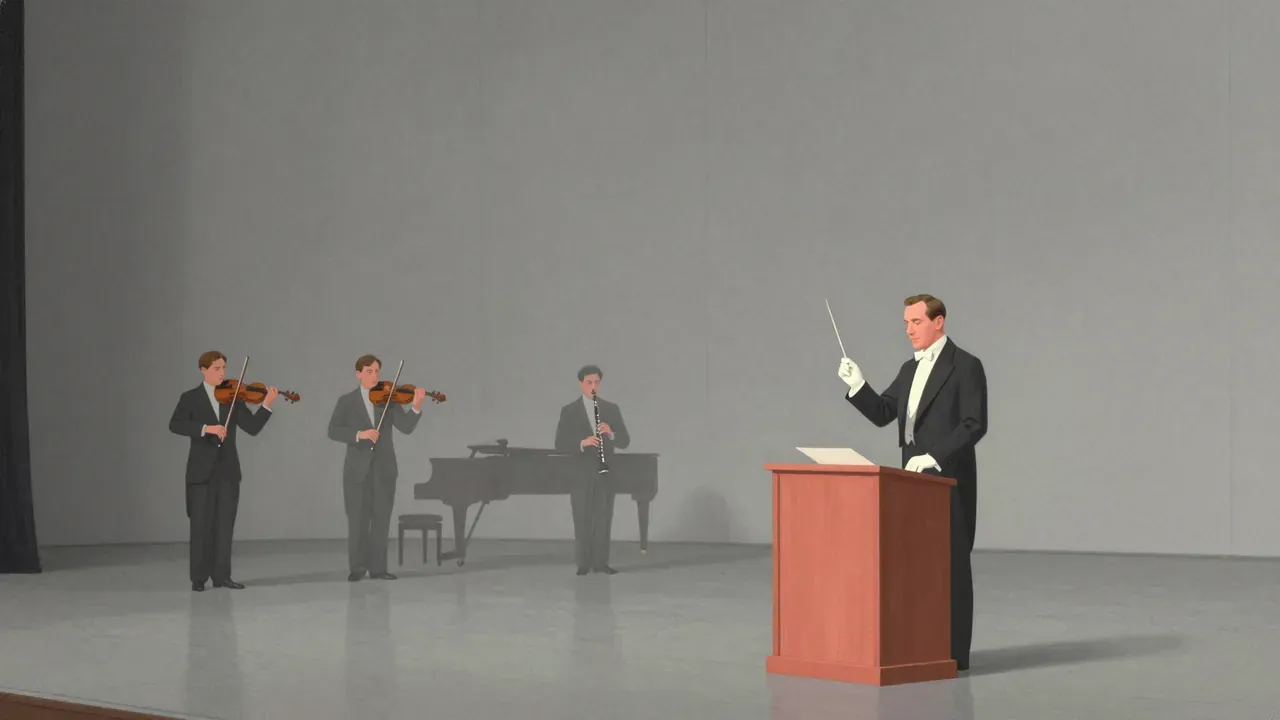
What lands is the sheer density of period-specific craft: the precision of Whiteman’s ensemble, the crispness of the black-and-white intertitles before the colour sequences begin, the tactile oddity of the Oswald the Lucky Rabbit cartoon—the first Technicolor animation, rendered in flat, saturated greens and pinks that contrast sharply with the film’s muted palette. The ‘Rhapsody in Blue’ sequence, though visually constrained, holds attention through Grofé’s arrangement and the deliberate slowness of its staging: Whiteman conducting against a silver void, musicians emerging one by one like figures from a frieze. The ‘Happy Feet’ number works because it abandons pretension—Rubber Legs Al Norman’s jerking limbs and the chorus’s syncopated claps land as pure kinetic punctuation. So too does the ‘Bridal Veil’ number: its absurd scale (a veil said to be the largest ever made) becomes its own joke, delivered with Victorian solemnity. These moments succeed not as storytelling but as discrete units of texture, timing, and technical curiosity—each a self-contained exhibit in a museum of early sound-film experiment.
Where the Frame Stalls
What does not land is the framing conceit—that Whiteman is the ‘King of Jazz’. The film never justifies the title dramatically or musically: Bix Beiderbecke had already left the band, and the jazz musicians present—Joe Venuti, Eddie Lang—are heard but not foregrounded as innovators. Their contributions are folded into arrangements that smooth out rhythmic tension and harmonic surprise. The ‘Melting Pot’ finale feels dated not because it is old, but because its assimilationist logic is presented without irony or friction—no immigrant voice speaks, no costume is questioned, no song lingers long enough to register as more than decorative. The blackout sketches rely on gags that depend on 1930s class assumptions—William Kent’s suicidal flautist, for instance, reads as arch rather than funny today—and their abrupt endings lack the snap of later vaudeville-derived cinema. The film’s refusal to move the camera becomes wearying across ninety-eight minutes; what begins as stylistic consistency hardens into visual stasis. And the reissue cuts—some numbers trimmed, others excised entirely—leave structural gaps that even the 2016 restoration cannot fully bridge.
The Melting Pot Is Empty
The themes that matter are standardisation, spectacle, and substitution. King of Jazz treats jazz not as a vernacular tradition but as repertory to be arranged, conducted, and packaged—Whiteman substitutes himself for collective improvisation, Grofé for spontaneous composition, Technicolor for lived colour. The film is about mediation: how sound is captured (via microphones hidden in flowers), how race is elided (by casting white performers in ‘ethnic’ costumes), how national identity is flattened into costume and chorus. Its ‘melting pot’ is not social but aesthetic—a forced synthesis where difference is ornamental and temporary. There is also a quiet theme of obsolescence: the film preserves vaudeville bits already fading from live stages, records singers known by voice but unseen until now, and uses animation to explain its own premise—as if the title needed justification beyond the music. It is a film about transition, made at the hinge between silent and sound, monochrome and colour, ensemble and star, radio and cinema—each shift marked less by celebration than by careful calibration.
Who Steps Into the Light
It is worth watching for film historians, students of early Technicolor, and anyone interested in how jazz was marketed before it was studied—particularly those who value primary sources over interpretation. It rewards attention to detail: the way Mohr lights a brass section, how Rosse arranges a chorus line in shallow space, how Crosby’s phrasing differs from Boles’s crooning. It is not for viewers seeking narrative cohesion, emotional development, or rhythmic propulsion—the film’s pacing assumes familiarity with vaudeville’s stop-start logic, and its humour depends on period-specific class codes. Anyone expecting the choreographic density of Berkeley or the improvisatory energy of later swing films will find it inert. A viewer who dislikes static framing or finds early colour processes visually fatiguing may struggle past the first twenty minutes. Those who value cultural context over entertainment will find more here than those who come only for the music—or for Crosby, whose role remains supporting, not central.
Why It Survives
Yes, it is worth your evening—but only if you watch it as a document, not a diversion. Its value lies in what it reveals about industrial priorities in 1930: how studios tested colour, how bands were branded, how jazz was translated for mass consumption. It is slow, repetitive, and structurally thin, yet every frame contains evidence—of lighting rigs, microphone placement, costume construction, even censorship decisions (the ‘Ragamuffin Romeo’ number survives, but its risqué edge has dulled with time). Someone who watches it looking for ‘fun’ will leave disappointed; someone who watches it asking ‘how was this made, for whom, and why?’ will find it rich. A modern viewer used to rapid cutting or immersive sound design may need to adjust expectations. But the Criterion Collection’s 4K restoration makes the textures legible—the grain, the dye transfer, the slight misalignment of red and green layers—and that material specificity is irreplaceable. No other surviving film from 1930 shows this much of its own making.