The man in the room
Louie Bluie is a one-hour documentary portrait of Howard ‘Louie Bluie’ Armstrong, recorded in the early 1980s and released in 1985. It does not attempt a biography in the conventional sense — there are no voiceover narrations, no archival photographs laid over explanatory text, no timeline graphics. Instead, it situates Armstrong in his Detroit living room, surrounded by paintings he made, instruments he played, and stories he told. Terry Zwigoff’s aim is narrower and more intimate: to capture Armstrong as a living repository — of repertoire, technique, linguistic fluency, visual wit, and oral history — at a moment when that kind of continuity was already rare. The film assumes no prior knowledge of string-band music or pre-war African-American vernacular performance, but it also refuses to translate Armstrong into digestible cultural exposition. It treats him as a person first, a musician second, an artist third — never as a relic. The camera stays close, the edits are sparse, and the pacing follows Armstrong’s own rhythm: deliberate, unhurried, occasionally digressive. It is a film about presence, not preservation.
The look of it
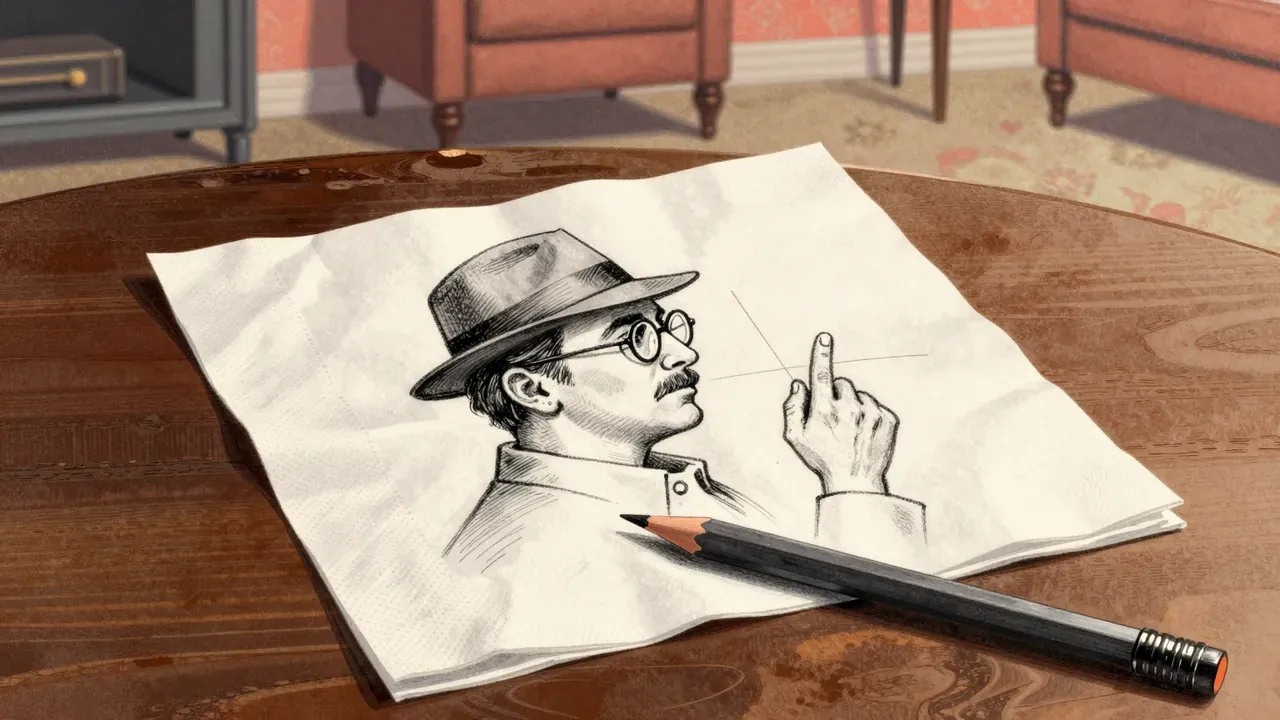
The film works through sustained observation and minimal intervention. Zwigoff films Armstrong in medium shots and loose close-ups, often from a fixed tripod position, letting the frame hold still while Armstrong moves within it — tuning a fiddle, sketching on a napkin, shifting between English, Mandarin, and Italian mid-sentence. There is no score beyond what Armstrong performs live: fragments of ‘State Street Rag’, ‘Lady Be Good’, ‘Chinatown, My Chinatown’, and several unrecorded tunes. Ted Bogan appears briefly, their rapport marked by dry mutual exasperation rather than nostalgia. Gordon Willis is not involved; the cinematography is credited to Zwigoff himself, with natural light and domestic interiors rendered in soft contrast and muted colour. Editing is functional, not expressive — cuts follow pauses, not beats. No interviews with scholars or curators interrupt the flow. The craft is modest, even unassuming: a single microphone, a single location, a single subject given space to speak, play, and be. Its strength lies in refusing to dramatise what is already vividly human.
The sound of it
What lands is Armstrong himself — his physical ease, his vocal timbre, his quick shifts between erudition and mischief. His command of melody across genres feels effortless because it is rooted in decades of adaptation, not theory. When he sings a verse of ‘Chinatown’ in Mandarin, the gesture reads not as novelty but as routine competence — the kind acquired when you’ve spent your life playing for audiences who spoke Polish, Mexican Spanish, or Appalachian English. His paintings, shown without commentary, carry the same quiet authority: stylised figures with elongated limbs, bold outlines, a folk sensibility fused with modernist economy. The film’s restraint pays off in moments where Armstrong’s laughter precedes his punchline by half a second, or when he adjusts his glasses mid-phrase and the lens catches the reflection of the window behind him. These are not curated ‘highlights’. They are textures — accumulated, unvarnished, held long enough for the viewer to register them as real.
What it leaves out
What does not land is the absence of context that some viewers will expect — and reasonably miss. There is no explanation of Vocalion Records, no map of the medicine-show circuit, no mention of how Armstrong’s wartime service interrupted his career, no discussion of why the Tennessee Chocolate Drops dissolved. The film presumes familiarity with the idea of vernacular music as practice rather than product, and it offers no bridge for those unfamiliar with the distinction. A viewer expecting historical scaffolding may find the film elliptical, even withholding. Likewise, the relationship with Ted Bogan remains under-explored: their friction is visible but unexamined, left as atmosphere rather than insight. Zwigoff does not probe Armstrong’s views on race, segregation, or the commercial erasure of Black string bands — topics Armstrong himself addressed elsewhere, but which this film sidesteps. That omission is neither careless nor accidental; it is a choice to foreground personality over polemic, and it leaves certain dimensions of Armstrong’s life unilluminated.
What it holds on to
The themes that matter are continuity and translation — not just of language or melody, but of self across time and circumstance. Armstrong learned fiddle from Blind Roland Martin, painted while studying cello in a symphony orchestra, translated Tin Pan Alley songs into Mandarin for immigrant audiences, and designed sets for Hollywood films while living in a Detroit bungalow. His life resists categorisation: Black Southern musician, Midwestern autoworker, visual artist, linguist, raconteur. The film treats these not as contradictions but as coexisting registers — each mode of expression feeding the others. It also quietly insists on the dignity of craft as daily practice: the way Armstrong’s fingers move across strings, the care he takes selecting beads for a necklace, the precision of his brushstroke. There is no grand thesis here, only the cumulative weight of a life lived with attention — to sound, to line, to speech, to memory — and the film trusts that attention to communicate its own value.
Who it’s for
This film is for viewers who value duration over exposition, who find interest in the grain of a voice or the posture of a hand, and who do not require signposting to feel engaged. It suits those already familiar with pre-war string-band music, but also those drawn to portraiture as a form of listening. It is not for viewers who need narrative propulsion, contextual framing, or thematic resolution — those who expect documentaries to explain, not accompany. Someone seeking a primer on African-American musical history would leave under-informed; someone hoping for analysis of Armstrong’s legacy within folk revivalism would find little. The film’s refusal to interpret Armstrong’s significance means its appeal depends on willingness to meet him on his own terms — a condition some may find alienating, others deeply refreshing. A change in structure — say, intercutting archival audio or brief contextual inserts — would alter the verdict, but not necessarily improve it.
Why it lasts
Yes, it is worth your evening — provided you are prepared to sit with a person, not a subject. At just over sixty minutes, it asks little in time but rewards attention with density: every glance, pause, and plucked note carries accumulated meaning. It does not flatter, persuade, or summarise. It simply holds space for Armstrong to be himself — wry, erudite, technically masterful, visually inventive, and entirely unperforming. Its value lies in its fidelity to that presence, not in any claim to comprehensiveness. Those who find profundity in specificity will leave with a sharper sense of how art lives in the body and voice before it becomes archive or argument. Others may feel adrift in its lack of scaffolding — and that is a legitimate response, not a failure of the film. Worthwhile does not mean universally accessible; it means the film fulfils its own quiet ambition with integrity, and that ambition remains rare and necessary.