What the film is
Kagemusha is a historical drama set in Japan’s Sengoku period, centring on a petty thief pressed into service as a political decoy for the dying daimyō Takeda Shingen. Akira Kurosawa wrote and directed it as a return to the jidaigeki form after a decade of smaller-scale or contemporary projects, and its ambition is structural as much as thematic: to stage belief itself as a collective act, sustained by gesture, repetition, and shared silence. It does not seek psychological realism but ritual precision — the kagemusha’s transformation is measured not in interiority but in how convincingly he occupies space, commands attention, and holds still. The film treats power as performance before it is authority, and legitimacy as something conferred by consensus rather than blood. Its scale — 5,000 extras, painted banners, lacquered armour, wide landscape shots — serves this idea: the weight of history rests less on individuals than on the apparatus that sustains their image. At 179 minutes, it moves with the gravity of ceremony, not urgency.
How it works
The story unfolds in three phases: selection, performance, and collapse. Tatsuya Nakadai carries both Shingen and the thief, distinguishing them through posture, stillness, and a deliberate withholding of expression — the thief learns to mimic not speech but silence, not command but containment. Takao Saito’s cinematography favours deep focus and symmetrical framing, keeping faces legible even in crowd scenes; interiors are lit with low, directional sources that carve figures out of shadow without softening their edges. Shinichiro Ikebe’s score uses taiko drums and biwa to mark time, not emotion. Kurosawa edits with long takes and minimal cuts during council scenes, forcing the viewer to watch the kagemusha absorb instruction before speaking — his hesitation becomes part of the performance. The battle sequences avoid close combat; instead, they show mass movement, cavalry charges rendered as rhythmic patterns across flat terrain, then cut abruptly to silence. This is choreography as exposition.
What lands
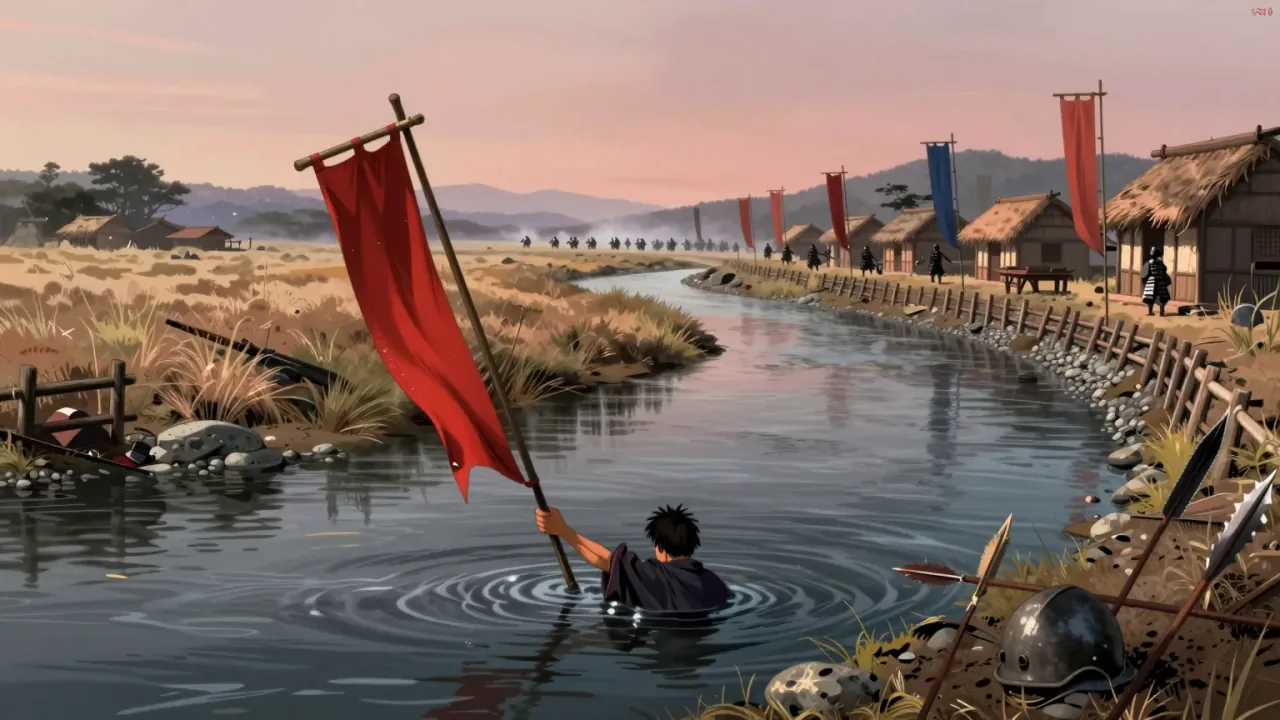
What lands most firmly is the film’s central paradox: that impersonation can become truer than truth. The kagemusha’s growing competence — his ability to sit, to nod, to pause before answering — convinces generals who know Shingen intimately, not because he resembles him, but because he obeys the same grammar of power. The visual language reinforces this: repeated shots of hands, banners, and backs convey hierarchy without dialogue. The Battle of Nagashino sequence works not as spectacle but as consequence — the arquebus volleys are heard before they are seen, and the carnage is shown from a distance, making the defeat feel inevitable, not tragic. Nakadai’s final charge is not heroic but desperate, and his death in the river — reaching for the fūrinkazan banner as the current pulls him under — lands with quiet finality because it follows so precisely from what the film has established about symbols, loyalty, and the body’s limits.
What does not
What does not land is the film’s middle stretch, where the kagemusha’s integration into court life becomes procedural rather than revelatory. Several council scenes repeat the same dynamic — Nobukado whispers, the kagemusha nods — without deepening our understanding of either man or system. The subplot involving Takashi Shimura’s servant (restored only in the Criterion edition) feels tonally disconnected, its quiet piety at odds with the film’s austere secularism. The horse-fall scene, meant to expose the impostor, relies on a physical detail — missing scars — that feels arbitrary rather than earned; the revelation depends on a single glance, not accumulated doubt. Some viewers may find the pacing unyielding: Kurosawa refuses to speed up or clarify when characters withhold information, trusting the audience to infer motive from delay. That patience is integral to the film’s design, but it also means certain transitions — especially Katsuyori’s shift from resentment to impatience — lack the textual support needed for full conviction.
The themes that matter
The themes that matter are belief as infrastructure, identity as delegation, and legacy as maintenance. The film treats the daimyō not as a person but as a node in a network — his death threatens collapse not because he was irreplaceable, but because the machinery of succession requires time to recalibrate. The kagemusha’s value lies not in resemblance but in his capacity to sustain the illusion long enough for the clan to regroup. His eventual failure is not moral but logistical: he cannot ride the horse, cannot lead the charge, cannot survive the battlefield — not because he lacks courage, but because the role demands more than performance. The film asks what remains when the symbol outlives its referent, and answers: nothing solid, only momentum. That momentum fails not at the moment of exposure, but earlier — when the generals stop rehearsing the lie and begin believing it, then stop believing it and start doubting themselves. Power here is not seized or inherited; it is collectively suspended, then collectively withdrawn.
Who should watch it
This film is for viewers who tolerate long silences, read composition as narrative, and accept that a character’s arc may be measured in shifts of shoulder angle or duration of gaze. It rewards attention to costume, banner placement, and the rhythm of footsteps on tatami. It is not for those who require psychological exposition, rapid plot turns, or moral clarity — the kagemusha is neither noble nor cynical, and Katsuyori’s ambition is never framed as villainy, only as impatience. Those who expect war films to centre individual heroism or tactical ingenuity will find the Battle of Nagashino frustratingly distant and abstract. The film assumes familiarity with Japanese feudal structure, but not specialist knowledge: its politics are legible through action, not exposition. A viewer who dislikes slow pacing or distrusts formal rigour may find it monolithic. But someone who values precision over explanation, and restraint over revelation, will find it exacting and generous.
Is it worth your evening
Yes, it is worth your evening — provided you give it your full attention and do not treat its length as a hurdle to overcome but as a condition of its argument. Its 179 minutes are not indulgent but necessary: the weight of three years’ deception, the slowness of consensus, the exhaustion of sustained pretence — none of these register without duration. It is not for casual viewing, nor for background consumption. Those who watch it while distracted will miss the subtle shifts in Nakadai’s bearing, the significance of a banner’s tilt, the way light falls differently on lacquer versus cloth. Someone who prefers tightly plotted thrillers or emotionally immediate dramas may leave unsatisfied, but that dissatisfaction would stem from mismatched expectations, not flaw. The verdict changes only if you reject the premise that belief is performative — and if you do, this film will not convince you. It assumes that position and argues from it, without apology.