The ambition of it
Half a Loaf of Kung Fu is a 1978 Hong Kong slapstick film that sets out to dismantle the solemnity of mainstream martial arts cinema. Directed by Chi-Hwa Chen and written by Jackie Chan, it treats kung fu not as a discipline of moral gravity or spiritual refinement but as a series of physical mishaps, mistaken identities, and opportunistic blundering. The film’s central figure, Jiang, is a long-haired acrobat with no lineage, no master, and no dignity — his ambition to learn kung fu is less about self-cultivation than about status, money, and avoiding beatings. This is not a genre revision so much as a genre puncture: it mocks the tropes — the reclusive masters, the forbidden rooms, the evil witches — by treating them as logistical problems rather than metaphysical tests. The film does not reject tradition outright; it treats tradition as something you might trip over while running from a woman in a leopard-skin coat. Its aim is not parody for its own sake, but a recalibration of tone — replacing reverence with ricochet, stoicism with stumbling.
The structure of it
The story moves through episodic set-pieces linked by Jiang’s restless, unmoored energy: a failed job interview, a voyeuristic misadventure, a corpse-based reward scheme, an impromptu apprenticeship under a beggar, and a quest for a jade plant accompanied by a princess whose presence feels less like romance than bureaucratic necessity. Jackie Chan’s performance is physically committed and rhythmically precise — he falls, flips, and flinches with the timing of a percussionist — but his character remains emotionally flat, a vessel for gags rather than growth. Chi-Hwa Chen directs with functional clarity: the fights are staged for impact and surprise, not choreographic elegance, and Frankie Chan’s score leans on jaunty brass and percussive stings to underline absurdity. Gordon Willis did not shoot this film; no cinematographer is named in the fact sheet, so no claim can be made about lighting or framing. What holds the film together is its refusal to let narrative logic override comic logic — when Jiang drags a dead man into town, the film treats the act as pragmatic, not grotesque.
The movement of it
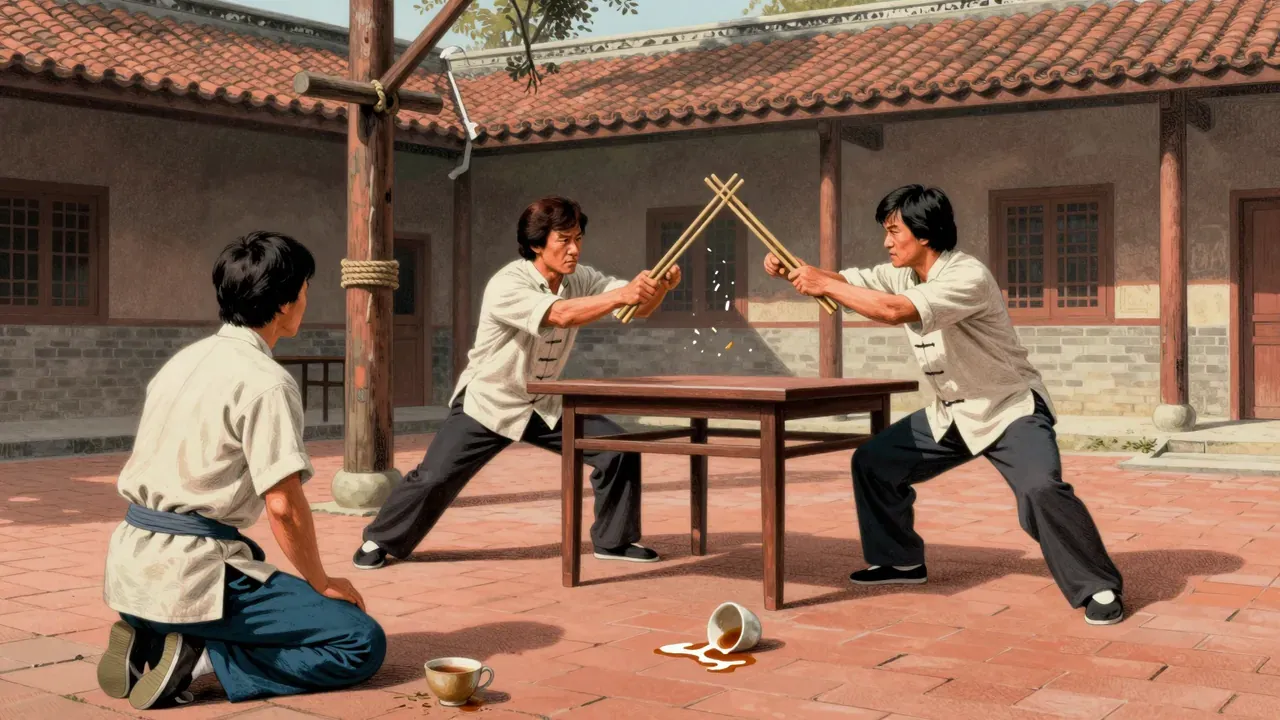
What lands most reliably is the physical comedy rooted in Jackie Chan’s early mastery of timing and spatial awareness. His body absorbs punishment without breaking stride — a kick sends him spinning into a wall, then he peels himself off and bows apologetically. The fight with the ‘snake woman’ works because it abandons realism for cartoonish escalation: limbs flail, props multiply, and gravity loosens its grip. Dean Shek’s crane-wielding eccentricity and Wu Ma’s urinating man land not as characters but as punctuation — brief, bizarre interruptions that reset the film’s tonal register. The film’s best moments occur when it treats kung fu as infrastructure: doors jam, floors creak, bamboo poles snap, and every surface becomes a potential hazard or assist. There is no irony in the way Jiang uses his acrobatic training to escape trouble — the film assumes competence and compounds incompetence, letting skill and stupidity coexist without explanation. That duality is sustained, if narrowly, across the full ninety-eight minutes.
The power of it
What does not land is any sense of stakes beyond immediate slapstick consequence. Jiang’s desire to learn kung fu never deepens into curiosity, discipline, or even consistent motivation — it flickers between hunger, vanity, and panic. The witch is visually striking but narratively inert; her menace evaporates the moment she is defeated, leaving no residue of threat or thematic weight. The princess subplot arrives without setup and departs without resolution, functioning less as a narrative thread than as a prop to justify travel. The film’s satire of ‘serious’ martial arts cinema is broad but shallow: it names the tropes without interrogating why they persisted, or what cultural work they performed. Without a stronger counterpoint — a straight man who believes, a master who embodies rigour — the parody risks becoming indistinguishable from the thing it mocks. The editing, while brisk, offers no rhythmic variation; gags follow one another at the same tempo, flattening peaks and diminishing returns.
The physics of it
The themes that matter are not philosophical but procedural: the gap between aspiration and execution, the instability of authority, and the improvisational nature of expertise. Jiang does not earn mastery — he stumbles into it, inherits it, and mistakes it for competence. The film treats teaching as transactional and lineage as accidental: the ‘mystery master’ is a bum who trades kung fu for food, and the final quest is less about enlightenment than about retrieving a plant that may or may not exist. Authority figures — the mansion owner, the witch, the crane-wielding man — are either corrupt, delusional, or comically ineffectual. Even the reward system is arbitrary: killing someone earns money, but only if you recognise the corpse and know where to take it. There is no moral framework, only cause-and-effect chains built from misunderstanding and momentum. The film’s quietest theme is exhaustion — not of the body, but of genre convention. It asks, without saying so, what happens when you remove the solemnity from ritual, the hierarchy from discipline, and the certainty from destiny.
The demand of it
This film is for viewers who value physical invention over narrative cohesion, and who find pleasure in the mechanics of failure — how a fall is set up, how a punch misses, how a plan unravels in real time. It rewards patience with its pacing and tolerance for repetition, particularly in the mid-section where Jiang cycles through variations of being chased, tricked, or mistaken. It is not for those who require emotional continuity, psychological consistency, or thematic resolution — anyone expecting character development, moral stakes, or even a clear antagonist will leave unsatisfied. A viewer who values Jackie Chan’s later, more integrated work — where comedy, choreography, and storytelling converge — may find this too fragmented. Someone drawn to the historical context of 1970s Hong Kong genre filmmaking, however, will see it as a necessary hinge: the moment before the formula solidified, when the rules were still being tested, broken, and rebuilt mid-take.
The promise of it
It is worth your evening if you approach it as a document of transition — not as a finished statement, but as a workshop in progress. At ninety-eight minutes, it sustains its premise without overstaying, and its best sequences remain sharply inventive decades later. Those who dislike slapstick rooted in bodily risk, or who expect coherence across plot, tone, and character, will find it frustratingly thin. A viewer who prefers tightly wound narratives or emotionally grounded performances would reasonably dismiss it as undercooked. But for anyone willing to meet it on its own terms — as a series of escalating stumbles dressed in kung fu robes — it delivers consistent, unpretentious physical wit. Its value lies not in what it achieves, but in what it attempts: to make the martial arts film breathe, sweat, and trip over its own feet.