What it tries to be
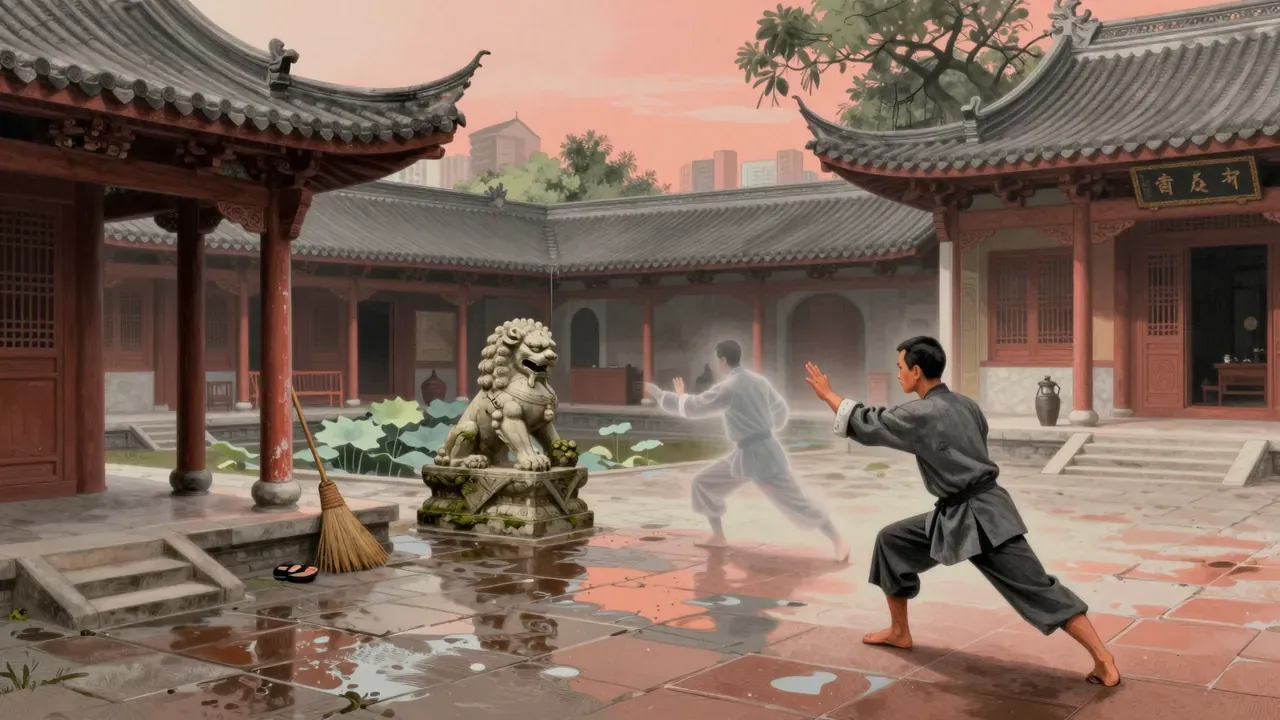
Spiritual Kung Fu is a 1978 Hong Kong martial arts comedy that attempts to fuse Shaolin discipline with supernatural farce. Lo Wei directs it as a deliberate pivot from Jackie Chan’s earlier Half a Loaf of Kung Fu, testing whether ghostly instruction and animal-style kung fu could sustain both narrative logic and comic rhythm. The film treats its premise — five spectral masters teaching Yi-lang the ‘Five Style Fists’ — not as allegory but as functional plot engine: the ghosts exist to explain rapid skill acquisition, justify slapstick vulnerability, and supply visual variety in fight choreography. It is not a satire of martial arts tropes, nor a philosophical inquiry into spirit or lineage; it is a workshop for tonal hybridity, built around Chan’s physical expressiveness and the studio’s limited but inventive use of early Hong Kong optical effects. Its ambition is structural: to hold together a temple setting, a theft, a haunting, a training arc, and a final confrontation without collapsing into incoherence. That it does so at all reflects the tightness of Pan Lei’s script and the discipline of its stunt coordination — though neither pretends to depth.
How it moves
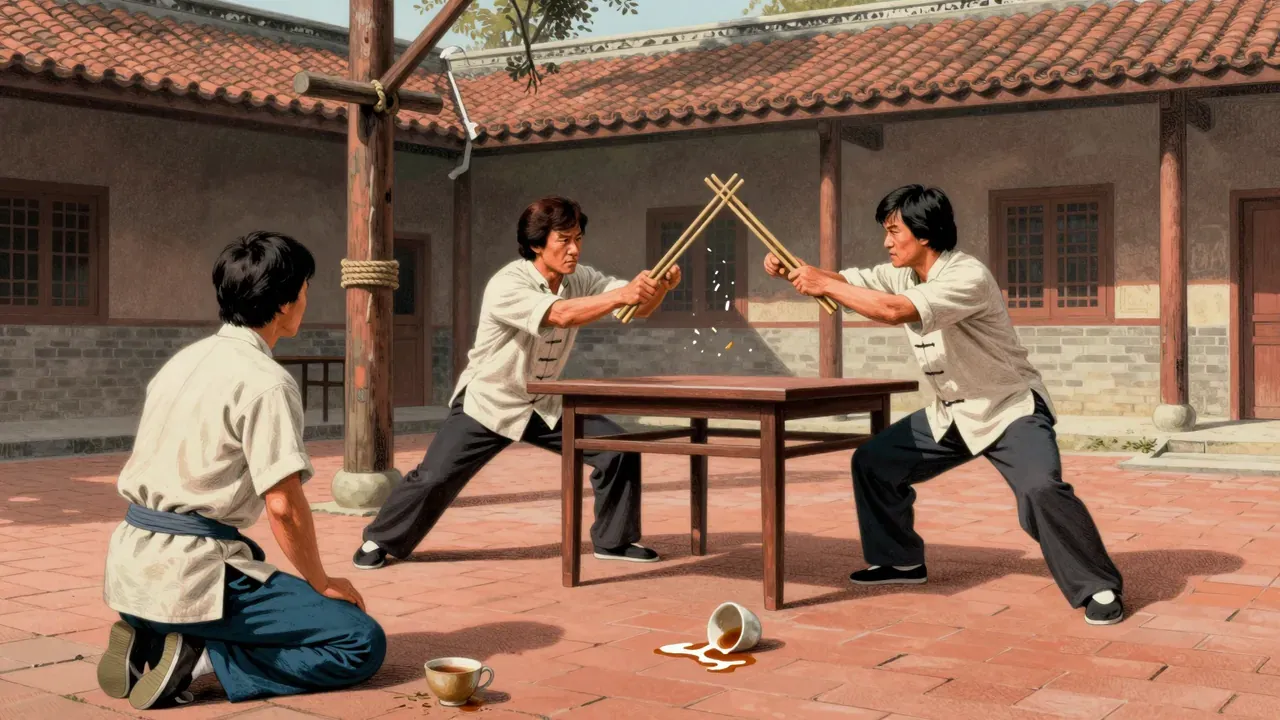
The story follows Yi-lang’s punishment, recruitment by ghosts, mastery of the Five Style Fists (Dragon, Tiger, Snake, Crane, Leopard), and eventual defence of the temple against the book thief. Jackie Chan carries it with precise timing: his reactions — wide eyes, flinching shoulders, startled double-takes — are calibrated to land every beat of the script’s physical comedy. James Tien plays the rival with dry authority; Dean Shek offers grounded exasperation as the supervising monk. Yuen Biao appears uncredited but integral as one of the Five Fists masters, his movements crisp and economical. Frankie Chan’s score leans on jaunty percussion and reedy woodwinds, underscoring action without swelling sentiment. Gordon Willis is not involved; the cinematography is by Wong Chung-Keung, who keeps compositions clean and fights legible, favouring mid-shots over cuts. Editing avoids disorientation: even during ghostly interludes, spatial continuity holds. The special effects — smoke, double exposure, matte lines — are modest but purposeful, never masking choreographic clarity. There is no attempt at realism, only consistency within its own rules.
What holds together
What lands is the rhythm of Chan’s physical comedy and the coherence of the film’s internal logic. His facial grammar — the way he blinks before reacting, or recoils just a fraction too late — gives weight to absurd situations without undercutting them. The Five Style Fists sequence works because each animal style is distinct in posture and tempo: the Crane’s balance, the Tiger’s lunges, the Snake’s coiling strikes. These are not decorative flourishes but functional variations that shape the fight staging. The temple setting feels lived-in, not symbolic: monks sweep courtyards, argue over chores, nap mid-duty. Even the ghosts behave like irritable teachers — impatient, pedantic, occasionally petty — which makes their presence feel earned rather than imposed. The final confrontation lands because it synthesises everything: Yi-lang uses each style deliberately, switching between them as tactical responses, not spectacle. There is no last-minute power-up; his victory rests on application, not revelation. The film’s modesty — its refusal to overstate its stakes — becomes its strength.
Where it slips
What does not land is the framing device and the tonal drift between genres. The opening — especially in the Korean version, which replaces it entirely — feels detached from the rest, offering no grounding for Yi-lang’s character beyond ‘smart-alec’. The theft of the manual lacks consequence: no one investigates, no one grieves its loss, and the thief’s motives remain vague. The ghosts’ backstories are absent; they appear fully formed, their authority asserted but unearned. This undermines the emotional weight of Yi-lang’s apprenticeship — we see him learn, but not why these particular masters matter. The comedy also falters when reliant on repetition without escalation: a gag about joss-stick poison recurs without variation, and the temple punishments grow formulaic. The Mandarin and Cantonese versions diverge on key beats — unconsciousness via neck strike versus smoke inhalation — suggesting editorial uncertainty about what kind of physical cause-and-effect the film trusts. Without a stronger anchor in character or world-building, the supernatural elements risk feeling like convenient scaffolding.
What it believes
The themes that matter are discipline as performance, knowledge as inheritance, and competence as quiet rebellion. Yi-lang does not reject the temple; he exploits its structure — its rituals, hierarchies, and punishments — to advance himself. His mastery of the Five Style Fists is not an act of defiance but of absorption: he learns not to break the system, but to move through it faster and more precisely than anyone else. The ghosts represent uncodified tradition — techniques preserved outside official records, passed down not in texts but in embodied memory. Their presence critiques institutional amnesia: the temple guards a library but forgets how to read its most dangerous books. The film treats kung fu less as philosophy than as craft — something you do with your hands, feet, breath, and timing. There is no grand moral about humility or vengeance; Yi-lang wins because he listens, observes, and adapts. His growth is procedural, not spiritual. The film’s quietest theme is patience: the time it takes to master a stance, the pause before a feint, the stillness required to see a ghost clearly.
Who it speaks to
This film is for viewers who value choreographic clarity, physical timing, and the mechanics of genre fusion — particularly those interested in how Jackie Chan’s early work tested the boundaries of martial arts comedy before Drunken Master codified them. It rewards attention to stunt coordination, editing rhythm, and the expressive economy of Chan’s face and shoulders. It is not for viewers seeking psychological realism, thematic density, or consistent world-building: the ghosts operate on narrative convenience, not internal logic, and the temple functions more as backdrop than community. Those expecting the layered irony of later Chan films — or the mythic gravity of Shaw Brothers wuxia — will find it undercooked. A viewer who values atmosphere over exposition, or who enjoys watching how a joke lands in the space between two frames, will respond more readily than one who requires motivation, backstory, or thematic resolution. It assumes familiarity with Shaolin iconography but does not require fluency in it.
What it gives you
Yes, it is worth your evening — provided you watch it as a technical document of transition, not as a finished statement. At 97 minutes, it moves briskly, never overstaying its central idea. Its pleasures are specific: the snap of a Crane-style kick, the way Chan’s eyebrows lift in unison with a shoulder shrug, the clean geometry of a courtyard fight. It is not profound, but it is precise. Someone who prefers character-driven drama or atmospheric horror would find it thin; someone who watches for how bodies occupy space, how timing shapes meaning, or how low-budget ingenuity solves staging problems will find it rich. Its belated release — shelved then revived after Snake in the Eagle’s Shadow succeeded — means it bears the marks of compromise, but also of recalibration. To dismiss it as a stopgap is to miss how carefully it balances its competing demands. It earns its place not as a masterpiece, but as a working blueprint.