What it is trying to do
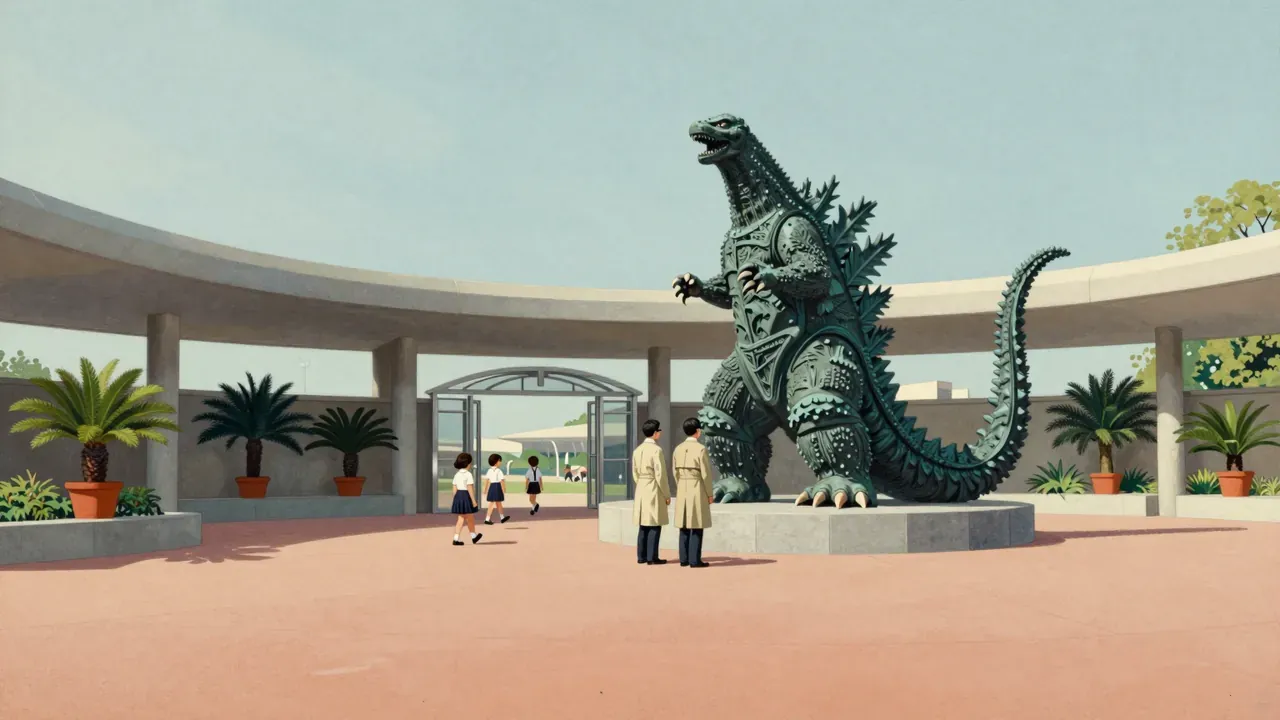
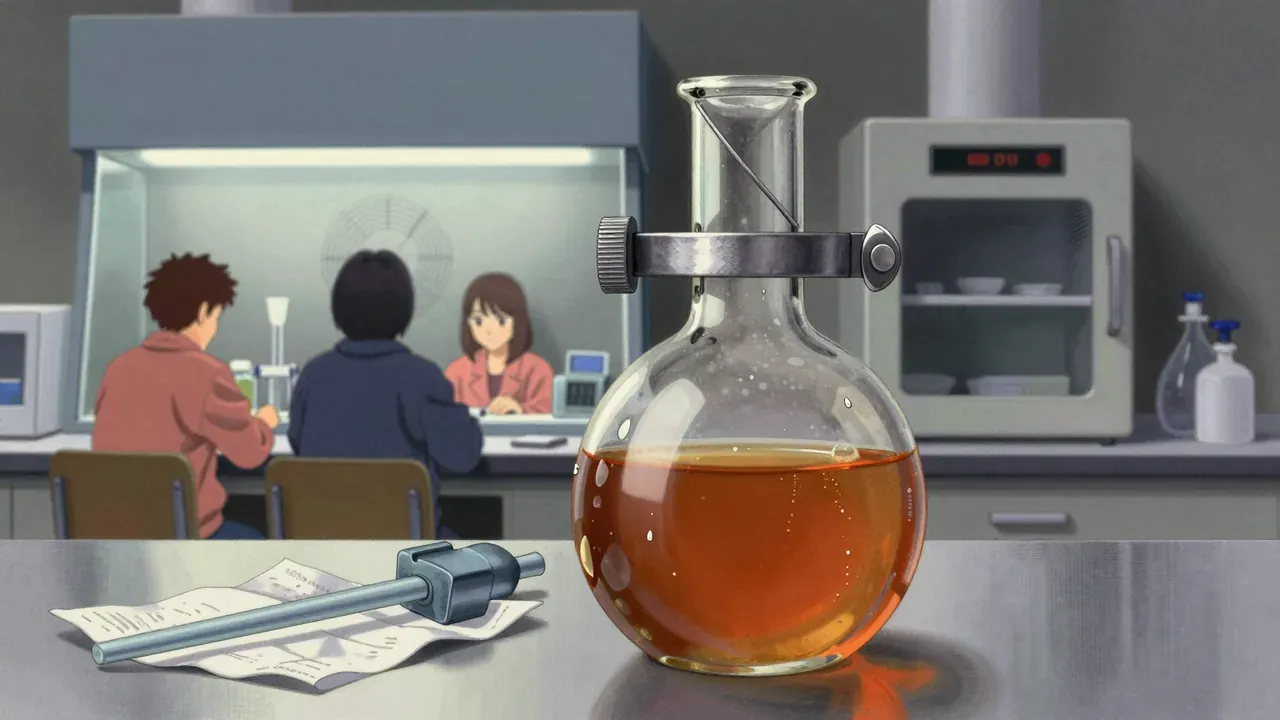
Godzilla vs. Biollante is a 1989 Japanese science fiction film that attempts to re-anchor the Godzilla franchise in biological and ethical complexity rather than nuclear allegory alone. Directed and written by Kazuki Ōmori, it is the second entry of the Heisei era and a direct sequel to 1984’s The Return of Godzilla. Its central project is to treat Godzilla not as a force of nature or vengeance, but as raw biological material — a genome to be harvested, spliced, and weaponised. The film builds its conflict around corporate and military competition for samples of Godzilla’s cells, which are fused with human and plant DNA to create Biollante: a creature born from grief, genetic hubris, and botanical sentience. Ōmori, trained as a biologist, structures the plot around plausible lab procedures, tissue culturing, and gene expression, avoiding cartoonish mutation in favour of incremental, almost clinical transformation. It is not a monster brawl dressed up as philosophy; it is a kaiju film that treats its monsters as subjects of biotechnology, not just spectacle. That ambition — to make the science feel grounded, the ethics urgent, and the tragedy personal — defines what the film is trying to do. (159 words)
How it works
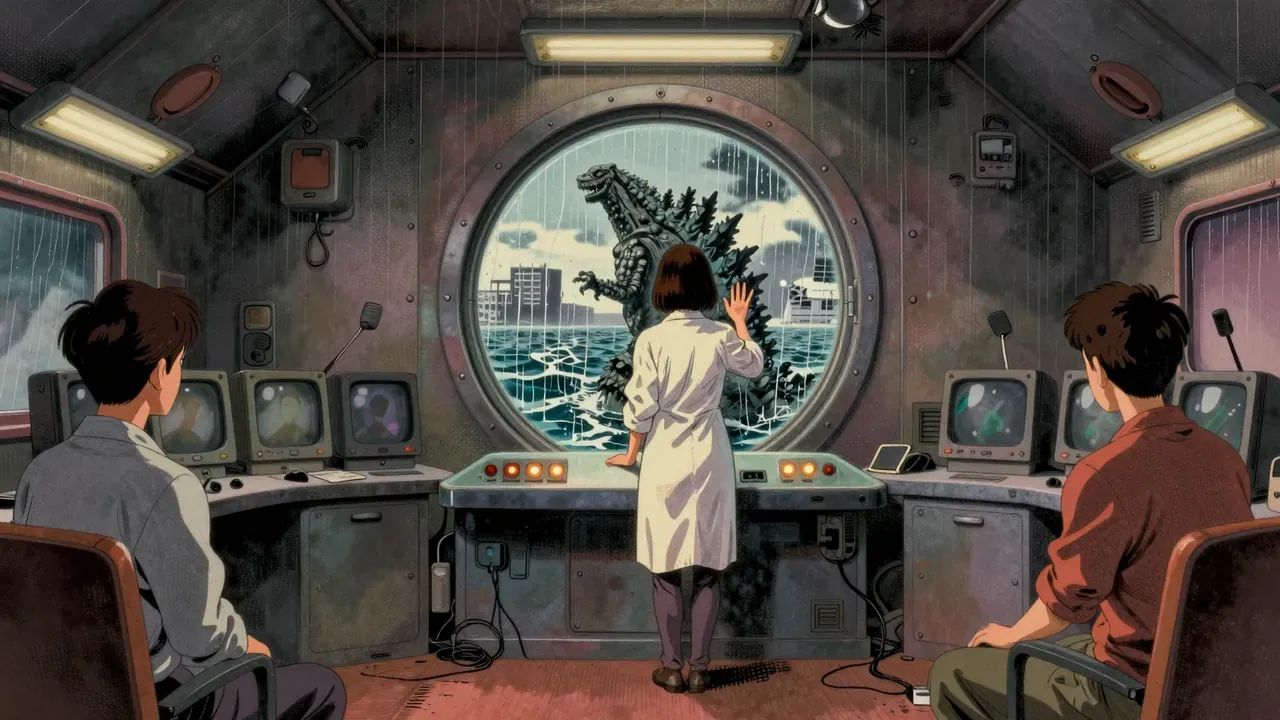
The story unfolds across three interlocking registers: a covert JSDF operation, a corporate bioethics dispute, and a scientist’s private mourning made public through genetic resurrection. Kenpachirō Satsuma’s Godzilla is less theatrical than before — slower, heavier, more reactive — and his physical performance reflects the suit’s improved ergonomics and lower centre of gravity. Megumi Odaka, in her first appearance as psychic investigator Miki Saegusa, carries quiet authority without exposition, her role shaped by Ōmori’s decision to replace the original journalist character with someone whose abilities stem from empathy rather than curiosity. Koichi Kawakita’s special effects rely on suitmation, animatronics, and limited CGI schematics; Biollante’s first form, operated by Masao Takegami inside a water-level platform, is deliberately unwieldy, its vines difficult to coordinate — a choice that makes the combat feel unbalanced, even clumsy, rather than choreographed. Sugiyama’s score blends Ifukube motifs with orchestral leitmotifs for Biollante’s floral motifs and Miki’s psychic resonance, conducted blind by David Howell. The editing favours medium shots and procedural pacing over spectacle, and the Lake Ashino location work grounds the action in tangible geography. (158 words)
What lands
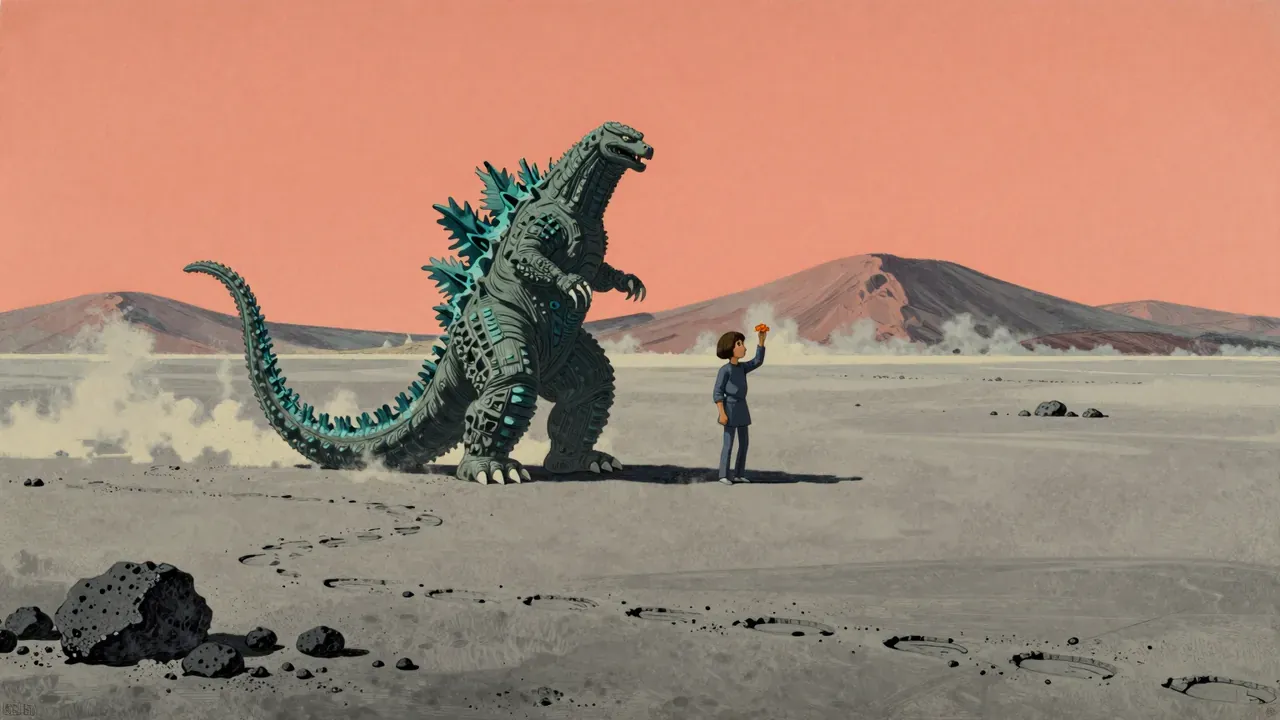
What lands is the film’s sombre tone and its refusal to resolve its central dilemma. The grief of Dr. Shiragami — who merges his daughter’s cells with a rose to preserve her consciousness — is never sentimentalised, nor is his transgression excused. Biollante’s final form, a towering amalgam of vine, thorn, and humanoid silhouette, does not speak or reason, yet its movements carry a mournful deliberation absent from most kaiju antagonists. The visual contrast between Godzilla’s scorched, reptilian mass and Biollante’s glistening, photosynthetic bulk remains striking forty years on: one is decay made animate, the other growth made monstrous. The JSDF sequences avoid jingoism, presenting military response as bureaucratic, under-resourced, and ultimately futile against emergent life. Even minor details land: the way Godzilla’s dorsal plates light up with actual bulbs, electrocuting Satsuma on first use; the sap from Biollante’s final form staining sets permanently; the absence of eye-whites in Godzilla’s redesigned head, lending him a flintier, less expressive gaze. These are not flourishes but functional choices — each reinforcing the film’s core idea that biology resists control, and that consequence is physical, visible, and irreversible. (157 words)
What does not
What does not land is the film’s structural indecision between spy thriller, biotech parable, and kaiju spectacle. The espionage subplot — involving stolen samples, double agents, and a shadowy corporation — feels bolted on, its stakes never cohering beyond exposition. Characters like Kōsuke Toyohara’s intelligence officer or Haruko Sagara’s corporate liaison remain schematic, their motivations reduced to institutional loyalty or professional pride. The dialogue often serves plot mechanics rather than character, particularly in lab scenes where technical terms are recited without dramatisation. Biollante’s first form, though conceptually strong, suffers from poor visibility and slack wire rigging, making its attacks feel arbitrary rather than threatening. The underwater suit, built for lake scenes, appears only briefly and adds little tonal or narrative weight. The film’s pacing sags in the middle third, where bureaucratic meetings and security footage slow momentum without deepening theme. And while Ōmori’s background in biology informs the script’s plausibility, it also narrows emotional access: viewers unfamiliar with PCR or somatic cell fusion may find key turning points opaque. This is not obscurity for its own sake, but a failure to translate scientific process into visceral cause and effect. (159 words)
The themes that matter
The themes that matter are inheritance, unintended consequence, and the instability of boundaries — between species, memory and matter, mourning and manipulation. Biollante is not a villain but an outcome: the literal embodiment of a father’s refusal to let go, amplified by corporate impatience and military pragmatism. The film treats genetic engineering not as a tool but as a rupture — one that scrambles identity at the cellular level, making ‘self’ a contested site. Godzilla’s cells are treated as both resource and relic: inert until activated by human intervention, then impossible to contain. This reframes the kaiju not as invader but as substrate — the raw material from which new forms emerge, whether by design or accident. The recurring motif of flowers blooming in irradiated soil or ash-strewn hills is not hopeful renewal but evidence of life adapting to toxicity, not transcending it. There is no redemption arc for Shiragami, no moral reset after Biollante’s defeat. Instead, the film ends with silence, smoke, and a single surviving petal — a reminder that biological processes continue regardless of human intention. That quiet persistence, not spectacle or salvation, is the film’s ethical centre. (156 words)
Who should watch it, and who should not
This film is for viewers who value thematic density over kinetic clarity, and who accept that a kaiju film can function as a chamber piece about grief and genetic ethics. It suits those familiar with the Heisei era’s tonal shift — its slower pace, muted palette, and procedural realism — and those willing to sit with ambiguity rather than demand resolution. It is not for viewers seeking straightforward monster action, rapid-fire plotting, or emotionally legible villains. Fans of Toho’s Showa-era films may find its restraint alienating; newcomers expecting American-style exposition or heroic arcs will likely disengage early. Those who reject science fiction that prioritises implication over explanation — or who require clear moral binaries — will find little purchase here. A viewer who values visual coherence over narrative propulsion, or who finds pathos in malfunctioning special effects, will respond more readily. The verdict shifts if the film were shorter by ten minutes, or if its espionage thread had been trimmed to two scenes instead of five — but as it stands, its audience is narrow by design, not accident. (158 words)
Is it worth your evening
Yes, it is worth your evening — provided you approach it as a deliberate, mid-tempo work of speculative biology rather than a summer blockbuster. Its 105-minute runtime moves with unhurried precision, and its rewards accrue slowly: in the weight of Satsuma’s footsteps, the texture of Biollante’s sap, the quiet dread of a lab technician realising what they’ve grown. It repays attention to craft — the reduction of Godzilla’s eye-whites, the double row of teeth added on Kobayashi’s advice, the way Sugiyama’s strings swell not for battle but for a dying flower. Those who dislike it tend to cite its sluggishness or its refusal to deliver cathartic destruction — a fair objection, but one that misreads the film’s purpose. It is not about victory. It is about aftermath. Watch it once for plot, again for texture, and a third time for the silence between the notes. Its value lies not in scale, but in specificity — and specificity, in this genre, is rare. (159 words)