The landing
The Blob is a low-budget American science fiction horror film made for teenage drive-in audiences in 1957 and released by Paramount Pictures in early 1958. It attempts to deliver a simple, escalating threat — an extraterrestrial organism with no intelligence, no motive, no speech — that grows by consuming people and cannot be stopped by conventional means. Its ambition is not psychological depth or social allegory but visceral escalation: from a roadside meteorite to a town-wide emergency, all within eighty-two minutes. It works within strict constraints — a single location cluster (small-town Pennsylvania), a fixed set of characters, minimal dialogue, and a monster defined entirely by physical behaviour. The film assumes its audience will accept the premise without explanation and respond to rhythm, scale, and urgency rather than logic or character development. It does not try to mimic realism; it tries to mimic the pulse of a summer night where something inexplicable has landed just beyond the hill. It is a procedural of panic, not a study of fear.
The look of it
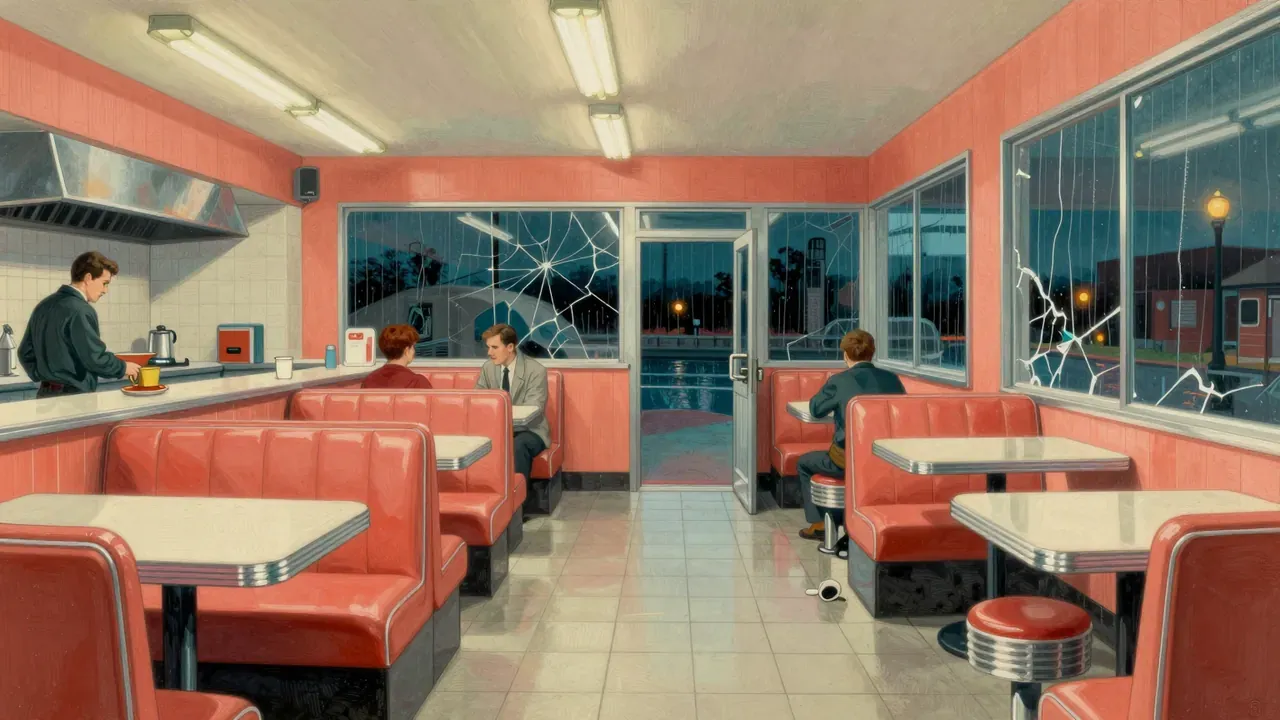
The story follows a linear, cause-and-effect chain: discovery, misjudgement, containment failure, mass alarm, and improvised solution. Steve McQueen’s Steve Andrews anchors the film with quiet persistence rather than charisma — he listens, observes, and acts, rarely explaining. Aneta Corsaut’s Jane Martin is given little interiority but functions as a steady counterpoint to his resolve. Supporting performances are functional: Olin Howland’s Barney is a brief, effective catalyst; Earl Rowe’s Lieutenant Dave Barton shifts from sceptic to coordinator without fanfare. Kay Linaker’s script avoids exposition, trusting action to convey stakes. Ralph Carmichael’s score is sparse and tonal, favouring low brass and percussion over melody, though the studio-recorded novelty song ‘The Blob’ — played over the opening credits — deliberately undercuts gravity. Irvin Yeaworth shoots in colour on 35mm at 1.66:1, using tight framing in interiors and wide shots for scale, especially during the diner siege. The Blob itself is realised through practical effects: gelatinous props, forced perspective, and reversed footage — all modest but coherent.
The spread
What lands is the film’s economy and momentum. Every scene serves the central escalation: the meteorite crash, the first absorption, the failed amputation, the theatre panic, the diner siege — each step tightens the loop. The cold-temperature vulnerability emerges organically: first in the freezer, then the fire extinguisher, then the Arctic solution — a chain of observation and deduction that feels earned, not contrived. The townspeople’s initial disbelief reads as plausible small-town inertia, not narrative obstruction. The use of real Pennsylvania locations — Downingtown Diner, Valley Forge Studios, Chester Springs streets — grounds the absurdity in tangible texture. Even the title song, though tonally dissonant, becomes part of the film’s identity: its jaunty rhythm contrasts with the visuals in a way that sharpens both. The final image — the frozen Blob lowered onto Arctic ice, ending on a question mark — refuses closure without feeling coy. It acknowledges the threat’s persistence while accepting the limits of human response. That restraint, rare in 1950s genre fare, gives the film durability.
The limits
What does not land is the attempt at adolescent romance and generational friction. Steve and Jane’s relationship exists only as plot scaffolding; their kiss opens the film but adds no emotional weight to later peril. Their parents appear solely to dismiss them, then vanish — not as satire of adult authority but as narrative dead ends. The school principal’s late arrival with fire extinguishers feels unearned, lacking setup or consequence. Several characters — Hugh Graham’s Baron Atholstan, John Benson, Pamela Curran — are credited but have no lines or screen time, suggesting reshoots or cuts that left gaps. The film’s pacing stutters between the second and third act, lingering too long on police dismissal when urgency should dominate. The Blob’s design, while consistent, lacks variation: it is always red, always amorphous, never adapting or reacting beyond temperature. This uniformity works for simplicity but undermines tension in longer sequences — there is no sense of learning, fatigue, or evolution in the creature, only arithmetic growth. The result is a threat that feels inevitable but never unpredictable.
The freeze
The themes that matter are containment, scale, and provisional solutions. The Blob cannot be reasoned with, converted, or bargained with — it can only be displaced. Its growth is literalised entropy: energy absorbed, form expanded, control eroded. The film treats cold not as a weapon but as a temporary condition — the Arctic is not a tomb but a holding cell, one whose integrity depends on climate stability, a detail underscored by Dave’s line about the cold lasting ‘as long as the Arctic stays cold’. There is no triumph, only deferral. The town’s response moves from individual action (Steve’s investigation) to collective improvisation (students retrieving extinguishers) to institutional intervention (Air Force transport) — a quiet affirmation of civic coordination, however ad hoc. There is no military heroism, no scientific revelation, no moral reckoning. The film resists Cold War binaries: the Blob is not communist, not capitalist, not ideological — it is simply there, demanding adaptation without offering meaning. Its indifference is the point.
The audience
It is worth watching for viewers who value structural clarity, practical effects executed with purpose, and genre films that treat their premises seriously without overburdening them with subtext. It rewards attention to pacing, editing rhythm, and how space is used to build dread. Those who require psychological complexity, thematic elaboration, or polished performances will find it thin. Fans of mid-century American regional filmmaking — particularly the Philadelphia-based independents who worked outside Hollywood studios — will recognise its craft and limitations as part of a specific ecosystem. Some critics argue its camp reputation overshadows its formal discipline; others say its charm lies precisely in its unselfconsciousness. A viewer expecting irony or self-awareness will be disappointed — the film is sincere in its simplicity. Its endurance rests on what it refuses to do as much as what it achieves.
The evening
Yes, it is worth your evening — provided you watch it as a tightly wound mechanism, not a character study or cultural artefact. At eighty-two minutes, it occupies less time than a commute and delivers a complete, unbroken arc of rising pressure and pragmatic resolution. Its pleasures are tactile: the grain of the film stock, the weight of the diner door closing, the hiss of CO2, the sudden silence after the power line strikes. It does not ask for patience or interpretation — it asks for attention to cause and effect. Anyone put off by monochrome morality, flat dialogue, or a monster with no face may find it hollow. But those open to a film that trusts its own logic, honours its runtime, and resolves its crisis with ice rather than gunfire will find it quietly satisfying. It is not profound, but it is precise — and precision, in this genre, is rare.