What it is
Godzilla is a Japanese horror film released in November 1954, produced by Toho and directed by Ishirō Honda. It is the first entry in what would become the longest-running film franchise in history. The film sets out to dramatise nuclear anxiety not through allegory alone but as a tangible, physical consequence — a creature awakened and mutated by hydrogen bomb testing, then unleashed upon Japan. Its ambition is documentary-like seriousness: to treat the appearance of a prehistoric reptilian monster as if it were a real national emergency, reported on by scientists, debated in cabinet meetings, and endured by civilians. Honda, producer Tomoyuki Tanaka, and special effects director Eiji Tsuburaya agreed early that the tone must avoid camp or spectacle for its own sake. This is not a monster movie disguised as drama; it is a drama that happens to involve a monster. The film’s structure follows bureaucratic response — investigation, containment, failure, escalation — with Godzilla functioning less as a villain than as an indifferent force of nature, amplified by human error and political silence. It was conceived mid-flight home from Jakarta after a co-production collapsed, inspired directly by the Daigo Fukuryū Maru incident and the global dread following Castle Bravo. Word count: 158
How it works
The story moves through three phases: discovery on Odo Island, scientific inquiry led by Dr. Yamane (Takashi Shimura), and the eventual siege of Tokyo. Performances are restrained, grounded in mid-century Japanese professional decorum — Shimura’s quiet authority, Akihiko Hirata’s weary government official, Momoko Kōchi’s conflicted daughter caught between two men. Haruo Nakajima wears the Godzilla suit, moving with deliberate, heavy gait across miniature cityscapes built at 1:25 scale. Masao Tamai’s cinematography avoids flourish: static frames, medium shots, shallow depth of field in interiors, long takes during committee scenes. Akira Ifukube’s score uses low brass, percussive woodblocks, and the iconic ‘Godzilla theme’ — a four-note motif played on contrabassoon and piano, repeated with increasing weight. Editing by Kazuji Taira maintains procedural pacing: no montage, no flashbacks, no music over dialogue. The special effects rely on suitmation and forced perspective, not illusion — the seams are visible, the miniatures recognisably handmade. This aesthetic choice reinforces the film’s central conceit: that the threat is real, and realism lies in texture, not seamlessness. Word count: 157
What lands
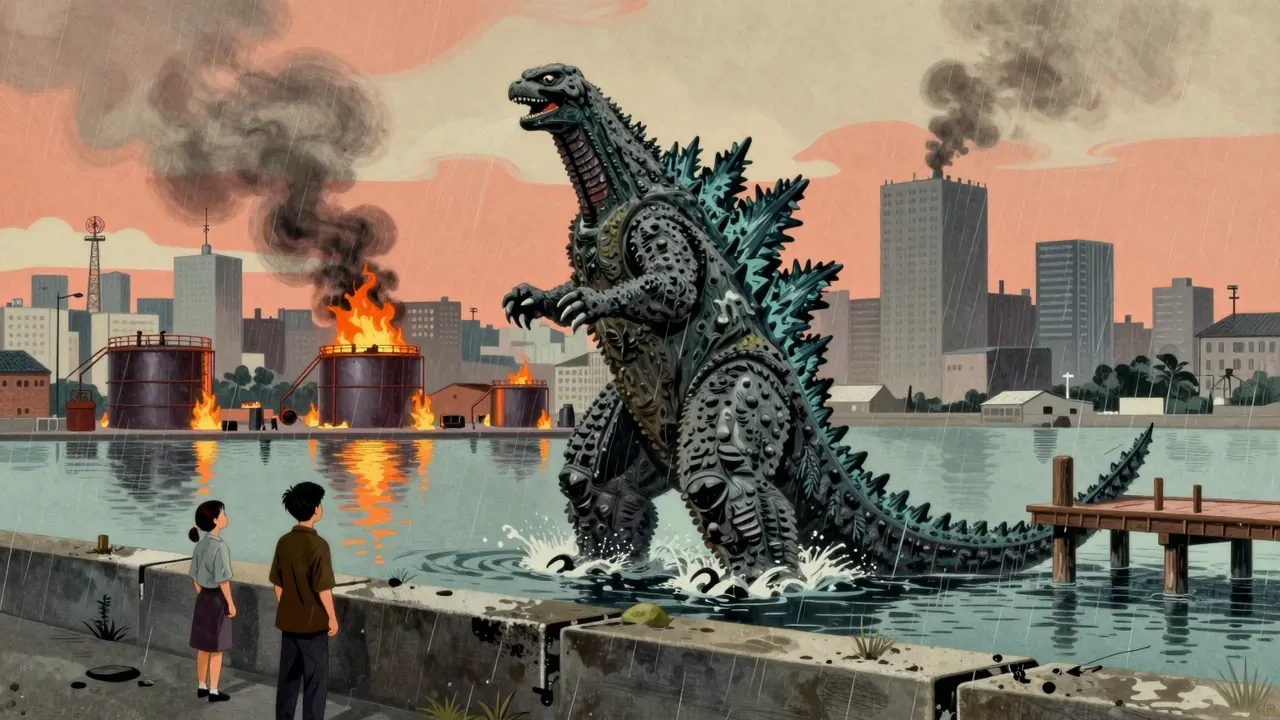
What lands is the cumulative weight of institutional helplessness. The film’s most effective sequence is not Godzilla’s rampage but the silent shot of Tokyo Bay at dawn after the attack — smoke rising, no music, just the distant wail of sirens fading into wind. The bureaucracy’s slow-motion response feels authentic: minutes lost to protocol, scientists sidelined by politicians, evacuation plans delayed by inter-ministerial disagreement. Shimura’s final monologue — delivered not with outrage but exhaustion — lands because it mirrors the audience’s dawning realisation that no one is in control. The creature’s design works precisely because it refuses majesty: Godzilla is hunched, scarred, amphibious, breathing radioactive steam like a failing engine. His presence is felt before he is seen — tremors, overturned boats, a single claw dragging across rock — building dread through absence. The decision to delay his full reveal until the storm sequence pays off: when he emerges, lit from below by burning oil tanks, he is not frightening because he is huge, but because he is inevitable. Word count: 159
What does not
What does not land is the love triangle involving Emiko (Kōchi), Ogata (Akira Takarada), and Serizawa (Akihiko Hirata). It functions as exposition delivery rather than emotional anchor — Serizawa’s sacrifice feels earned only in retrospect, not in the moment, because his motives remain opaque until the final reel. The character of Hagiwara, introduced as a radio operator, vanishes without narrative purpose after the island sequence. Some dialogue exchanges — particularly in cabinet scenes — lapse into functional summary, repeating information already established visually. The film’s commitment to procedural realism occasionally flattens dramatic tension: a scene of scientists debating radiation levels reads like a technical briefing, not a confrontation. The Americanised 1956 cut removed much of this, but the original’s restraint risks monotony for viewers unprepared for its pace. The miniature work, while pioneering, shows its age in places — wires visible, matte lines faint but present — though these do not undermine the film’s gravity so much as remind us of its material constraints. Word count: 159
The themes that matter
The themes that matter are not simply anti-nuclear sentiment but the fragility of civil order when confronted with forces beyond comprehension or control. Godzilla is not a metaphor for the bomb; he is the bomb’s aftermath made flesh — persistent, uncontainable, indifferent to apology or intent. The film treats science not as salvation but as witness: Yamane’s research confirms origin but offers no solution; Serizawa’s invention is not a weapon but a last-resort erasure. There is no triumph, only resignation — the final line is not hope but warning. Colonialism surfaces obliquely: the Daigo Fukuryū Maru incident occurred in waters claimed by no nation, yet policed by nuclear powers; the film’s opening titles cite real footage of fishermen suffering radiation sickness, linking imperial ambition to technological hubris. Class appears in the contrast between Tokyo’s concrete towers and Odo Island’s thatched roofs — both equally vulnerable. The film’s enduring power lies in its refusal to resolve these tensions: it leaves the question unanswered, the sea still radioactive, the next test still possible. Word count: 159
Who should watch it
This film is for viewers who value historical craft over contemporary pacing, who find weight in silence and precision in restraint, and who approach genre not as escapism but as cultural record. It rewards attention to composition, to the rhythm of bureaucratic speech, to the way light falls on a model building moments before it collapses. It is not for those who require narrative propulsion, psychological interiority, or visual polish — the miniature work, while ingenious, lacks the seamlessness modern audiences expect. Those who reject films where characters speak in measured tones about radiation half-lives will find it inert. Anyone expecting a creature feature with set-piece action will be disappointed: Godzilla attacks twice, briefly, and the rest is waiting, debating, documenting. A viewer who values thematic density over kinetic energy will find it urgent; one who equates seriousness with speed will not. Word count: 159
Is it worth your evening
Yes, it is worth your evening — not as entertainment but as encounter. One hundred minutes is enough time to absorb its architecture: the way the camera holds on a scientist’s face as he hears bad news, the way the score drops out entirely during the evacuation of Tokyo, the way the final shot returns to the ocean, unchanged. It is not ‘fun’, nor is it meant to be. Its value lies in its singularity: a studio horror film made with the gravity of a state inquiry, released nine years after Hiroshima, three months after Castle Bravo, by people who had lived under air raid sirens and ration cards. To skip it is to miss the origin point of an entire mode of cinematic thinking — one that treats mass trauma not as backdrop but as subject. Those who insist on ‘accessibility’ may prefer the 1956 Raymond Burr version, but they will have traded substance for fluency. Word count: 159