The premise
Fail-Safe is a Cold War thriller built on a single, unrelenting premise: a technical failure triggers an unstoppable nuclear strike against Moscow, and the only way to prevent global annihilation is for the US president to authorise the destruction of New York City as proof of good faith. It does not seek suspense through misdirection or character backstories, but through the tightening logic of irreversible cause and effect. The film treats its scenario as a closed system — no last-minute hardware fixes, no rogue agents, no moral ambiguity in the chain of command. Its ambition is procedural and philosophical: to dramatise how rational actors, operating within institutional protocols, can arrive at irrational, catastrophic outcomes. It assumes the viewer understands the doctrine of mutually assured destruction not as theory but as infrastructure — embedded in radar screens, voice scramblers, and the weight of a red telephone. The film’s urgency comes not from action but from the narrowing of options, minute by minute, as every contingency fails or compounds the error. It is less about what happens than how it must happen, given the premises.
The look of it
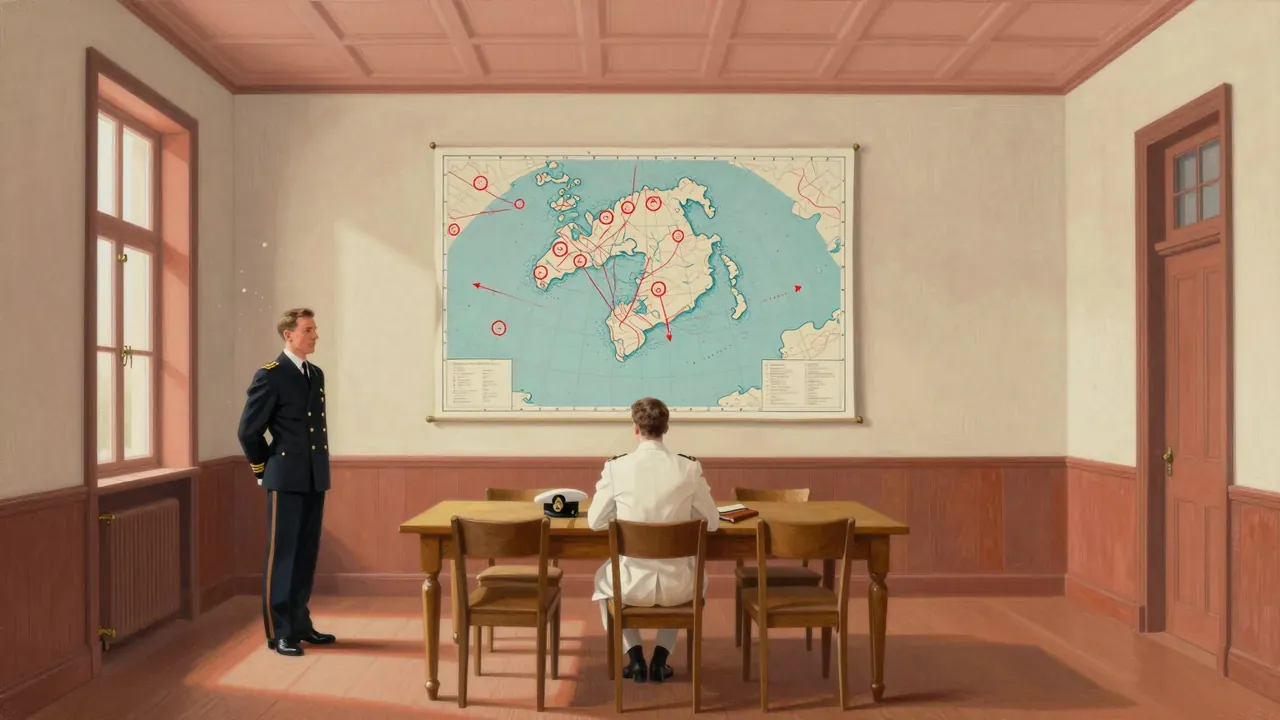
The story unfolds almost entirely in three claustrophobic locations: the Pentagon war room, the White House situation room, and the airborne command post of the rogue bomber squadron. Gerald Hirschfeld’s cinematography keeps the frame tight and the lighting flat, avoiding chiaroscuro or dramatic shadows; instead, he uses fluorescent glare and shallow focus to flatten hierarchy and amplify tension. Ralph Rosenblum’s editing sustains rhythm without flourish — cuts land on faces mid-thought, not on revelations. Henry Fonda plays the president with quiet exhaustion rather than gravitas, his voice low and deliberate, never rising above a controlled register. Walter Matthau, as the civilian advisor, delivers exposition with dry precision, not wit. Dan O’Herlihy and Frank Overton anchor the military side with procedural rigidity — their authority lies in adherence, not charisma. There are no subplots, no romantic interludes, no flashbacks. Every line serves either clarification or consequence. Even the minor roles — Booke as the anxious general, Hagman as the junior aide — function as calibrated pressure valves, registering escalation without breaking the film’s tonal discipline.
What holds
What lands is the suffocating inevitability of the central dilemma. The film’s power resides in its refusal to offer escape hatches — no sabotage, no miscommunication, no last-second override. When the president orders the destruction of New York, the decision carries weight because it follows logically from every prior choice, every protocol observed, every safeguard bypassed by design. The performances avoid grandstanding: Fonda’s stillness makes the final order more devastating than any outburst could. The sound design — sparse, dominated by radio static, teletype clatter, and the hum of ventilation — reinforces the sense of systems operating beyond human control. The script’s dialogue is stripped of metaphor or flourish; it reads like transcripts from a Joint Chiefs briefing, and that austerity becomes its strength. Even the casting of lesser-known actors in supporting roles (Sorrell Booke, Dom DeLuise) avoids star power that might distract from collective responsibility. The film’s restraint makes its conclusion feel less like tragedy than arithmetic — and that is precisely what sticks.
Where it narrows
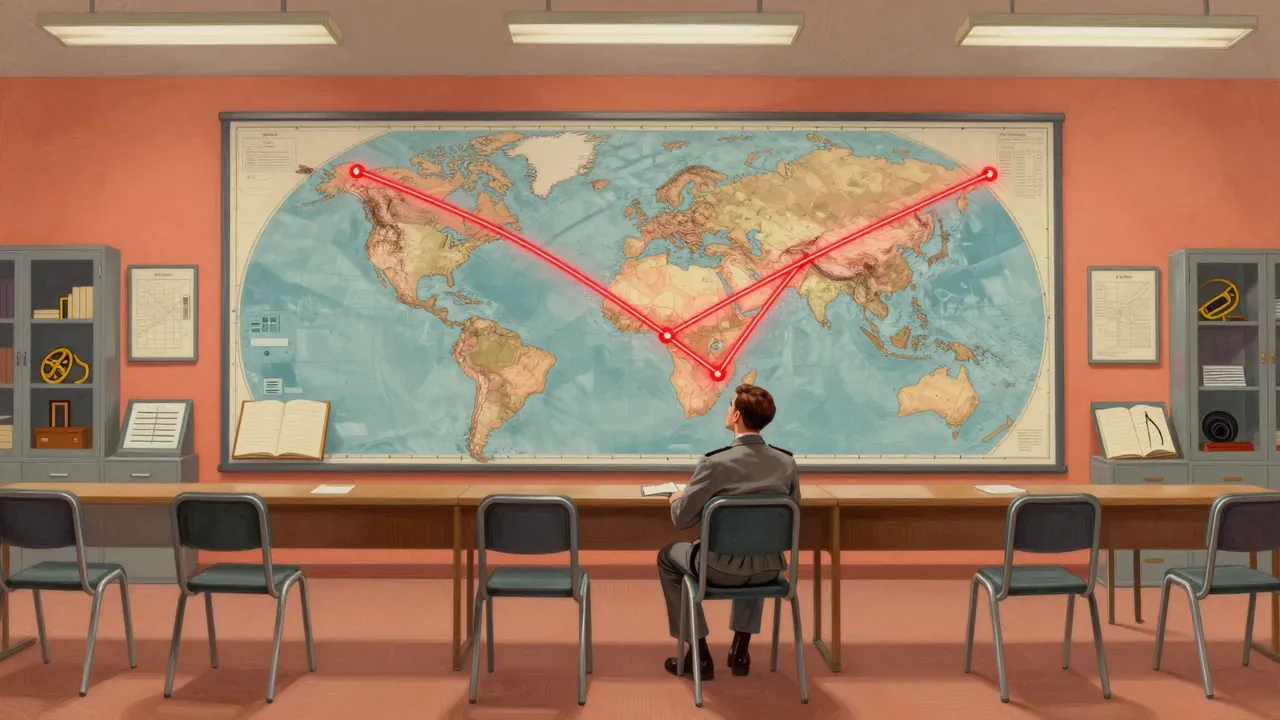
What does not land is the film’s handling of the Soviet side. Though the plot hinges on Moscow’s response to the incursion, the USSR appears only as a voice on a scrambled line and a target on a map. There is no Soviet perspective, no attempt to dramatise their own command structure or internal debate — a limitation that risks flattening the stakes into American self-absorption. The film also struggles with the bomber crew’s psychology: their obedience is presented as duty, but their silence feels under-explored, especially given the moral weight placed on their eventual fate. Some exchanges between military officers verge on exposition-as-lecturing, particularly when explaining fail-safe protocols to the audience rather than to each other. The absence of visual variety — no establishing shots, no cutaways to civilian life, no sense of scale beyond the war rooms — begins to wear after ninety minutes, not from monotony but from a kind of conceptual fatigue. A viewer expecting psychological nuance or geopolitical texture may find the film’s narrow aperture too severe.
What it argues
The themes that matter are failure as system, not flaw; command as burden, not privilege; and accountability as distributed, not individual. Fail-Safe treats bureaucracy not as red tape but as architecture — one that channels intention toward unintended ends. It interrogates the myth of control: the more safeguards installed, the more brittle the system becomes when assumptions break down. The film’s cold-war context is inseparable from its argument — it presumes a world where trust is structurally impossible, where verification is always partial, and where speed of response is valued over depth of judgment. It also quietly questions the gendered nature of crisis management: all decision-makers are men, all communication is formalised, all emotion is suppressed until it leaks in micro-expressions — a portrait of leadership as emotional quarantine. The film does not ask whether nuclear war is wrong, but whether the machinery built to prevent it has already made it inevitable. That is its enduring, uncomfortable insight.
Who it is for
This film is for viewers who value intellectual rigour over emotional release, who find tension in procedural fidelity rather than set pieces, and who are comfortable with endings that resolve nothing but logic. It suits those familiar with Cold War history or interested in systems thinking — engineers, policy students, political theorists — but also anyone willing to sit with discomfort without catharsis. It is not for viewers seeking character arcs, visual spectacle, or narrative relief; those who require moral clarity, redemption, or even a clear antagonist will find it alienating. Some critics have argued its austerity borders on didacticism, and viewers accustomed to contemporary pacing or layered subtext may perceive it as emotionally withholding. A different verdict would follow if the film allowed even one moment of subjective interiority — a letter home, a memory, a hesitation — but it refuses that concession, and that refusal is central to its purpose.
What it costs
Yes, it is worth your evening — provided you approach it as a sustained thought experiment rather than entertainment. Its 112 minutes pass with the weight of a tribunal, not a thriller, and its value lies in how thoroughly it commits to its premise without flinching. It rewards attention, not distraction; patience, not anticipation. You will not leave uplifted, but you may leave unsettled in a precise, useful way — aware of how easily competence, diligence, and good intentions converge on catastrophe. Those who dislike films that prioritise idea over image, or who expect resolution beyond grim coherence, will rightly find it unrewarding. But for anyone willing to engage with its narrow, unblinking focus — especially in a moment of renewed nuclear anxiety — it remains urgent, not archival. Its power is cumulative, not immediate, and its impact deepens with reflection, not reaction.