The look of it
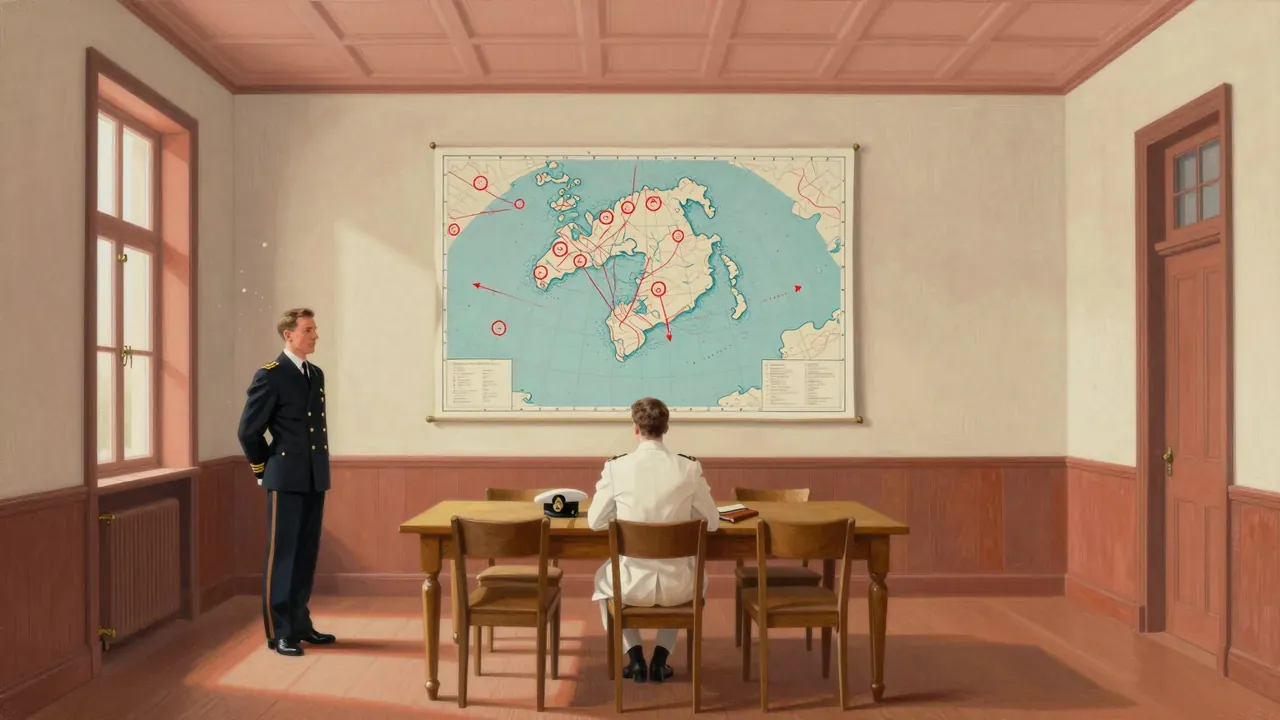
The Atomic Submarine is a low-budget, black-and-white American science fiction film released in January 1959, produced independently by Alex Gordon and directed by serial veteran Spencer Gordon Bennet. It attempts to fuse Cold War naval techno-optimism with extraterrestrial threat, using the newly operational nuclear submarine as both setting and symbol. The film positions itself within the mid-century USO (Unidentified Submerged Object) subgenre — a maritime counterpart to the flying saucer cycle — and leans into contemporary fascination with atomic propulsion, deep-sea exploration, and scientific authority. Its ambitions are modest but coherent: to stage a contained, plausible-seeming confrontation between human ingenuity and non-human intelligence beneath the Arctic ice, relying on narrative economy rather than spectacle. At 69 minutes and $135,000, it makes no claim to prestige or realism; instead, it works within strict constraints of time, budget, and studio capacity to deliver a functional, idea-driven genre piece. It does not seek to reinvent the form, but to test how much thematic weight a B-movie frame can hold. (158 words)
How it moves
The story moves briskly from Pentagon briefing to polar confrontation, compressing exposition into tight dialogue and military protocol. Performances are functional rather than expressive: Arthur Franz grounds the film as Holloway with quiet intensity, Dick Foran lends gravitas as Commander Wendover, and Brett Halsey’s Dr. Neilson carries the pacifist argument without caricature. Orville H. Hampton’s script avoids outright camp, though its logic hinges on convenient leaps — the alien’s telepathy, its biological tech, its stated colonial intent — all delivered without irony or elaboration. Gilbert Warrenton’s cinematography uses tight framing and high-contrast lighting to imply claustrophobia aboard the Tigershark; stock footage of submarines and underwater shots is integrated without seamlessness but with serviceable rhythm. Alexander László’s score underlines tension without flourish. Editing by William Austin maintains pace, cutting away from lingering takes to preserve momentum. There is no attempt at psychological depth or visual poetry — only clarity, continuity, and forward motion. The craft serves the premise, not the other way around. (159 words)
What holds
What lands is the film’s earnest engagement with its central dilemma: whether pacifism holds when faced with an existential, non-negotiable threat. The debate between Holloway and Neilson is neither reduced to shouting nor resolved with ease; it lingers in the silence after Holloway says ‘Fortunes of war’, a line that carries moral weight precisely because it is understated. The design of the USO — a single light, a living hull, a gelatinous defence — feels conceptually cohesive, more memorable than many contemporaneous monster suits. The use of real naval terminology, the emphasis on torpedo guidance systems and minisub deployment, gives procedural texture that anchors the absurdity. Even the low-budget constraints work in its favour: the lack of elaborate sets forces focus onto character dynamics and ideological friction. The Arctic setting remains stark and effective throughout, aided by judicious stock footage and sound design that evokes pressure, cold, and isolation. These elements cohere into something leaner and more deliberate than its reputation suggests. (157 words)
Where it slips
What does not land is the film’s attempt at emotional intimacy outside the central conflict. Supporting characters — Julie, Helen Milburn, Admiral Terhune — exist only as functional signposts: romantic interest, domestic concern, institutional authority. Their lines serve exposition or tone, never development. Joi Lansing and Jean Moorhead appear briefly, their roles unmoored from narrative consequence. The alien’s monologue about biological evolution and planetary colonisation arrives without sufficient setup, making its motives feel tacked-on rather than inevitable. Some performances stiffen under the weight of exposition-heavy dialogue, particularly in the Pentagon scenes, where pacing falters. The resolution — retrofitting a torpedo into a water-to-air missile — relies on a sudden, unexplained leap in engineering capability that contradicts the film’s earlier emphasis on technical limitation. The voice of the alien, though distinctive, lacks tonal variation, reducing its presence to a plot device rather than a character. These weaknesses do not derail the film, but they prevent it from achieving the thematic resonance its premise promises. (159 words)
What it thinks
The themes that matter are technological sovereignty, the ethics of first contact, and the limits of pacifism in the face of absolute difference. The film treats the nuclear submarine not as a weapon but as a vessel of civilisational continuity — a mobile laboratory, command centre, and last line of defence. Its crew includes scientists and sailors not as foils but as interdependent specialists, suggesting a post-military model of crisis response. The alien’s biology-as-technology reframes progress itself: what humans build externally, the creature grows internally — a critique of mechanistic thinking embedded in the design. The Arctic setting functions as more than backdrop; it is a zone beyond national jurisdiction, where sovereignty dissolves and survival depends on cooperation across discipline and ideology. The film’s Cold War context is present but muted — no Soviet antagonists, no ideological binaries — replaced by a shared human vulnerability. This allows the pacifism debate to avoid polemic and settle instead on epistemological humility: how do we recognise intelligence that operates outside our frameworks of language, motive, or morality? (159 words)
Who it’s for
This film is for viewers who value conceptual rigour over execution, who find pleasure in tightly wound genre mechanics and mid-century scientific optimism. It rewards attention to structure, dialogue economy, and the quiet accumulation of thematic detail. It is not for those who require polished performances, immersive worldbuilding, or emotional catharsis — the film offers none of these. Fans of Irwin Allen’s Voyage to the Bottom of the Sea may appreciate its proto-version of the same template, while students of Cold War sci-fi will note its departure from red-scare allegory toward biological and philosophical speculation. Anyone expecting camp or kitsch may be disappointed: the tone is sober, even sombre. Those who dislike exposition-dense dialogue or static interior scenes will find little to hold them. A viewer who values thematic coherence above production value, and who accepts the B-movie as a site of serious inquiry, will find more here than its reputation allows. (159 words)
Is it worth your evening
Yes, it is worth your evening — provided you watch it on its own terms, not as a curiosity or a joke. Its 69 minutes pass without drag, its ideas remain legible and quietly urgent, and its restraint makes its moments of moral ambiguity land with unusual force. It is not for viewers seeking spectacle, sentiment, or stylistic innovation — those will leave unsatisfied. But anyone open to a compact, idea-led thriller that treats its audience as intelligent, not nostalgic, will find it unexpectedly resonant. A different verdict would follow if the film were longer, slower, or more visually ambitious — but its brevity and clarity are assets, not deficits. To dismiss it as merely ‘creaky’ or ‘wooden’ is to mistake economy for emptiness. Its value lies in what it chooses not to show, and what it trusts the viewer to infer. (159 words)