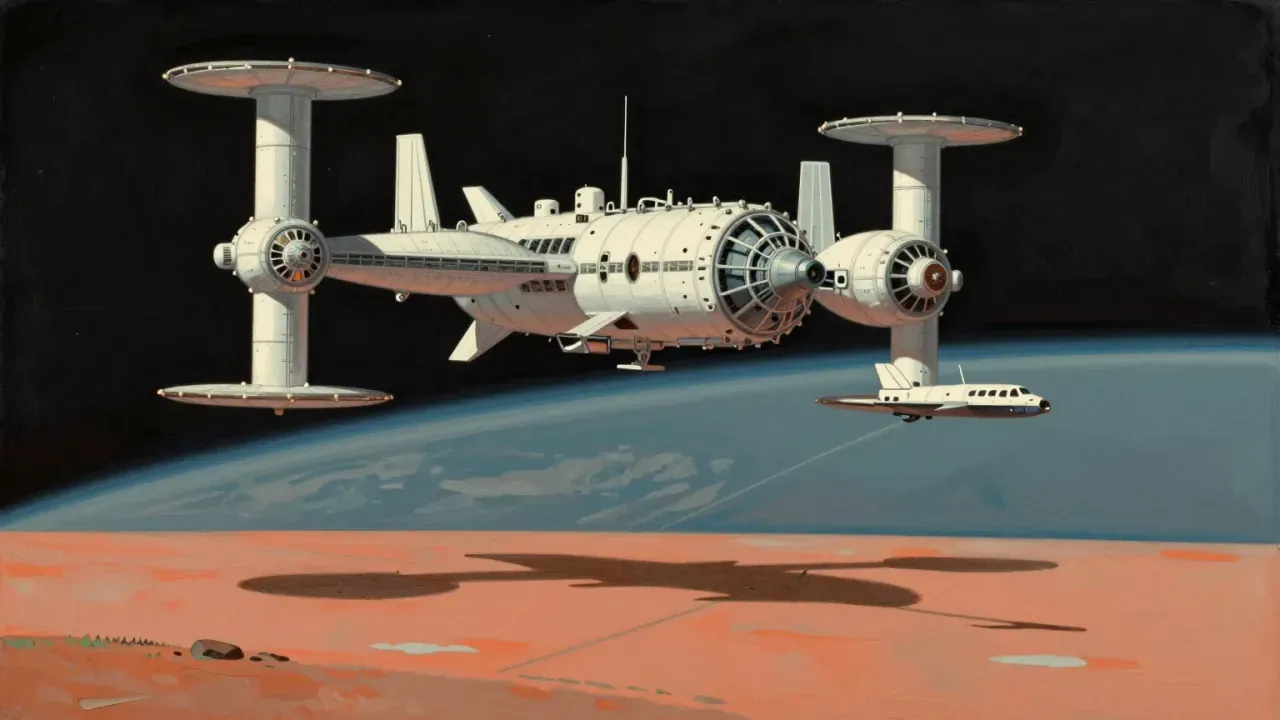
A bone thrown into space, four million years
2001: A Space Odyssey opens with a tribe of hominids on a parched African plain who touch a smooth black monolith and shortly afterward discover that a bone can be swung as a weapon, a leap Kubrick cuts straight from a thrown bone to an orbiting satellite four million years later. From there the film follows a lunar expedition that uncovers a second monolith buried on the Moon, then a mission to Jupiter aboard a ship run largely by the calm, all-seeing computer HAL 9000. Written with science fiction author Arthur C. Clarke, the film is less concerned with plot than with charting human tool-use, curiosity and technology as a single unbroken line, and it refuses to explain what is guiding that line or where it leads.
Barely any dialogue for over two hours
Long stretches of the film pass without a word of dialogue, including the entire opening section and much of the closing sequence, and even the shipboard scenes are sparse and functional, more concerned with process than character. Geoffrey Unsworth’s cinematography favours wide, symmetrical compositions and the effects team, led by Kubrick himself alongside Douglas Trumbull, built its space imagery in-camera using front-projection techniques that took over a year to perfect. Rather than commission an original score, Kubrick used existing recordings by Richard Strauss, Aram Khachaturian and György Ligeti, pairing the stately opening of Strauss’s Also sprach Zarathustra with the film’s most triumphant images and Ligeti’s dissonant choral pieces with its most disorienting ones.
HAL is the only character with a stated feeling
HAL 9000, voiced by Douglas Rain in an unhurried, conversational register, ends up the film’s most vivid character by a wide margin, expressing pride, doubt and self-preservation more clearly than either human astronaut manages across the whole mission. The docking sequences, scored to Johann Strauss’s waltz, turn routine spacecraft manoeuvres into something genuinely graceful rather than merely technical, and the effects still hold up as physical, tangible objects rather than obviously composited images. The centrifuge set, a full rotating ring built for the ship’s interior, lets Kubrick stage entire scenes of astronauts jogging or eating with no visible trickery, which grounds the film’s more abstract stretches in something concretely built.
Where the pacing tests patience
The deliberate pacing, which gives full real-time attention to airlock procedures, meal preparation and shuttle docking, is a choice some viewers will simply experience as slowness rather than as the meditative rhythm it is going for, particularly across a 143-minute runtime with almost no exposition to orient a first-time viewer. The human characters are written flat on purpose, but that leaves long sections carried by process rather than people, and a viewer expecting even minimal emotional access to the astronauts will not get it until HAL’s death scene arrives near the end. The closing psychedelic sequence, built from Trumbull’s slit-scan photography, abandons narrative logic almost entirely, and the film offers no framework afterward to help a viewer parse what has happened.
What it is actually asking
The film’s real interest is evolution treated as a technological rather than a biological process, with each monolith appearance marking a jump in capability rather than character growth, and no clear indication of who or what is orchestrating the jumps. Mortality runs through the HAL sequence in particular, where a machine’s fight to survive its own shutdown becomes more affecting than any human death would have been, given how little the film has invested in its human cast. There is a persistent thread of existentialist unease under the whole structure: humanity’s tool use, from bone to spacecraft to whatever the ending gestures toward, is presented as a continuation of instinct rather than a triumph of reason.
A poor fit for casual viewing
This suits viewers willing to treat ambiguity as the point rather than a flaw, and anyone drawn to physical, pre-digital effects work and slow, exact visual composition. It is a poor fit for anyone wanting a story that explains itself as it goes, since the film withholds context by design and its final act drops narrative logic almost entirely. Viewers who find HAL the most compelling reason to watch should be warned that his role occupies roughly the middle third rather than the whole film. Distracted or casual viewing works against it more than most films, since so much of its effect depends on sustained, unbroken attention.
Best seen once, on the largest screen available
At 143 minutes with almost no dialogue to lean on, the film is not an easy watch, but the version of it seen once, attentively, on as large a screen as possible, delivers an experience that a second, more divided viewing rarely matches. Its returns, more than eighteen times its budget, and Kubrick’s only competitive Oscar, for visual effects that still read as convincing decades on, reflect a film that found its audience despite asking a great deal of it. Worth an evening for anyone prepared to meet it on its own slow terms, and a frustrating one for anyone hoping it will meet them halfway.