The claim of truth
Fargo is a crime film that presents itself as a re-enactment of real events, but functions instead as a tightly wound fable about moral collapse in a landscape of quiet surfaces. It does not aim for procedural realism or documentary fidelity; the opening text claiming it is ‘a true story’ is a structural feint, a narrative licence that loosens the audience’s expectations so the Coens can heighten tone, flatten causality and amplify character through stylisation rather than psychology. The film’s ambition lies in sustaining a precise tonal equilibrium — between deadpan comedy and chilling violence, between Midwestern restraint and sudden brutality — without letting either side tip the scale. It treats crime not as a puzzle to be solved or a system to be exposed, but as a series of misjudged transactions, each escalating in absurdity because no one involved possesses enough self-awareness to stop. Its setting is not Minnesota as a place, but Minnesota as a rhetorical device: a culture of politeness so ingrained that even deception must be delivered with a smile and a nod.
The tone of it
The story follows Jerry Lundegaard’s botched scheme to have his wife kidnapped for ransom, then unravels through a chain of poor decisions, miscommunications and escalating incompetence among three men who mistake lethargy for competence. Frances McDormand’s Marge Gunderson anchors the film with unflustered authority and granular attention to detail — her performance avoids caricature by grounding every line in lived rhythm and physical ease. William H. Macy gives Jerry a tremulous, near-physical vulnerability, making his cowardice feel less like choice than reflex. Steve Buscemi and Peter Stormare play Carl and Gaear as variations on vacancy: one talkative and restless, the other mute and methodical. Roger Deakins’ cinematography uses flat, overcast light and static compositions to reinforce the film’s anti-dramatic stance; interiors are functional, exteriors vast and indifferent. Carter Burwell’s score — built from a Norwegian folk melody — underlines the irony of cultural displacement without underscoring emotion. The Coens’ editing maintains a deliberate, almost bureaucratic pace, refusing to rush even when blood is spilled.
The texture of it
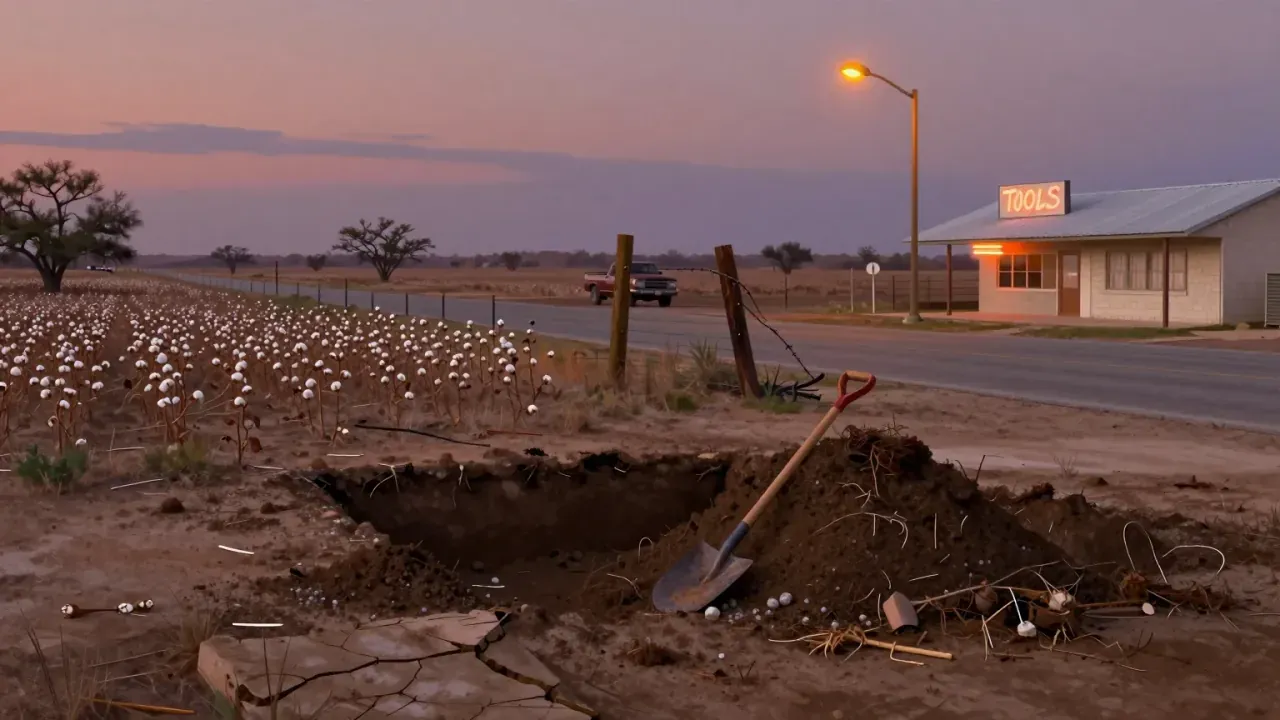
What lands most decisively is the film’s tonal control: the way a line like ‘And it’s a beautiful day’ can follow a murder without irony, yet land as both sincere and devastating. The regional speech patterns — coached, not improvised — function as texture rather than punchline, giving weight to pauses, head-nods and the softening of consonants. Marge’s calm interrogation of suspects, her matter-of-fact handling of evidence, her lunchtime conversation with her husband about pancakes — all land because they are rendered without commentary or elevation. The wood chipper sequence works not for its shock value but for its logistical banality: the focus stays on snow, sound, and the practical difficulty of disposal, not on gore or catharsis. Even the film’s most stylised moments — the giant Paul Bunyan statue, the blue-lit truckstop, the frozen roadside — feel earned because they are anchored in a consistent visual grammar: low contrast, wide shots, minimal movement. Nothing feels inserted for effect; everything feels observed, however selectively.
The limits of it
What does not land is the film’s insistence on its own mythic framing — the ‘true story’ conceit, repeated in interviews and parodied endlessly since, now reads less like subversion and more like a tic the Coens could not drop. The claim wears thin once the plot’s contrivances become visible: Jerry’s plan relies on such profound ignorance of human behaviour that it ceases to function as satire and starts to feel arbitrary. The father-in-law’s passive response to the kidnapping lacks psychological plausibility, and the police investigation proceeds with improbable speed and precision given the resources shown. Some supporting performances — particularly Harve Presnell’s Wade Gustafson — remain underwritten, their motivations reduced to exposition or symbolic function. The film’s resistance to interiority becomes a limitation when characters like Gaear require more than silence to register as anything beyond a narrative hazard. And while the accent work is precise, its exaggeration occasionally tips into caricature, especially in secondary roles where vocal tics replace personality.
The question behind it
The themes that matter are not those of crime or punishment, but of competence, complicity and the illusion of control. Jerry believes he is orchestrating events, but he is merely reacting — to debt, to paternal disapproval, to his own inadequacy — and every action he takes widens the gap between intention and outcome. Marge represents a different kind of agency: one rooted in observation, patience and accumulated knowledge, not grand design. The film treats language as both shield and failure point — people speak politely to avoid conflict, then misunderstand each other completely. The cold, flat landscape mirrors this: no dramatic weather, no moral topography, just endless horizontal space where consequences arrive slowly but inevitably. There is also a quiet critique of masculinity as performance: Jerry’s bluster collapses at the first sign of pressure; Carl talks constantly to mask his emptiness; Gaear enacts violence without motive or reflection. What endures is not the crime, but the refusal to look away from how ordinary people fail — and how ordinary people, like Marge, keep working anyway.
The audience for it
This film rewards viewers who tolerate slow pacing, appreciate linguistic precision and find moral clarity in understatement rather than pronouncement. It suits those familiar with American regional speech or willing to listen closely to how syntax and pause shape meaning. It will frustrate viewers who require clear motivation, emotional escalation or narrative payoff proportional to the stakes. Those expecting a conventional thriller or a faithful true-crime adaptation will find its rhythms alienating. People who dislike deadpan delivery, resist irony without a safety net, or expect protagonists to evolve psychologically may leave unsatisfied. A viewer who values craft over catharsis, who finds tension in stillness and horror in banality, will respond strongly. Someone who needs cause-and-effect logic or empathetic alignment with central characters will likely reject its methods — and that rejection would be reasonable, not mistaken.
The time in it
Yes, it is worth your evening — not as escapism, but as calibration. Its 98 minutes ask you to recalibrate what constitutes tension, what counts as character development, and how much moral weight can reside in a shrug or a sip of coffee. It repays close attention, not because it hides clues, but because its power lives in accumulation: in the third time Marge says ‘Oh, ya’, in the way snow gathers on a car roof between cuts, in the silence after a gunshot fades. It is not a film to watch while distracted, nor one that yields much on first viewing without active listening. But its construction is so exact, its performances so grounded, its worldview so unsentimental yet humane, that it lingers long after the credits. You do not need to love crime films to value it — you only need to trust that precision, restraint and quiet authority can be more forceful than volume or velocity.