A Mickey Mouse short that got too expensive
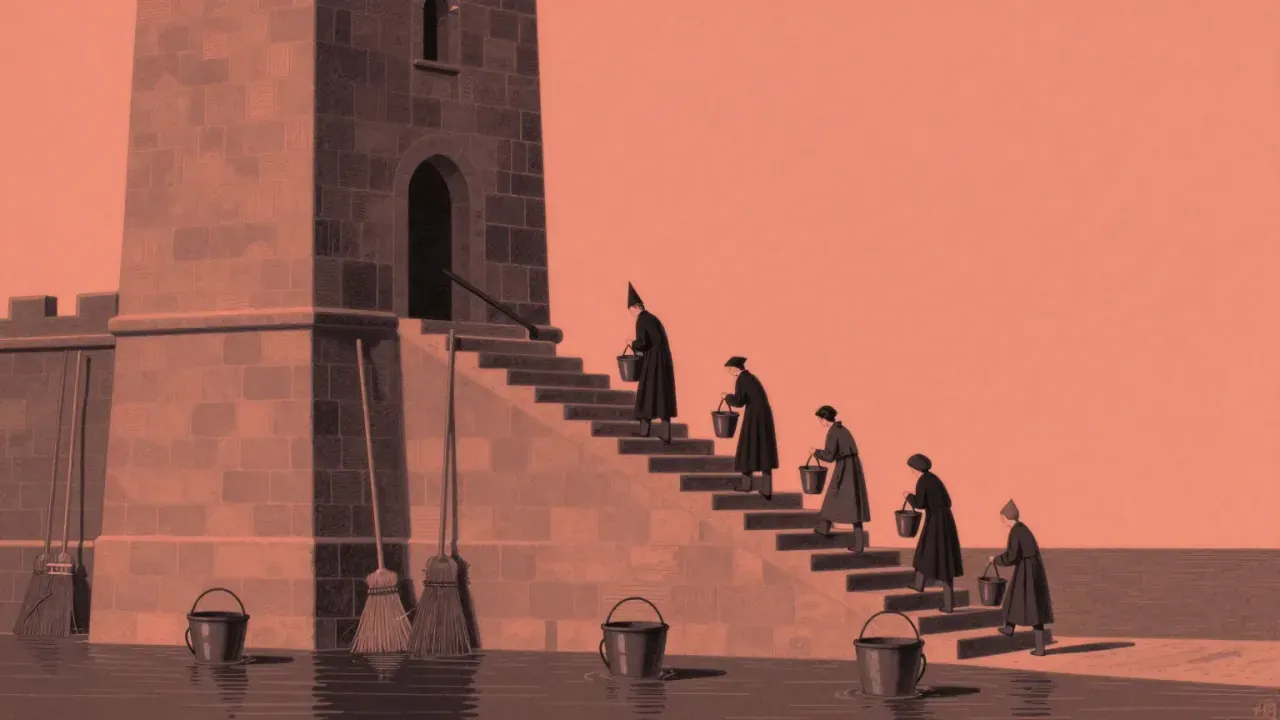
Fantasia is eight animated sequences, each set to a different classical composition and introduced on screen by critic Deems Taylor, conducted throughout by Leopold Stokowski. The project began narrowly: Walt Disney wanted to revive Mickey Mouse’s flagging popularity with The Sorcerer’s Apprentice, a lavish short built around Paul Dukas’s orchestral piece, and met Stokowski by chance at a Hollywood restaurant, where the conductor offered to record the music for free. Once the short’s costs passed $125,000 — four times an average Silly Symphony — Disney’s brother Roy, who ran the studio’s finances, recognised it could never recoup that on its own, and the short was folded into a full-length anthology built around the same idea.
Building a sound system for one film
To support the film’s roadshow release across thirteen cities, Disney and RCA engineers developed Fantasound, a multi-channel recording and playback system that made Fantasia the first commercially exhibited film shown in stereo, years before surround sound became standard. Building and installing the equipment in each roadshow theatre was expensive on top of an already costly production, and that expense, combined with the loss of European distribution once the war began, meant the film failed to turn a profit on its original run despite widespread critical praise. Stephen Csillag’s editing threads the segments together with Taylor’s live-action introductions doing the connective work a conventional plot would otherwise provide.
Eight segments, one uneven anthology
The segments vary sharply in ambition and success. The Bach-scored Toccata and Fugue opens the film with pure abstraction — shapes, light and colour with no representational content at all — a genuinely bold choice for a 1940 studio feature to lead with. The Rite of Spring segment, reimagined as a prehistoric-earth sequence culminating in dinosaurs, is more conventionally illustrative and less interesting for it, essentially a nature documentary staged to Stravinsky rather than a visual response to the music. The Sorcerer’s Apprentice remains the clear centrepiece, tighter and funnier than anything surrounding it, which is presumably why it was the piece the whole project grew out of.
Stokowski and Taylor as on-screen authority
Stokowski conducts on screen in silhouette at several points, and Taylor’s between-segment commentary frames the film explicitly as a concert experience rather than a cartoon program — an approach meant to lend the material prestige but one that occasionally slows the film’s momentum more than it earns. The tone these framing choices set is more formal and reverent than the animation itself always needs; the abstract Bach sequence, in particular, would likely land just as well without a critic first explaining what kind of thing the audience is about to see.
Animation arguing it belongs next to classical music
The film’s underlying argument is that animation deserves to be taken as seriously as any other visual art paired with concert music, and that abstraction — shapes and colour moving without a story — is a legitimate use of the medium rather than a novelty. That’s a more radical claim for a mainstream studio to make in 1940 than it might read as now, and it’s the throughline connecting the wildly different segments: whether the visuals are abstract, mythological or slapstick, each is being offered as a serious response to a piece of music rather than an illustration of one.
Who this is for
This rewards viewers with some patience for uneven pacing and a genuine interest in classical music, since several segments ask for a kind of attention closer to a concert than a cartoon. Anyone curious about early experiments in abstract or non-narrative animation, or about how far a major studio was willing to push formal risk, will find the strongest segments worth the detour. It’s a poor match for viewers who want one sustained story or a consistently fast pace — the segments vary enough in energy and quality that the anthology format itself becomes a real factor in how the film plays.
Is it worth the evening
Fantasia made the National Board of Review’s list of the year’s top ten films, holds a 95% score on Rotten Tomatoes and 96 on Metacritic, and was later selected for the National Film Registry — reputations built substantially after the fact, since the film needed years of rereleases to become profitable at all. Watched today, the abstract and comic segments have aged better than the more literal ones, and the film is most rewarding taken as a set of experiments rather than a unified whole. Worth the evening for the segments that work, with the understanding that not every one of the eight will land equally.