The world it lives in
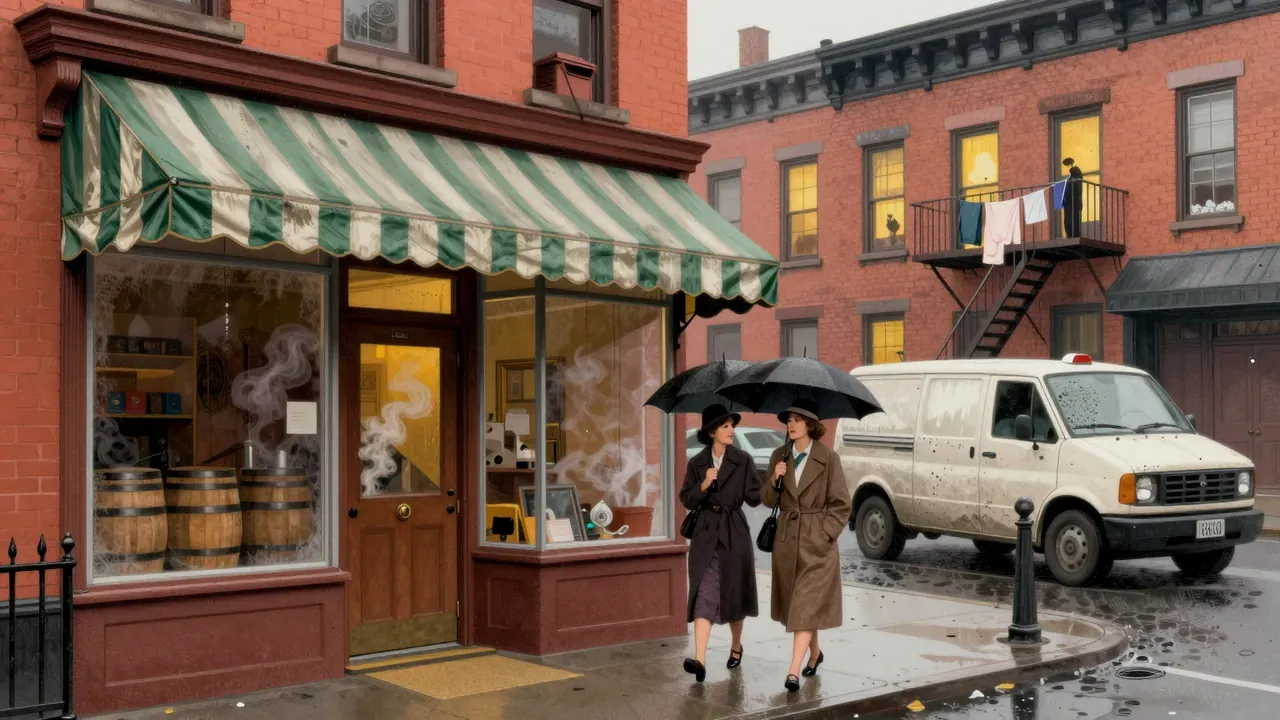
Crossing Delancey is a 1988 American romantic comedy adapted by Susan Sandler from her own stage play, directed by Joan Micklin Silver. It sets out to trace the quiet recalibration of a woman’s expectations — not through grand gestures or external crisis, but through the friction between inherited tradition and self-chosen aspiration. Its ambition is modest in scale but precise in aim: to treat Orthodox Jewish life on Manhattan’s Lower East Side as lived reality, not backdrop; to let matchmaking function not as caricature but as social infrastructure; and to locate romance in mutual recognition rather than infatuation. It does not seek to universalise its setting, nor does it exoticise it — instead, it anchors emotional shifts in specific places: a pickle shop, a bookstore, a grandmother’s kitchen, the balcony off that kitchen. The film assumes familiarity with neither Yiddish nor literary New York, but it refuses to over-explain either. Its tone is conversational, its pacing unhurried, its stakes personal rather than symbolic. It is not about assimilation or rebellion, but about what happens when someone begins to listen — to others, to memory, to the weight of a glance held too long across a crowded room. (158 words)
The pace of feeling
The story follows Isabelle Grossman — played by Amy Irving with a watchful stillness that avoids both coyness and irony — as she moves between two worlds: the bookish, secular intelligentsia of her workplace and the Yiddish-speaking, observant world of her Bubbe Ida, portrayed by Reizl Bozyk in her only film role. Peter Riegert’s Sam Posner is grounded in physical detail — his hands stained with brine, his posture relaxed but never careless. Theo van de Sande’s cinematography keeps interiors warm and slightly soft-edged, favouring natural light through tenement windows and avoiding stylised contrast. Paul Chihara’s score blends Prokofiev fragments with original themes and Roches songs, using melody as punctuation rather than commentary. Dialogue is written for rhythm and hesitation, not punchlines: characters interrupt, backtrack, pause mid-sentence. The matchmaker scenes avoid farce; Sam’s quiet admission — that he recognised Isabelle long before the broker showed him her photo — lands because it is delivered without flourish, just as Bozyk’s Ida feigns senility not for comic effect but as tactical patience. There are no montages, no voiceover, no narrative shortcuts. (159 words)
The weight of presence
What lands is the film’s fidelity to small emotional truths: the discomfort of being seen before you feel ready to be known; the way guilt can sharpen attention; the relief of being met at your own pace. Isabelle’s shift from disdain to curiosity to tenderness toward Sam feels earned because it is shown in increments — a longer look, a corrected assumption, a shared silence while peeling onions. Bozyk’s performance carries decades of unspoken history in her gestures: how she folds a napkin, how she watches Isabelle from behind teacup steam, how she lets her false dementia slip just enough for the audience to notice. The Roches’ soundtrack works not as decoration but as counterpoint — their harmonies underscoring the communal texture of Isabelle’s world, their lyrics hinting at longing without spelling it out. Even minor roles land: Sylvia Miles’ sharp-tongued neighbour, Rosemary Harris’ measured bookstore owner, David Hyde Pierce’s dryly earnest friend — each occupies space without demanding it. The film trusts its actors to hold ambiguity: no one is wholly right or wrong, no choice is framed as final. That restraint makes the ending feel less like resolution and more like alignment — a subtle settling into place. (157 words)
The shape of absence
What does not land is the film’s handling of Anton Maes. Jeroen Krabbé plays him with polished detachment, but the character remains underwritten — a cipher of literary pretension rather than a plausible object of desire. His sudden pivot from charming author to entitled employer feels narratively expedient, not psychologically coherent. The film gives him no interiority, no motive beyond narcissism, and so his rejection lacks emotional weight. Similarly, Nick — Isabelle’s married lover — appears only twice, both times as plot device: first to establish her loneliness, then to punctuate her disillusionment. Neither man is allowed complexity, which flattens Isabelle’s arc: her turn away from them reads less as growth than as course correction. The subplot with Marilyn and Sam also falters — their brief courtship is sketched, not built, and its dissolution serves exposition rather than character. A few scenes linger too long on transitional moments — a walk down Delancey Street, a slow pour of tea — not for atmosphere but for pacing, and the rhythm sags. These are not failures of craft, but of selection: the film chooses to withhold from some characters the same attention it bestows on others. (156 words)
The grammar of belonging
The themes that matter are continuity and quiet agency. Not tradition versus modernity, but how tradition holds space for change — how Ida’s matchmaking is not control but curation, how Sam’s pickle business is not provincial but rooted, how Isabelle’s literary life is not superior but simply different in register. The film treats Jewishness as embodied practice — Yiddish as spoken language, food as ritual, neighbourhood as kinship — not as doctrine or identity label. Loneliness is presented not as absence but as misalignment: Isabelle is surrounded, yet unmoored. Her journey is not toward ‘finding herself’ but toward noticing what has always been there — Sam’s steady presence, Ida’s quiet strategy, the dignity of work done well. Class operates without fanfare: Isabelle’s bookstore job pays less than Sam’s shop, but neither is framed as aspirational or diminished. The film’s moral centre is humility — not self-abasement, but the willingness to revise one’s assumptions. That humility extends to form: no scene declares its significance; meaning accrues through repetition, gesture, return. It is a film about how love becomes possible when we stop performing for an imagined audience and start attending to the person already in the room. (159 words)
The terms of attention
This film is for viewers who value character over plot, texture over tempo, and emotional precision over dramatic escalation. It suits those familiar with New York’s layered urban geography or with intergenerational Jewish life, though neither is required — what matters is patience with understatement. It is not for viewers who need clear antagonists, escalating stakes, or narrative velocity. Those who expect romantic comedy to deliver catharsis through confrontation may find its resolutions too muted, its conflicts too internal. Some will object to its narrow focus — no political context, no economic pressure beyond budget lines, no reckoning with wider cultural shifts of the late eighties. Others may feel its gentleness borders on avoidance. But that gentleness is deliberate: the film’s refusal to dramatise hardship is not evasion but focus. Change here arrives not through rupture but through attention — and that demands a viewer willing to sit still, watch closely, and trust that a glance across a kitchen table can carry more weight than a kiss in the rain. (158 words)
The measure of an evening
Yes, it is worth your evening — not as escapism, but as calibration. Its ninety-seven minutes offer a rare kind of emotional economy: no moment overstays, no feeling is inflated, no relationship is reduced to function. You leave not exhilarated but gently reset, as if you’ve spent time in a room where people speak plainly and listen deeply. It rewards rewatching, not for hidden clues but for new inflections — how Bozyk’s eyes shift when she pretends to drift off, how Riegert’s shoulders drop the first time Isabelle laughs with him, not at him. Those who dismiss it as slight mistake quietness for emptiness. Those who praise it as ‘quaint’ miss its rigour: every line of dialogue, every composition, every edit serves the central question — what does it mean to be truly seen? If your evening is measured in resonance rather than reaction, this film delivers. It asks little of your attention and returns much — not answers, but permission to move slower, look closer, choose softer. (157 words)