The weight of the experiment
Corridors of Blood is a British horror film made in 1958, set in the 1840s, that uses medical history as its scaffold: it dramatises the early, perilous experiments with surgical anaesthesia, particularly through opium and ether-like gases. It is not a period piece for its own sake, nor a procedural about discovery; it treats science as a moral precipice. The film attempts to fuse gothic atmosphere with ethical tragedy — to show how noble intent curdles under addiction, institutional rejection, and criminal entanglement. Its ambition lies in making Dr. Thomas Bolton’s downfall legible not as melodrama but as consequence: each misstep follows from the last with grim causality. It does not seek to explain anaesthesia to lay audiences, nor does it flinch from showing surgery without it — the opening operation is brief but unvarnished. The film’s frame is narrow, its stakes personal and professional rather than societal, yet it insists on the weight of one man’s failure to reconcile compassion with control. It is a studio-bound, low-budget horror film that behaves like a chamber tragedy dressed in fog and shadow. (142 words)
The look of it
The story moves in tight, repetitive loops: demonstration, disaster, disgrace, dependency, descent. Karloff plays Bolton with physical restraint — his collapse is measured in slurred diction, trembling hands, and a slow withdrawal from light — while Christopher Lee’s Resurrection Joe is all coiled menace, less a character than a walking consequence. Geoffrey Faithfull’s cinematography keeps interiors dim and grainy, favouring high-contrast lighting that pools around faces and leaves doorways black. Buxton Orr’s score is sparse, leaning on low strings and dissonant woodwind stabs rather than theme or flourish. Peter Mayhew’s editing sustains rhythm without urgency: scenes breathe, sometimes too long, but never rush. The production design is economical — Seven Dials tavern is cramped and sticky, hospital corridors are narrow and echoing — and this limitation becomes texture. Performances are uniformly grounded: Finlay Currie’s Supt. Matheson is weary rather than arch, Nigel Green’s Inspector Donovan methodical, not flamboyant. There is no comic relief, no romantic subplot that distracts; even Betta St. John’s Susan functions as witness, not catalyst. (156 words)
What holds still
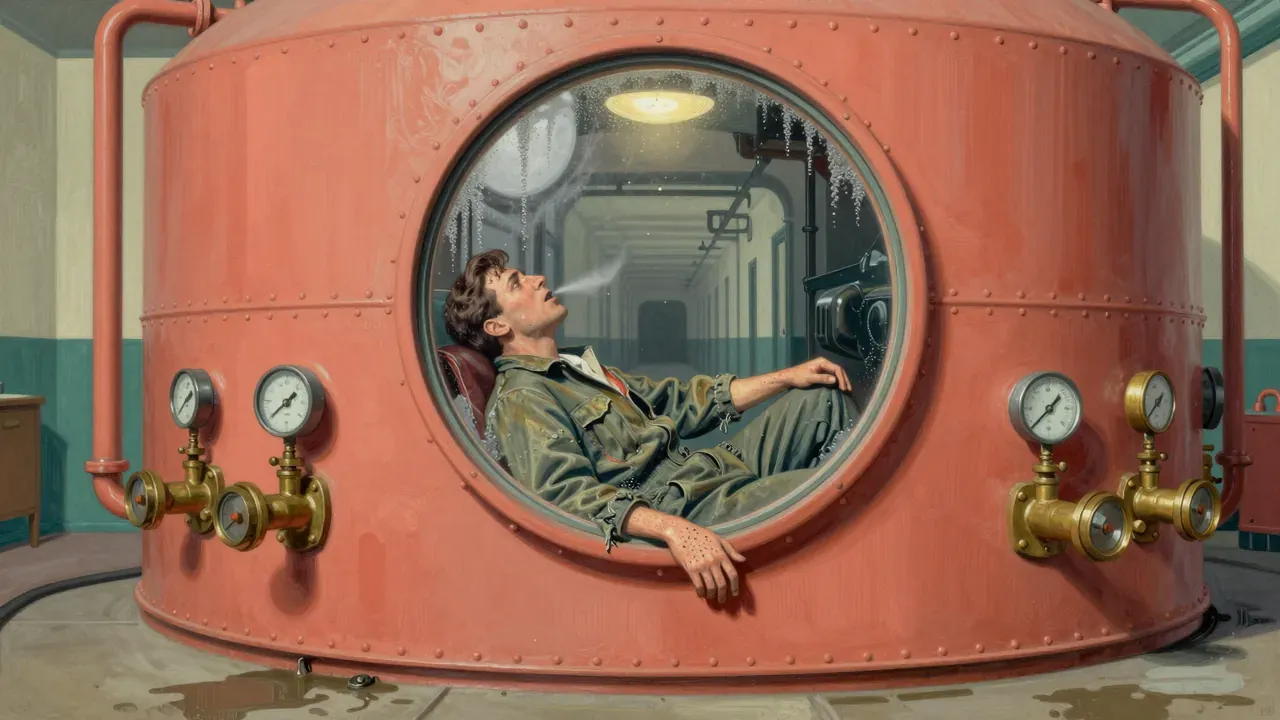
What lands is the cumulative pressure of Bolton’s unraveling. His first failed demonstration — the patient screaming mid-incision — is not sensationalised but presented as clinical catastrophe, its horror lying in the silence that follows. Later, when he inhales gas alone in his study, the camera holds on Karloff’s face as his pupils dilate and his breath slows: no music, no cutaway, just duration and physiology. The tavern sequences work because they feel lived-in, not stylised — the dwarf, the berserk patient, the drunkards are background noise, not set dressing. The acid-throwing climax is abrupt and ugly, not cathartic, and its brutality sticks because it arrives without warning or justification beyond desperation. The final shot of Jonathan Bolton presenting his father’s notes to a receptive medical board lands not as triumph but as quiet restitution — the science survives the scientist. These moments succeed because they refuse to editorialise. They do not ask the audience to pity Bolton, only to register cause and effect. The film’s restraint makes its few eruptions of violence feel earned, not exploitative. Its moral architecture is simple but rigorously maintained: every choice narrows the next option. (151 words)
Where it circles
What does not land is the structural repetition. The film returns three times to Bolton signing false death certificates, each time with near-identical framing and dialogue, and each time the dramatic weight diminishes. Black Ben, played by Francis de Wolff, is broad to the point of caricature — his corpulence and bluster lack psychological purchase, functioning only as plot device. The blackmail mechanism feels thin: a notebook left behind at a tavern is plausible, but its leverage over a man already disgraced stretches credulity. The hospital burglary sequence lacks tension — the watchman’s murder is off-screen, and Bolton’s subsequent dissociation is conveyed through a single dissolve and a sigh, which undercuts the gravity of what has occurred. The script gives Resurrection Joe no motive beyond loyalty-as-habit, leaving Lee’s performance stranded between menace and blankness. There is also a tonal uncertainty in the closing act: the police raid descends into near-farce with Ben’s rooftop fall, undermining the earlier gravity. These are not flaws of budget or craft, but of construction — the film’s discipline elsewhere makes its lapses in pacing and motivation more conspicuous. (153 words)
What it thinks about
The themes that matter are addiction as erasure, science as double-edged vocation, and institutional failure as accelerant. Bolton’s dependence on gas is never eroticised or mystified; it is shown as physiological need, then as avoidance, then as reflex. His laboratory is both sanctuary and cage — the same room where he measures vapour density later becomes the site of his self-administered oblivion. The medical establishment does not oppose him out of dogma but indifference: his suspension is bureaucratic, not ideological. The film treats progress not as linear but recursive — Jonathan completes the work not by rejecting his father’s methods but by recontextualising them within sanctioned structures. Class is present but unspoken: Seven Dials is where the unrecorded die, and Bolton’s forged certificates serve not to hide crime but to erase poverty’s visibility. There is no redemption arc, only transmission — knowledge persists, but the man who bore it does not. The film’s moral centre is not virtue but continuity: the experiment outlives the experimenter, but only if someone else is willing to hold the notebook steady. (147 words)
Who it is for
This film is for viewers who value precision over spectacle, who find tension in stillness and horror in consequence rather than gore. It suits those familiar with Karloff’s late-career work — his performance here is quieter than Frankenstein or The Mummy, more akin to his turn in The Haunted Strangler — and those attentive to British studio craft of the late 1950s. It is not for viewers seeking narrative propulsion, thematic ambiguity, or stylistic innovation. Anyone expecting Gothic grandeur or Lee in full villain mode will be disappointed: his role is subsidiary, functional. Those who require clear moral binaries or emotional resolution will find the ending unsatisfying — Jonathan’s success is factual, not felt. A viewer who values historical accuracy over dramatic licence may object to the compression of anaesthetic history, though the film makes no claim to documentary fidelity. What changes the verdict is tolerance for austerity: remove the expectation of entertainment, and the film reveals itself as a tightly wound study in professional and physiological collapse. (143 words)
Is it worth your evening
Yes, it is worth your evening — provided you approach it as a compact, deliberate artefact rather than an immersive experience. Its eighty-six minutes pass without strain, its pacing deliberate but never slack. It rewards attention to gesture and silence, not plot twists or set pieces. Someone who watches films primarily for escapism or momentum may find it inert; someone who watches for texture, tone, and the weight of performance will find it richly sustained. It is not a ‘great’ film in the canonical sense, but it is a coherent one — every element serves its central idea. Its modesty is not weakness but calibration. Those who dismiss it as dated or slow mistake economy for emptiness. A second viewing clarifies its architecture: the repetitions are not flaws but refrains, reinforcing the narrowing of Bolton’s world. It asks little of the viewer except patience — and repays that patience with consistency, clarity, and a kind of grim respect for cause and effect. (142 words)