The premise
The Haunted Strangler is a British horror film from 1958 that attempts to fuse Victorian crime procedural with psychological possession horror, using Boris Karloff’s star presence as both anchor and lure. It sets out to rework the Jack the Ripper mythos through a dual-identity framework — not as serial killer biography but as inherited guilt made flesh, literalised by a cursed object: a knife buried with an innocent man. The film leans on period authenticity — gaslit interiors, Newgate Prison, music halls — not for historical fidelity but as atmospheric scaffolding for its central conceit: that moral contamination can be physically transmitted across time via touch and proximity. Its ambition lies in structural irony: the investigator becomes the subject, the reformer the regressed, the rationalist the possessed. It does not aim for realism, nor for satire; it seeks a slow, sombre descent into irrevocable doubling, where identity unravels not through madness but through forensic revelation. At its core, it is a cautionary tale about the limits of reason when confronted with inherited violence — one that treats memory, evidence and embodiment as inseparable.
The method
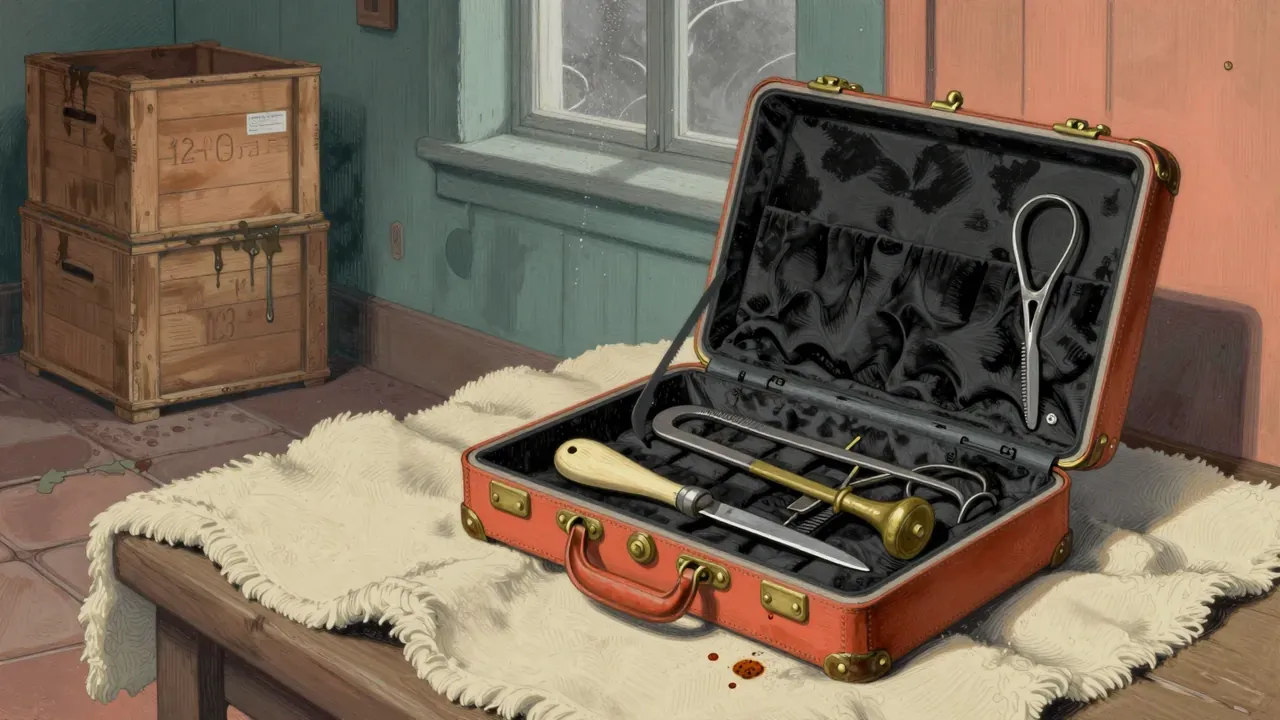
The story follows James Rankin’s methodical reinvestigation of a 1860s murder case, then fractures as he uncovers his own erased past. Jan Read’s original script was reshaped by John Croydon to foreground physical transformation — paralysis, facial distortion, behavioural rupture — rather than spectral possession. Karloff’s performance is restrained, internalised: he registers shifts in posture and vocal timbre rather than broad gestures, letting Peter Mayhew’s editing punctuate transitions with abrupt cuts or lingering close-ups on hands or eyes. Buxton Orr’s score avoids shrieking strings; it uses low brass and muted piano to sustain unease without underlining it. Robert Day directs with deliberate pacing: long takes in Tennant’s abandoned rooms, tight framing in the Judas Hole’s cramped corridors, and a consistent refusal to show the Strangler’s face until Rankin’s final recognition. The production design at Walton Studios grounds the fantasy in tangible texture — damp brick, frayed velvet, tarnished surgical steel — making the supernatural feel like a physiological inevitability rather than a narrative convenience.
The performance
What lands is the cumulative weight of the film’s restraint. Karloff’s physical control — the way he holds his left arm rigid before it fully atrophies, the subtle slackening of his jaw during early episodes of dissociation — conveys more than exposition ever could. The hospital sequence, where Rankin sifts through Tennant’s effects, works because it refuses to rush: the journal’s pages are shown but not read aloud, the missing knife’s absence registered in silence. The Judas Hole scenes gain menace from their banality — Cora’s weary professionalism, the off-key piano, the way Rankin’s first kill happens just outside frame, leaving only a dropped shawl and a single footstep echoing down stairs. The cemetery exhumation is stark and unsentimental: no music, no reaction shot, just Rankin’s gloves sinking into wet earth and the glint of cold steel. These moments land because they trust the viewer to infer consequence, not because they explain it. The film’s quietness makes its eruptions of violence feel less like shocks and more like confirmations — inevitable returns to a logic already established in gesture and setting.
The fracture
What does not land is the resolution’s reliance on exposition over implication. Once Rankin accepts he is Tennant, the film abandons its earlier ambiguity and resorts to Barbara’s monologue — delivered in a single static take — to retroactively rewrite his entire biography. This flattens the psychological tension built over fifty minutes into a tidy origin story, undermining the earlier suggestion that Rankin’s breakdown might be environmental, chemical or even political. The police are functionally inert: Burk permits access but never questions Rankin’s sudden instability; Coldbath Fields is depicted as a caricature of institutional cruelty rather than a plausible pressure point. The final chase to Newgate feels perfunctory, its geography unclear, its stakes diminished by the fact that Rankin has already confessed and been disbelieved. The film’s commitment to mood falters when plot mechanics take over — particularly in the second half, where motivation shifts from psychological compulsion to narrative obligation. It is not that the ending is implausible, but that it stops behaving like the film it was.
The weight
The themes that matter are inheritance, erasure and the instability of legal truth. The Haymarket Strangler case is not solved by new evidence but by the collapse of Rankin’s self-conception — suggesting that justice cannot be separated from identity, and that identity itself may be a construct built on suppressed history. The film treats the courtroom not as a site of fact-finding but of theatrical performance: Styles’ trial is recalled through fragmented testimony, while Rankin’s later ‘trial’ occurs entirely within his own mind, with no jury but his own conscience. The knife functions as both relic and archive — a physical record of violence that bypasses language, law and memory. The Victorian setting is not decorative: it underscores how systems of policing, medicine and psychiatry were already entangled in 1860, and how easily those systems could obscure truth behind diagnoses like ‘nervous breakdown’ or verdicts like ‘guilty’. The film’s quietest theme is exhaustion — the exhaustion of reform, of investigation, of remembering — and how that fatigue opens space for older, darker patterns to return.
The audience
This film is for viewers who value atmosphere over action, who find dread in stillness and horror in continuity of gesture rather than gore. It suits those familiar with Karloff’s late-period work — the gravitas, the economy, the willingness to play ambiguity without resolution — and those interested in British studio horror before Hammer’s colour explosion. It is not for viewers who require clear moral binaries, narrative momentum or psychological plausibility in the modern clinical sense. Those expecting a Jack the Ripper thriller will find its pace too measured; those seeking Karloff as monster will find him too contained. A viewer who values tightly constructed cause-and-effect storytelling may reject its final act as arbitrary. But someone who responds to films where setting behaves like character — where a surgeon’s kit, a music hall balcony or a coffin nail carries narrative weight — will find it richly sustained. Its limitations are structural, not aesthetic; change the ending’s exposition to visual metaphor, and its power would hold.
The duration
It is worth your evening if you accept its terms: a slow-burn descent anchored by Karloff’s precision and Robert Day’s unshowy control. At 78 minutes, it asks little time but demands attention — not to plot twists but to shifts in light, posture and silence. It rewards patience with texture: the grain of 1950s British film stock, the cadence of Ealing-era dialogue, the way a single prop (the knife, the journal, the surgeon’s kit) accrues meaning across scenes. It is not a film to watch while distracted, nor one that yields much on first viewing beyond surface unease — its architecture reveals itself on reflection. Those who dislike period horror or find Karloff’s late work too subdued may leave unmoved. But for anyone willing to sit with its gravity, it offers a compact, coherent vision of possession as historical recurrence — not supernatural intrusion, but the return of what was buried, unexamined, in plain sight.