The world it lives in
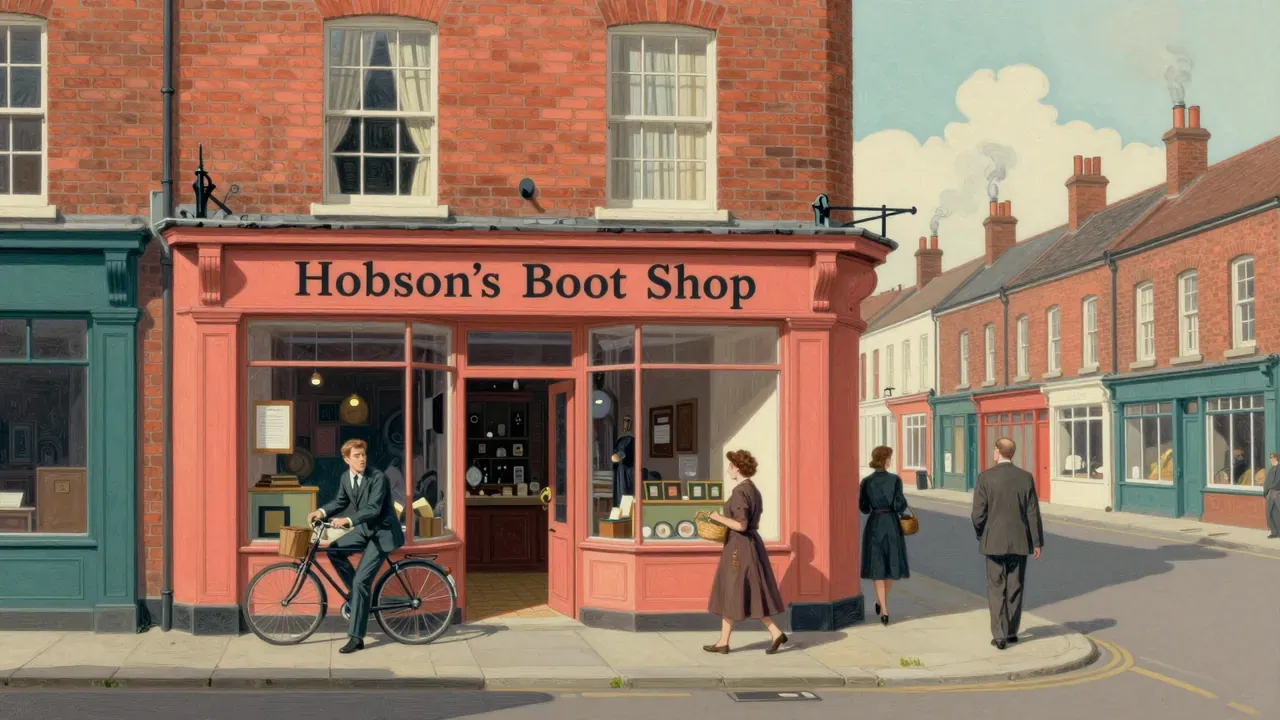
Hobson’s Choice is a British drama with strong comedic and romantic currents, adapted from Harold Brighouse’s 1915 play and set in 1880 Salford. It aims to dramatise a quiet social reversal: the subversion of Victorian patriarchal authority not through rebellion or rhetoric, but through shrewd partnership, quiet competence, and economic self-determination. Its central project is structural rather than symbolic — it shows how power shifts when labour is recognised, credit extended, and domestic work named as value. David Lean directs with restraint, avoiding caricature even in broad strokes: Hobson’s drunkenness is never grotesque, Maggie’s resolve never declamatory. The film does not argue for women’s rights in abstract terms; it demonstrates them in ledger entries, lease agreements, and the reordering of a shop sign. It treats class not as backdrop but as binding constraint — one that can be loosened only by collective action, literacy, and access to capital. The period detail serves function, not nostalgia: the damp brickwork of Peel Park, the cramped basement workshop, the precise cut of a boot heel — all anchor the stakes in material reality. (158 words)
How it moves
The story follows a tight cause-and-effect chain: Maggie’s decision sets off a sequence of contractual, financial, and familial recalibrations. Charles Laughton grounds Hobson in physical specificity — his gait, his wheeze, the way he grips a pint glass — never letting him slip into pantomime. John Mills plays Will Mossop with granular attention to transformation: his posture softens then firms; his speech gains weight without losing its northern cadence; his hands, always visible, move from hesitant tool-handling to assured craftsmanship. Brenda de Banzie’s Maggie is neither strident nor saintly — she negotiates, calculates, and waits. Jack Hildyard’s cinematography keeps interiors dim but legible, favouring medium shots that hold both speaker and listener in frame, reinforcing the film’s emphasis on dialogue as transaction. Malcolm Arnold’s score uses the musical saw sparingly but decisively, aligning sound with psychological fracture rather than comic punctuation. Peter Taylor’s editing sustains rhythm without hurry: scenes breathe, pauses land, and no moment is trimmed to fit a beat. (159 words)
What sticks
What lands is the quiet accumulation of dignity. Will Mossop’s first solo sale — not to a customer, but to Mrs. Hepworth, who chooses him over Hobson — carries more emotional weight than any declaration of love. The brass ring Maggie takes from stock is not ironic; it is factual, economical, and quietly defiant. The film’s comedy arises from mismatched expectations — Hobson assuming intimidation will work, Prosser assuming legal procedure will proceed politely, Beenstock assuming sobriety is contagious — all undermined by Maggie’s unflinching literalism. Even the Golden Bear win feels earned not for spectacle but for coherence: every performance, every set piece, every line of dialogue serves the same proposition — that agency is built, not bestowed. The Salford locations do not evoke ‘authenticity’ as a mood; they register as lived-in infrastructure — cobbles worn by cart wheels, windows fogged by breath, shopfronts lettered by hand. When Will reads aloud from a newspaper, stumbling over syllables, the scene does not ask for pity; it asks the audience to register the effort as labour, like stitching leather or balancing accounts. (157 words)
Where it stops
What does not land is the framing of Alice and Vicky as purely decorative foils. Their motivations — marriage, social mobility, escape — are clear, but their interiority remains underwritten; their resistance to caring for Hobson reads as petulance rather than exhaustion, and their absence from the final reconciliation feels less like character logic and more like narrative expediency. The subplot involving Freddy Beenstock and Nathaniel Beenstock lacks the same textual density: their teetotalism functions as shorthand, not substance. Some of the supporting cast — particularly Denton and Tubby Wadlow — exist only to echo Hobson’s worldview, offering no counterpoint or complication. The film also avoids confronting the racial and imperial context of 1880 Manchester: there is no mention of cotton imports, colonial trade, or the working-class poverty that underpins the boot trade’s modest prosperity. While this omission does not break the film, it narrows its field of vision — the ‘choice’ in the title applies strictly within a white, Protestant, artisanal sphere. A viewer attuned to structural analysis may find the resolution too tidy, the class mobility too frictionless, the moral economy too self-contained. (156 words)
What it’s really about
The themes that matter are interdependence, literacy as leverage, and the quiet violence of unpaid domestic work. Maggie’s marriage proposal is not romantic but contractual: she offers Will security, training, and status in exchange for his skill and presence. Her education of him — reading, speaking, pricing — is not patronising but pragmatic; it expands his capacity to claim what is due. Hobson’s decline is not moral failure alone but systemic collapse: his refusal to pay wages, settle marriages, or invest in staff erodes his business from within. The film treats alcoholism not as personal weakness but as occupational hazard — the result of isolation, lack of oversight, and no succession plan. Class is shown as procedural: it lives in who signs leases, who holds loans, who reads banns, who names shops. Even the brass ring speaks to theme — not as symbol of poverty, but as evidence of asset ownership, however small. The film’s most radical idea is that dignity is not inherent but negotiated, and that negotiation requires language, memory, and the ability to hold a pen. It refuses to separate economics from ethics, or craft from care. (159 words)
Who it’s for
This film is for viewers who trust slow accumulation over exposition, who find tension in a signed contract or a changed shop sign, and who value performances that withhold more than they reveal. It suits those familiar with British regional inflection and industrial history, but does not require specialist knowledge — its mechanics are clear in action. It is not for viewers who need rapid plot turns, visual spectacle, or explicit thematic statements. Those expecting satire may find it too grounded; those seeking romance may find the courtship transactional. A viewer who values irony over integrity, or who reads restraint as emptiness, will likely disengage. The film assumes patience with silences, tolerance for unspoken grief, and interest in how institutions — marriage, business, apprenticeship — are built sentence by sentence. It rewards attention to hands, to ledgers, to the weight of a belt dropped on a floor. Anyone who has ever renegotiated a relationship, revised a budget, or taught someone to read will recognise its terrain. (159 words)
Is it worth your time
Yes, it is worth your evening — not as diversion but as calibration. It occupies time deliberately, refusing to flatter attention spans or inflate stakes. Its 107 minutes pass without strain because nothing is wasted: no shot lingers without purpose, no line repeats without consequence. It works best watched whole, in one sitting, with minimal interruption — its logic is sequential, not episodic. Someone who prefers fast cuts, voiceover narration, or psychological exposition may find it withholding; a viewer accustomed to streaming algorithms may misread its pacing as inertia. But its economy is precise: every scene advances either character position, financial status, or spatial control. The verdict holds even for those unmoved by period detail — because its concerns are current: wage theft, caregiving labour, the gendered distribution of risk, and the quiet work of building something that lasts. It earns its runtime by making each minute count as labour, not filler. (159 words)