What it is trying to do
Blackhat is Michael Mann’s attempt to treat cybercrime as a physical, atmospheric, and geopolitical thriller — not as data on a screen but as heat in a server room, sweat on a brow, and surveillance across borders. It follows a convicted hacker, released from prison to track a global attack that begins at a nuclear plant and spreads through financial markets, shipping logistics, and personal devices. Mann aims for procedural authenticity, grounding the digital in real locations: Los Angeles, Hong Kong, Jakarta, Kuala Lumpur. He uses digital cinematography throughout — his first fully digital feature — to capture the grain of night streets, the glare of monitors, the weight of silence before an intrusion. The film tries to map how code moves like weather: invisible until it floods a system, then undeniable in its consequences. It treats hacking not as magic but as labour — slow, iterative, collaborative, and deeply embedded in infrastructure. The ambition is structural: to make networked threat feel tangible, urgent, and human-scaled, without reducing it to gadgetry or caricature. This is not a film about hackers as rebels or geniuses, but as technicians operating inside systems they did not build but must navigate. Word count: 158
How it works
The story moves across jurisdictions and time zones with deliberate, sometimes glacial pacing; exposition arrives in clipped dialogue or on-screen text overlays rather than exposition scenes. Viola Davis plays a federal agent whose authority is procedural, not performative — she briefs, coordinates, and endures bureaucratic friction. Tang Wei and Wang Leehom bring grounded presence as counterparts in Hong Kong and Beijing, their roles defined by institutional loyalty and quiet competence. Chris Hemsworth’s lead performance is muted, physically restrained, and emotionally withheld — consistent with Mann’s preference for interiority over declaration. Stuart Dryburgh’s cinematography favours long takes, shallow focus, and low-contrast interiors, keeping faces half-submerged in shadow or reflection. Sound design leans into ambient hum: air conditioning, keyboard clatter, distant sirens — not score. Harry Gregson-Williams’s original music was largely replaced in the theatrical cut, leaving synthetic textures and reused cues from Elysium. Editing privileges duration over rhythm: a server-room breach unfolds over two minutes of near-silence. Word count: 159
What lands
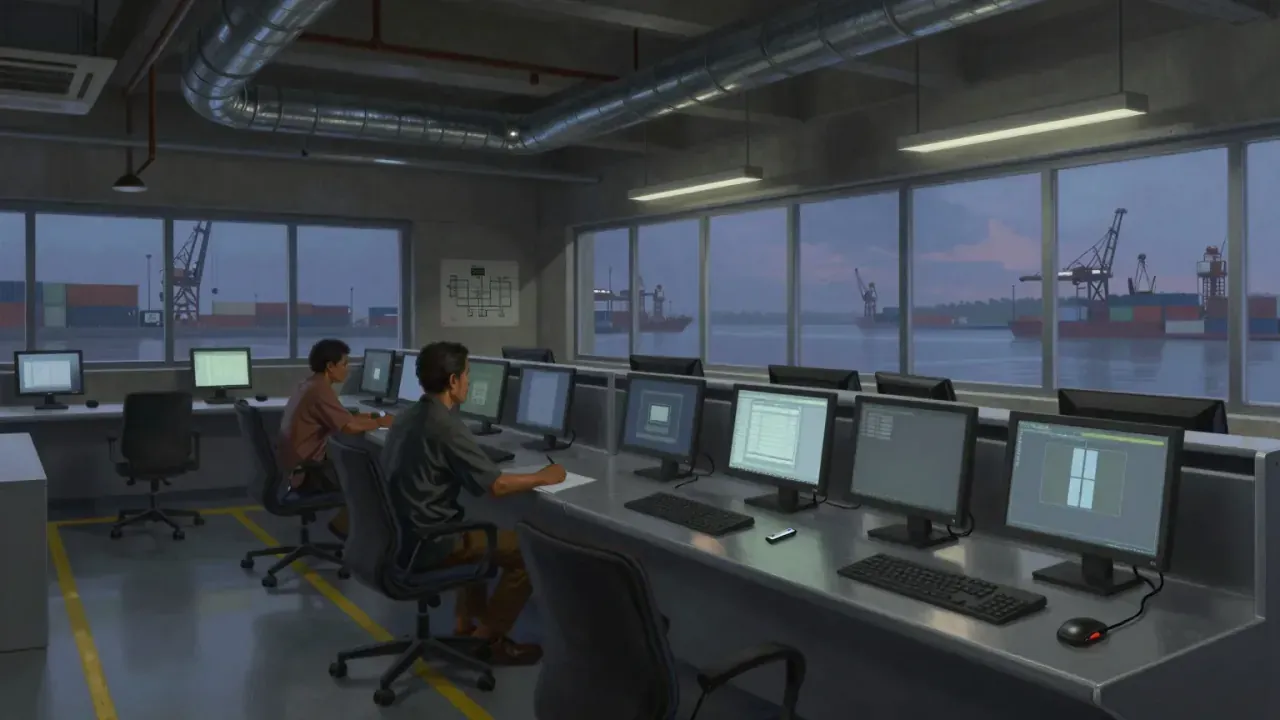
What lands is the film’s sense of place as character: the humid claustrophobia of a Hong Kong apartment block, the sterile geometry of a Jakarta control room, the vertiginous scale of a Rotterdam port at dawn. Mann’s attention to operational detail — how a USB drive is inserted, how a thermal camera scans a wall, how a cargo manifest is cross-referenced — gives the digital world tactile weight. The action sequences avoid choreographed violence; instead, tension builds through proximity, timing, and consequence — a chase through Koreatown ends not in gunfire but in a van stalling at a red light. The film’s strongest moments are those where technology recedes and human consequence advances: a technician’s hesitation before executing a command, a diplomat’s pause before confirming a decision, a glance between colleagues who know what failure would cost. These are not heroic beats but professional ones — calibrated, weary, precise. The film earns its atmosphere not through spectacle but through sustained attention to the conditions under which decisions get made. Word count: 157
What does not
What does not land is the central relationship — between Hemsworth’s character and Tang Wei’s — which remains emotionally unanchored despite repeated attempts at intimacy. Their romance feels imposed by narrative obligation rather than earned by interaction, its gestures too sparse and its silences too opaque. The script’s technical fidelity comes at the expense of psychological clarity: motivations stay vague, backstories absent, moral stakes diffuse. The film assumes familiarity with cybersecurity concepts — zero-day exploits, SCADA systems, lateral movement — without offering context or consequence beyond plot function. Some performances suffer from underwritten arcs: Wang Leehom’s role, though dignified, lacks dimension beyond duty; Yorick van Wageningen’s antagonist registers as functional rather than threatening. The pacing, while intentional, misjudges audience stamina: long stretches of procedural setup yield little emotional return, and the film’s refusal to clarify stakes leaves viewers adrift rather than immersed. Its austerity becomes alienation. Word count: 159
The themes that matter
The themes that matter are sovereignty, latency, and accountability in networked systems. Blackhat treats infrastructure not as background but as contested terrain — power grids, shipping lanes, financial exchanges — all vulnerable not to singular villains but to cascading failures enabled by interdependence. It asks what happens when responsibility is distributed across jurisdictions, corporations, and protocols, and no single actor can be held to account. The film’s nuclear opening is not metaphor but precedent: physical damage caused by remote code, with delayed, uneven fallout. It explores how speed in attack outpaces deliberation in response — how a decision made in Jakarta reverberates in Chicago before anyone has verified the source. There is no ‘good’ or ‘bad’ side here, only competing interests, compromised systems, and professionals trying to contain what they did not design. The film’s quietest theme is exhaustion: the fatigue of vigilance, the wear of translation across languages and agencies, the erosion of certainty in a world where evidence is ephemeral and attribution is guesswork. Word count: 159
Who should watch it
This film is for viewers who value procedural rigour over narrative propulsion, who find tension in duration rather than escalation, and who trust Mann’s formal discipline enough to sit with ambiguity. It rewards patience with texture, not payoff — those who respond to the look of rain on glass more than the punchline of a chase will find it absorbing. It is not for those who need clear moral coordinates, emotional catharsis, or tightly wound plotting. Fans of Mann’s earlier work may find its restraint familiar; newcomers expecting action-thriller conventions will likely feel stranded. A viewer who values thematic coherence over character arc, or who studies infrastructure as culture, will engage more deeply than one seeking escapism. Those who disliked Public Enemies for its clinical tone or Miami Vice for its mood-over-plot will recognise this as a continuation of that line. Word count: 159
Is it worth your evening
It is worth your evening if you approach it as a study in digital materiality — not as entertainment but as a calibrated exercise in tone, space, and systemic thinking. Its 133 minutes do not pass quickly, but they accumulate a specific kind of gravity: the weight of interconnected risk, the friction of cross-border coordination, the quiet persistence of skilled labour. It fails as mass-market thriller but succeeds as a stylistic document of how one major director tried to film the internet as landscape. That success is narrow, partial, and demanding — but real. Someone who watches for plot mechanics alone will leave dissatisfied; someone attuned to how light falls on a server rack or how silence functions in a control room may find it resonant. A rewatch after the director’s cut became available in 2023 clarifies some structural choices, but does not resolve the film’s central tension: between authenticity and accessibility. Word count: 159