The look of it
As Tears Go By is Wong Kar-wai’s first feature, a Hong Kong crime drama set in Mong Kok’s humid, low-level triad world. It attempts something precise: to ground a genre framework — debt collection, gang loyalty, impulsive violence — in the quiet weight of personal consequence, not spectacle. The film does not seek to mythologise the underworld but to observe how its rhythms wear down character, how ambition and loyalty fray under pressure, and how tenderness persists in interstices — a ferry pier, a restaurant kitchen, a borrowed coat. Its model is stated in context as Scorsese’s Mean Streets, but its method diverges: less kinetic escalation, more suspended time, more attention to what happens before and after the blow lands. It tries to make atmosphere structural — the rain-slicked pavements, the cramped apartments, the cigarette smoke hanging in doorways — not just backdrop but pressure. This is not a debut announcing stylistic fireworks; it is one calibrating tone, testing how much silence, hesitation and unspoken regret a genre film can hold without breaking.
How it holds time
The story follows Wah, a mid-tier enforcer played by Andy Lau with restrained physicality — shoulders slightly hunched, speech measured, eyes often lowered. Maggie Cheung’s Ngor moves through the film with deliberate stillness, her presence a counterpoint to the men’s agitation. Jacky Cheung’s Fly is all nervous energy and misplaced bravado, his performance keyed to a pitch that feels authentically adolescent rather than caricatured. Andrew Lau’s cinematography avoids flash: compositions are tight, lighting functional but never flat — streetlights bleed into interiors, neon signs flicker without stylisation. William Chang’s editing sustains rhythm without urgency; scenes breathe longer than genre convention allows, especially in the Lantau sequences, where time dilates without explanation. Dialogue is sparse and unembellished; exposition arrives in fragments — a phone call, a glance, a note left on a table. There is no score beyond diegetic music — a radio playing, a jukebox in a bar — and no attempt to heighten emotion through orchestration. The craft serves accumulation, not punctuation.
What lingers
What lands is the film’s moral gravity. Wah’s slow erosion — from dutiful operator to compromised protector to exhausted witness — registers because it is shown in increments: a delayed reaction, a held breath, a hand withdrawn from a gun before pulling the trigger. The contrast between Mong Kok’s claustrophobic immediacy and Lantau’s open-air quiet is neither romanticised nor sentimentalised; it simply exists as two registers of lived time. Ngor’s quiet agency — her decision to leave, her return, her care without commentary — carries weight precisely because it is unremarked upon by the narrative. The final sequence, with Wah walking into the police compound, works not as catharsis but as inevitability: the logic of the world he inhabits has closed all exits except this one. Even the memory of his first kiss with Ngor feels earned, not inserted for pathos — it arrives as a fragment, unmoored from chronology but anchored in feeling. These moments land because they are withheld, not deployed.
Where the frame bends
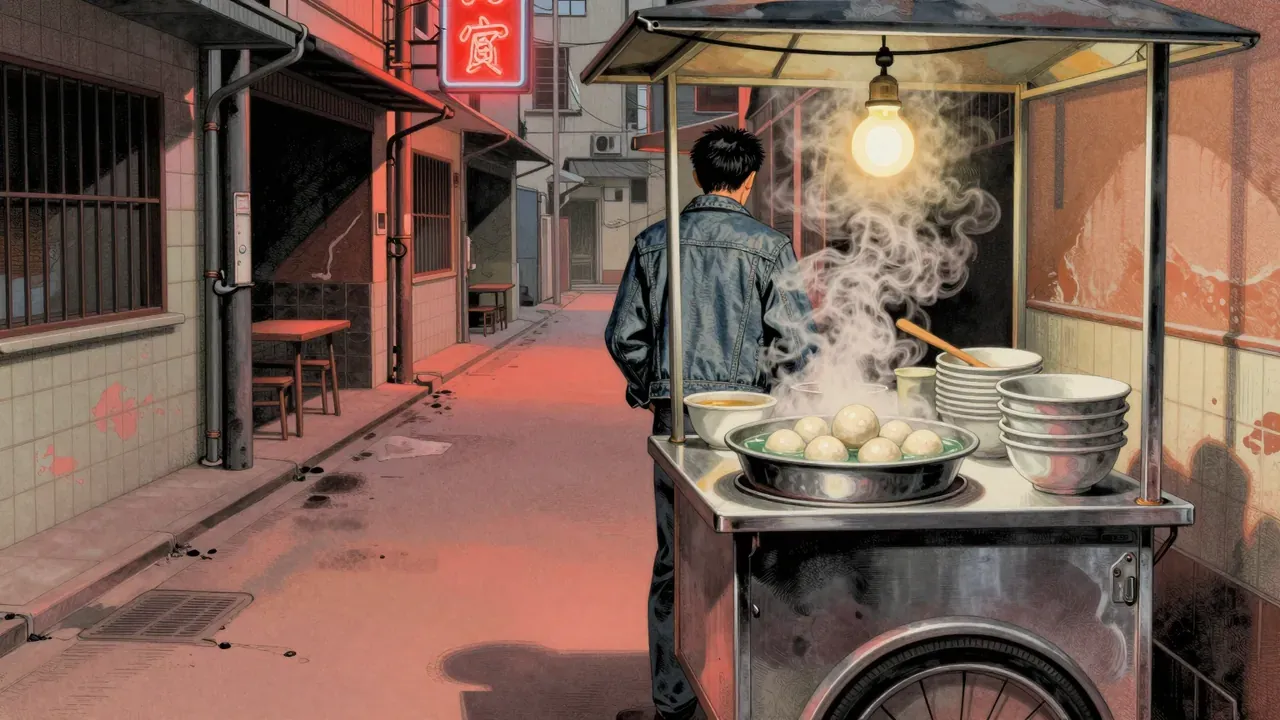
What does not land is the structural unevenness between its halves. The first hour establishes Wah’s routine and Fly’s volatility with patient precision, but the second half accelerates into plot points that feel externally imposed: Fly’s snooker bet, the fishball cart, the assassination assignment. These developments serve narrative function more than psychological necessity, and their pacing jars against the film’s earlier tempo. Tony, played by Alex Man, remains a cipher — a source of grievance rather than a character with interiority. The police informant subplot arrives late and resolves abruptly, its stakes never fully integrated into Wah’s internal calculus. Some supporting roles — Site, Uncle Kwan — exist only to service Fly’s arc or Wah’s obligations, without texture or contradiction. The film’s restraint begins to read as omission in places where ambiguity would have served better than absence. A viewer expecting the coherence of Wong’s later work may find these gaps unresolved rather than elliptical.
What it’s really about
The themes that matter are loyalty as exhaustion, masculinity as performance under surveillance, and escape as geography rather than transformation. Wah’s loyalty to Fly is not noble but habitual — a duty he honours even as it undoes him. His masculinity is defined by containment: holding back anger, swallowing shame, absorbing blows meant for others. There is no triumph in stoicism here, only attrition. Ngor represents an alternative axis — not innocence, but autonomy rooted in place and labour, unmediated by hierarchy or debt. The film treats class not as backdrop but as grammar: Wah’s mobility is horizontal (Mong Kok to Lantau, then back), never upward; his economic reality is fixed, his social options narrowing. Time itself becomes thematic — not as nostalgia or memory, but as duration: the long wait at the ferry pier, the hours spent bandaging wounds, the days passing without resolution. These are not metaphors; they are conditions.
Who it asks for
This film is for viewers who value mood over momentum, who trust silence as meaning, and who accept that a character’s inner life may be legible only through posture, pause and proximity. It suits those familiar with Hong Kong cinema’s 1980s vernacular — the cadence of Cantonese dialogue, the texture of urban decay, the unspoken codes of obligation. It is not for those seeking narrative propulsion, clear moral binaries or stylistic flamboyance; Wong’s later films offer more overt visual invention, and contemporaneous triad dramas like A Better Tomorrow deliver tighter cause-and-effect. A viewer who finds ambiguity frustrating, or who requires emotional signposting, will likely disengage before the Lantau interlude. The film assumes patience as a condition of engagement — not as a virtue, but as a prerequisite. Without it, the structure reads as slack rather than deliberate.
Why it stays
Yes, it is worth your evening — provided you watch it as a threshold work, not a summation. Its value lies in seeing Wong Kar-wai’s preoccupations take shape before they harden into signature: the weight of waiting, the politics of proximity, the way light falls on wet pavement at 3 a.m. It rewards attention to what is withheld — the unsaid apology, the unasked question, the glance that does not return. Those who expect the saturated colour or fractured chronology of Chungking Express may find it austere; those who approach it on its own terms — as a study in restraint, in the cost of small choices — will find it quietly resonant. It is not flawless, but its flaws are instructive: they show where the director’s instincts outpace his control, and where his control begins to serve something deeper than plot. That makes it essential, not perfect.