The premise
Yojimbo is a jidaigeki — a period drama set in the late Edo era — that uses the conventions of the samurai film not to affirm bushidō but to dismantle them. It is not a story about honour, loyalty or duty, but about a man who treats moral systems as stage props and violence as leverage. Akira Kurosawa co-wrote, directed and edited it; he built it as a tightly wound mechanism: a single rōnin enters a town hollowed out by two rival gangs, assesses their weakness, then manipulates both sides into mutual exhaustion. The film’s aim is structural satire — less concerned with historical fidelity than with exposing how power consolidates through fear, incompetence and performative brutality. It does not ask whether the rōnin is good or bad, but whether either side deserves survival. Its tone is deliberate, unsentimental, dryly amused — a farce conducted with swords and silence. It borrows from American noir and hard-boiled fiction, but strips away their psychological interiority in favour of clean, almost diagrammatic cause and effect. This is not myth-making; it is demolition work done with precision.
The construction
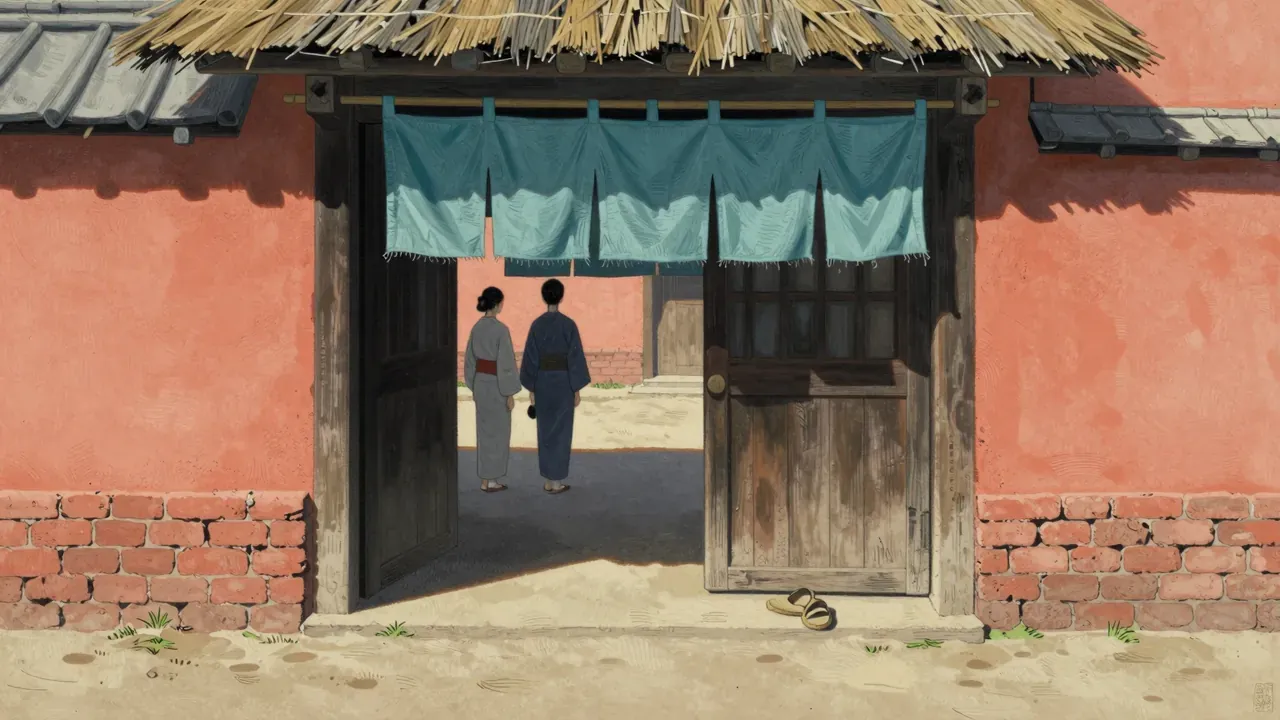
The story moves like a clockwork trap: each decision triggers a countermove, each alliance unravels before it solidifies. Toshirō Mifune’s performance anchors this — his Sanjuro is physically loose but mentally unblinking, his face shifting between boredom, calculation and sudden, brutal focus. Kazuo Miyagawa and Takao Saito’s cinematography keeps compositions stark and shallow, using deep focus only where it serves irony — a wide shot revealing the town’s emptiness behind a boastful gangster, or tight framing that makes a sword draw feel inevitable rather than heroic. Masaru Sato’s score mixes taiko drums with brassy, off-kilter jazz motifs, its jaunty dissonance underlining the absurdity of the bloodshed. Editing is rhythmic and unsparing: cuts land like blows, pauses hang like threats. There are no flashbacks, no voiceover, no exposition beyond what the rōnin himself overhears or observes. Every prop has weight — the mulberry field, the worn kimono, the tavern’s sliding door — and every gesture is calibrated: a tilt of the head, a flick of the blade, a slow sip of sake. Nothing is decorative; everything is functional.
The execution
What lands most firmly is the film’s economy of implication. A glance tells us more than a monologue; a pause before a kill carries more tension than the act itself. The town feels lived-in because its decay is shown in detail — cracked plaster, dusty tatami, the way Gonji wipes the same counter three times before speaking. Mifune’s physicality remains unmatched: the way he slouches into doorways, shifts weight mid-sentence, or lets his eyes drift past a threat before returning to it — all signal control without declaration. The duel sequences avoid choreographic flourish; they are short, decisive, and often end before the audience registers the motion. Even the music lands precisely: its brass stabs and flute skitters never accompany action but comment on it, as if the score is the rōnin’s internal monologue made audible. The film’s humour — dry, situational, deeply unkind — arrives without cueing, making it land harder. When Sanjuro watches two gangs blunder into a standoff over a corpse they both claim to have killed, the comedy is structural, not verbal, and it holds up across six decades because it depends on behaviour, not language.
The friction
What does not land for some viewers is the film’s refusal to grant moral gravity to its violence. There is no mourning, no reckoning, no aftermath beyond the rōnin walking away — which can read as evasion rather than resolution. The female characters exist largely as plot devices or symbols: Seibei’s wife schemes, Ushitora’s sister pleads, but none are granted interiority or agency beyond their function in the rōnin’s scheme. The townspeople remain a collective murmur, never individuals — a choice that serves the satire but risks flattening the human cost. Some may find the pacing too deliberate, the repetitions too insistent: the same alley, the same tavern, the same gestures recur until they become ritual. The film assumes familiarity with jidaigeki tropes — the significance of the mon, the weight of the katana, the social meaning of a rōnin’s status — and offers no hand-holding. Without that context, the satire loses teeth; without patience for its rhythm, the structure feels mechanical rather than purposeful. It asks the viewer to meet it on its terms, and will not bend.
The argument
The themes that matter are power as theatre, competence as scarcity, and morality as negotiation. The town is not corrupt because its people are evil, but because no one has the will or ability to enforce order — so authority devolves to whoever shouts loudest or strikes first. Sanjuro succeeds not because he is virtuous, but because he sees the system clearly and exploits its gaps. His ‘neutrality’ is tactical, not ethical: he sells his skill to both sides because neither merits loyalty. The film treats hierarchy as farce — the yakuza bosses mimic feudal lords while running gambling dens; the mayor is a silk merchant installed by thugs; even the bugyō’s arrival is treated as a bureaucratic interruption, not a restoration of justice. Loyalty is transactional, tradition is costume, and violence is infrastructure. There is no redemption arc, no revelation of hidden virtue — only a sustained demonstration that when institutions fail, competence becomes the only currency, and it trades in cold logic, not conscience.
The audience
This film is for viewers who value precision over warmth, structure over sentiment, and irony over catharsis. It rewards attention to composition, timing and subtext — those who watch films for narrative propulsion alone may find it withholding. It suits fans of classical Hollywood westerns, French New Wave editing, or Japanese theatre’s economy of gesture. It is not for those who require emotional exposition, character backstories or moral clarity — nor for viewers who expect historical authenticity in costume or setting, as the film deliberately stylises its Edo-era world. Those who dislike long silences, repetitive motifs or endings that offer no closure will resist it. Some critics have found its satire too detached, its violence too casual — Pauline Kael called it a ‘shaggy man’ movie, implying a looseness others might mistake for indifference. A viewer who needs the protagonist to be legible as hero or antihero will leave unsettled. Its power lies in its refusal to choose.
The verdict
Yes, it is worth your evening — provided you approach it as a machine built to run, not a mirror built to reflect. Its 110 minutes pass with the inevitability of a well-set trap: each scene tightens the spring, each cut releases a fraction of tension. It repays rewatching not for hidden clues but for its craftsmanship — how a glance is timed, how light falls on a blade, how silence stretches before violence. Those who find it cold or cynical are not wrong; they are simply encountering its design intention. It is not for everyone, but for those it is for — viewers attuned to rhythm, restraint and structural wit — it remains singular. Its influence is vast, but its pleasure is intimate: the satisfaction of watching intelligence applied without apology, form held without compromise, and a story told so cleanly that every element feels necessary, nothing ornamental. That economy is rare, and still exacting.