The name he gives
Sanjuro is a jidaigeki — a Japanese period film — made by Akira Kurosawa in 1962 as a deliberate sequel to Yojimbo, though it departs from that film’s border-town lawlessness and Western-inflected structure. It aims not to repeat but to refine: to place the same ronin, played again by Toshirō Mifune, inside a more tightly wound feudal power struggle, where moral ambiguity resides not in rival gangs but in competing factions of a single clan. The film tests whether its protagonist can operate without the crude leverage of brute force alone — whether he can outthink rather than overpower, and whether his cynicism might admit something like restraint. It does not seek historical realism, nor does it treat samurai codes with reverence; instead, it uses the genre’s conventions as scaffolding for a dry, socially observant comedy about competence, miscommunication, and the gap between intention and consequence. Its ambition is structural and tonal: to sustain tension through misdirection, to build action from character error, and to let irony do the work that spectacle often does elsewhere. (158 words)
The plans they make
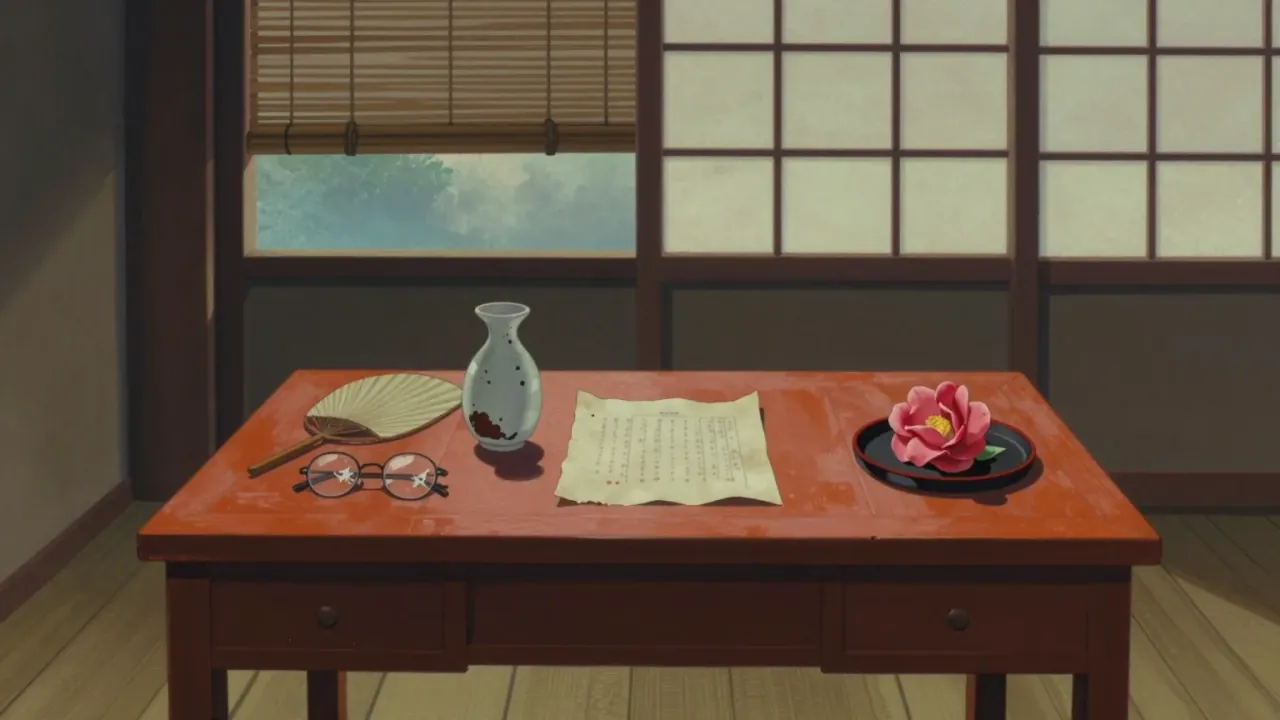
The story follows nine earnest young samurai whose political idealism is immediately undermined by their tactical illiteracy; Sanjuro intervenes not as mentor but as corrective friction. Mifune’s performance is less flamboyant than in Yojimbo — quieter, more watchful, his humour delivered in pauses and glances rather than gestures. Tatsuya Nakadai’s Hanbei is calibrated with equal precision: not a villain but a mirror, a man of comparable skill and isolation who chooses alignment over autonomy. Masaru Sato’s score avoids grandeur, favouring sparse, percussive motifs that underscore timing rather than emotion. Akira Kurosawa’s editing tightens sequences to their functional core — no shot lingers longer than needed, and the duel at the end arrives only after thirty minutes of withheld violence. Cinematographer Takao Saitō keeps compositions balanced but unornamental, using shallow depth of field to isolate faces during deception, and wide frames to expose the vulnerability of groups acting in concert. The camellia motif recurs visually and verbally, not as symbolism but as a repeated, grounding detail — a name chosen on the spot, then treated with quiet insistence. (159 words)
The laughter in the silence
What lands most firmly is the film’s rhythm of correction and consequence: every time Sanjuro solves a problem, the young samurai undo part of the solution through haste or literal-mindedness, and each reversal feels earned, not contrived. The chamberlain’s wife insisting that ‘the best sword is kept in its sheath’ lands because it comes from lived consequence, not doctrine — she has seen what killing costs, and says so plainly. The final duel works not as catharsis but as rupture: the blood spray is shocking not for its gore but for its sudden, almost clinical violation of the film’s prevailing restraint. That moment, intentional per Kurosawa’s own later account, lands because it is isolated — the only instance of graphic violence in ninety-six minutes, and therefore legible as commentary, not convention. The social comedy lands too: the samurai’s rigid adherence to form — kneeling, bowing, quoting precedent — becomes funnier the more desperately Sanjuro tries to make them see the situation as it is, not as they wish it to be. Their earnestness is never mocked; it is simply shown to be inadequate without perception. (157 words)
The blood in the stream
What does not land is the film’s occasional reliance on coincidence as narrative engine: the torn petition fragment floating downstream, the chance discovery of Hanbei’s suspicion just as the camellias are being dropped — these hinge on timing so precise it strains plausibility without offering thematic compensation. The young samurai remain functionally indistinct beyond their collective ineptitude; none acquires a voice or motive strong enough to make their repeated failures feel tragic rather than schematic. The subplot involving the superintendent’s suicide lacks emotional weight because the man is never given interiority — he exists only as a plot pivot, and his death registers as administrative closure, not moral reckoning. The film’s refusal to linger on consequence extends to its treatment of violence: while the blood spray is memorable, the earlier killings happen off-screen or in quick cuts, leaving little residue — an aesthetic choice that serves pacing but weakens the stakes Sanjuro claims to care about. Some viewers may find the tone too detached, mistaking its dryness for indifference. Those expecting the swashbuckling momentum of Yojimbo will feel the pacing slacken in the middle stretch, where strategy replaces skirmish. (159 words)
The swords they keep sheathed
The themes that matter are competence as moral practice, anonymity as resistance, and the burden of perception. Sanjuro’s mastery lies not in swordsmanship alone but in reading people faster than they read themselves — and in knowing when to withhold that reading, or weaponise it. His choice of name — Tsubaki Sanjūrō — is not whimsy but principle: a rejection of lineage, title, and inherited authority in favour of something local, seasonal, and unclaimable. The film treats loyalty not as virtue but as risk assessment: the young samurai pledge allegiance to ideals they cannot yet interpret, while Hanbei pledges himself to structure he knows is rotten — both are trapped by what they refuse to name. The chamberlain’s regret at the superintendent’s suicide points to a subtler theme: the cost of maintaining order without justice. There is no utopian resolution — Mutsuta is restored, but the system remains intact, and Sanjuro walks away because he recognises that his presence sustains the illusion of fixability. The film’s enduring concern is not with who wins, but with who sees clearly — and what happens when clarity is inconvenient to those who depend on fog. (156 words)
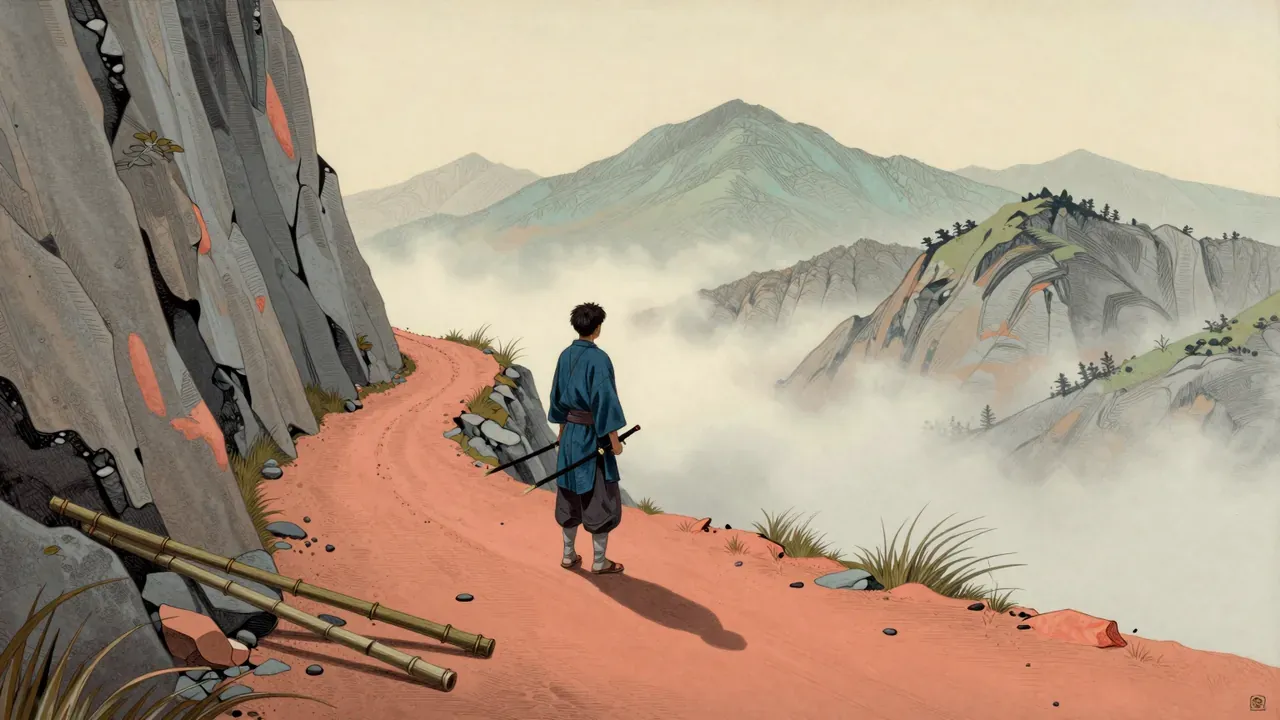
The road he walks away down
This film is for viewers who value precision over propulsion, who find pleasure in watching intelligence navigate incompetence, and who accept that a samurai film need not culminate in a battlefield to earn its genre credentials. It suits those already familiar with Yojimbo or Kurosawa’s broader work, but it is not inaccessible to newcomers — its mechanics are clear, its pace deliberate, its ironies legible without prior knowledge. It is not for viewers who require emotional exposition, psychological backstories, or sustained interpersonal warmth; the characters speak in function, not confession. Nor is it for those who equate action with velocity: the film’s longest fight lasts under thirty seconds, and its most consequential moments occur in silence or stillness. Anyone expecting mythic heroism or moral clarity will leave unsatisfied — Sanjuro offers neither. A viewer who values visual economy, verbal economy, and the cumulative weight of small decisions will find it rich; one who needs catharsis, closure, or character arcs will find it withholding. Its appeal is narrow but deep, and its demands are formal, not emotional. (158 words)
The eyes that watch the shadows
Yes, it is worth your evening — provided you watch it without expectation of escalation, and with attention to how much is said by what is withheld. Its ninety-six minutes accumulate quietly: each scene tightens the knot between perception and action, each cut removes redundancy, each performance resists flourish. It repays slow viewing, not because it is obscure, but because its intelligence is procedural — visible in cause and effect, not stated in dialogue. Those who dislike it tend to cite its pacing or its emotional reserve, but those objections mistake austerity for emptiness. The film’s value lies in its consistency of method: no shot, line, or gesture contradicts its central idea — that clarity is rare, costly, and rarely rewarded. It is not a film to love easily, but one that stays lodged, reappearing in memory as a series of precise images: a hand dropping petals into water, a shadow bound to a post, a man walking away from applause. To skip it is to miss a masterclass in narrative discipline. (159 words)