The look of it
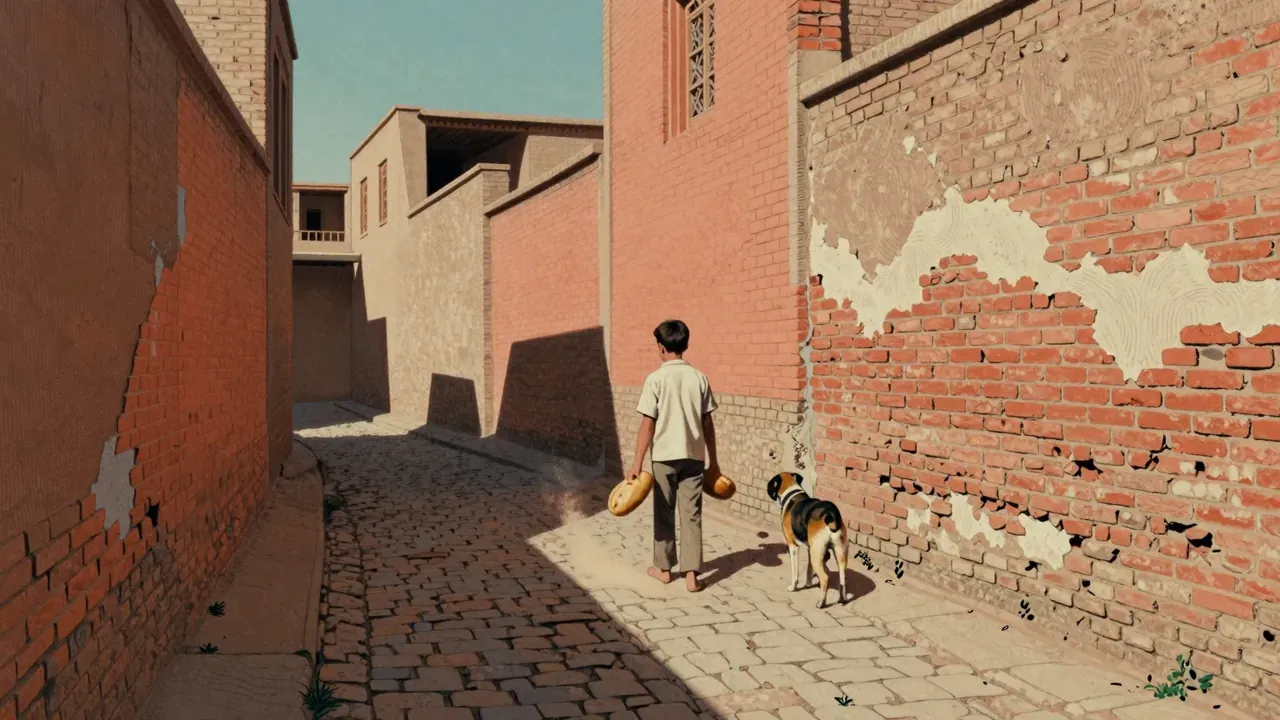
The Black Stallion is a 1979 American children’s film adapted from Walter Farley’s 1941 novel, aiming to translate the book’s mythic simplicity — boy, horse, isolation, trust, speed — into cinematic form without adult mediation. It treats childhood not as a stage to be outgrown but as a condition of heightened perception and unspoken reciprocity. Carroll Ballard’s direction, his first feature, avoids exposition or psychological framing; instead, it builds narrative through duration, light, and physical proximity. The film does not seek to explain why Alec Ramsey bonds with the stallion, nor does it moralise survival or triumph. Its ambition is quieter: to make visible the grammar of mutual recognition — how a hand extends, how a head lowers, how breath synchronises — across species and silence. It assumes the viewer will follow attention, not plot. This is not a film about racing, though it ends at the track; it is about the long, wordless work of learning to move as one body. It asks for patience, not interpretation.
The island
The story unfolds in two distinct movements: the island sequence, which occupies nearly half the runtime, and the training-and-race sequence that follows. Caleb Deschanel’s cinematography anchors both — keeping daylight soft and shadows deep, using shallow focus to isolate gesture over expression, and holding shots long enough for rhythm to replace dialogue. Kelly Reno, in his debut, speaks little and listens with his whole posture; Mickey Rooney’s Henry Dailey offers warmth without whimsy, grounding the second act in quiet expertise rather than caricature. The editing by Robert Dalva sustains this tempo: cuts are sparse, often motivated by movement or change in light, never by urgency. Carmine Coppola’s score avoids melody in favour of low brass pulses and suspended strings, underscoring tension without dictating emotion. The horse Cass Ole is not ‘played’ but present — reactive, unpredictable, physically dominant — and the film never disguises the labour of that presence: the sand, the salt, the strain in the tendons, the weight of the rider’s small frame against the horse’s flank.
The horse
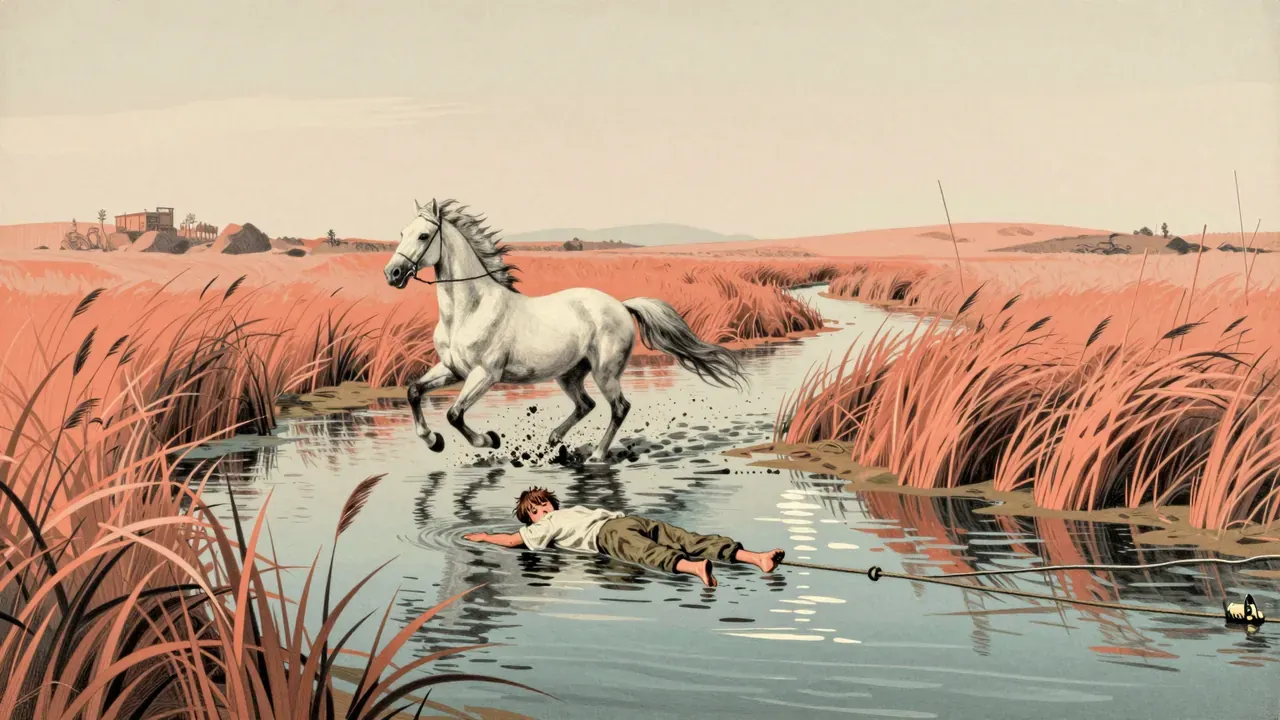
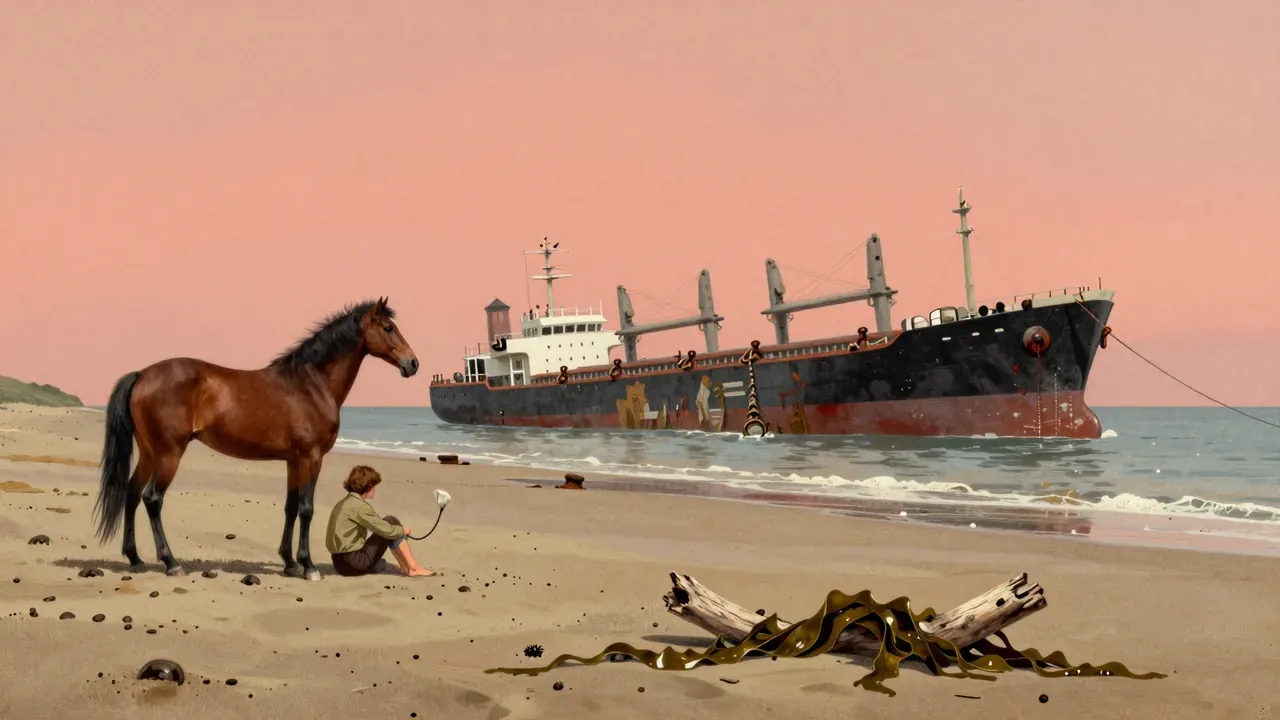
What lands most firmly is the island sequence: its tactile precision, its refusal of sentimentality, and its fidelity to the logic of survival and slow trust. When Alec cuts the stallion’s restraints for the second time, or when the horse kills the cobra not as protector but as instinctive response, the film earns its emotional weight without recourse to music or close-up reaction shots. The beach scenes — Alec offering seaweed, the horse lowering his head, the first unsteady ride — succeed because they are built on repetition and failure, not revelation. The film also lands its sense of scale: the vastness of the sea, the intimacy of the barn loft, the oppressive stillness before the race bell. Even the minor roles — Teri Garr’s calm practicality, Hoyt Axton’s brief, grounded paternal presence — register without elaboration. These moments do not ask to be admired; they simply hold their ground, and in doing so, they settle into memory with the weight of something observed, not staged.
The return
What does not land is the transition from island to racetrack — not as a narrative break, but as a shift in tonal authority. The second half introduces exposition, scheduling, and stakes that feel imported rather than earned: the secret night demonstration, the reporter’s astonishment, the sudden media buzz. These elements sit uneasily beside the earlier economy of means. Henry Dailey’s backstory arrives too late and too thinly to anchor the training arc, and the race itself, while visually precise, relies on a last-minute injury and recovery that strains plausibility without irony or self-awareness. Janet Maslin’s dissent — that Ballard’s ‘too-painstaking cinematography’ stifles curiosity — finds purchase here: the camera remains reverent, but the stakes no longer emerge from character or environment; they are imposed by genre convention. The film never reconciles its meditative core with its competitive climax, and the result is not ambiguity but asymmetry — a first half that breathes, a second that hurries.
The race
The themes that matter are not those of mastery or conquest, but of attunement and limitation. The film treats speed not as dominance but as alignment — the moment when rider and horse cease to be two bodies negotiating force and become one system responding to terrain and timing. It treats language as secondary: Arabic, English, and silence all carry equal narrative weight, and the film’s most consequential exchanges happen without translation. It treats childhood not as innocence but as competence — Alec’s knife, his observation, his endurance — and refuses to infantilise either him or the horse. There is no anthropomorphism; the stallion’s fear, aggression, and curiosity are rendered without metaphor. The film also engages with legacy not as inheritance but as echo: Bucephalus appears only as a statue, a story told once, then absorbed into action. What endures is not the legend, but the posture — the way a boy holds himself on a horse’s back, the way a jockey reads a stride — passed not through words but through shared motion.
The pace
This film is for viewers who value sustained attention over exposition, who find resonance in physical detail over verbal explanation, and who accept that some stories need space to settle rather than momentum to drive. It suits adolescents who have not yet been trained to scan for plot points, and adults who remember watching films before they learned to critique them. It is not for those who require narrative efficiency, clear cause-and-effect, or emotional signposting — viewers who expect the cobra scene to foreshadow danger, or the race injury to resolve neatly, will find the film withholding. Those accustomed to contemporary pacing may perceive slowness as vacancy. A different verdict would follow if the second half matched the first in rigour: tighter integration of Henry’s expertise, less reliance on external validation, and a race that emerged from the island’s logic of reciprocity rather than Hollywood’s logic of climax.
The legacy
Yes, it is worth your evening — provided you watch it as a study in attention, not as a story with a destination. Its 112 minutes pass without hurry but not without weight: the sand, the rope, the barn floor, the curve of a neck — these are not decorative but structural. It rewards stillness, not analysis. You will not leave with answers, but with afterimages: the horse’s eye catching light, the boy’s fingers brushing the withers, the silence just before the gate opens. Those who dislike it tend to cite its pace or its avoidance of psychology — fair objections, but objections to its method, not its failure. Its value lies precisely in what it refuses: exposition, irony, backstory, even consistent tone. To watch it expecting a conventional children’s adventure is to misread its contract. To watch it as a slow, sensory transcription of trust — that is to meet it on its own ground. And on that ground, it holds.