The problem it solves
Unstoppable is a studio action thriller built around a single, escalating physical problem: a runaway freight train. It aims to deliver sustained tension through procedural detail and mechanical stakes, not character revelation or thematic expansion. The film treats the railroad as infrastructure first — a network of switches, couplers, brake systems, gradients and signalling protocols — and human roles second: yardmaster, engineer, conductor, safety inspector. Its ambition is narrow: to make the viewer feel the weight, momentum and fragility of a 39-car train moving at 50mph with no one at the controls. It does not seek ambiguity, moral complexity or psychological realism. It seeks clarity of cause and effect, visibility of process, and consequence that follows from physics before personality. Tony Scott directs it as a machine in motion: every cut serves velocity, every frame privileges spatial orientation over interiority. The real-life CSX 8888 incident provides the spine, but the film strips away investigative nuance or systemic critique in favour of operational immediacy. It is not about why the train ran away, but how to stop it — and whether anyone will live long enough to try.
The language of rails
The story moves by calibrated escalation: miscommunication leads to miscalculation, which triggers improvisation, then desperation. Mark Bomback’s script structures time tightly — 98 minutes for roughly two hours of in-film clock time — and avoids digression. Chris Pine and Denzel Washington anchor the central pairing with functional restraint: Pine’s Will Colson is all nervous energy and procedural doubt; Washington’s Frank Barnes is weathered authority without exposition. Rosario Dawson’s Connie Hooper operates the command centre with clipped efficiency, her authority constantly undermined by corporate hierarchy. Ben Seresin’s cinematography favours wide shots of rail corridors, low-angle tracking alongside moving locomotives, and tight handheld work inside cabs — never lingering on faces when a throttle lever or air-brake gauge conveys more. Harry Gregson-Williams’ score pulses but rarely swells; Robert Duffy’s editing sustains rhythm without flash. The craft serves the premise without ornament: this is a film where the sound of metal grinding on rail matters more than a monologue.
The weight of steel
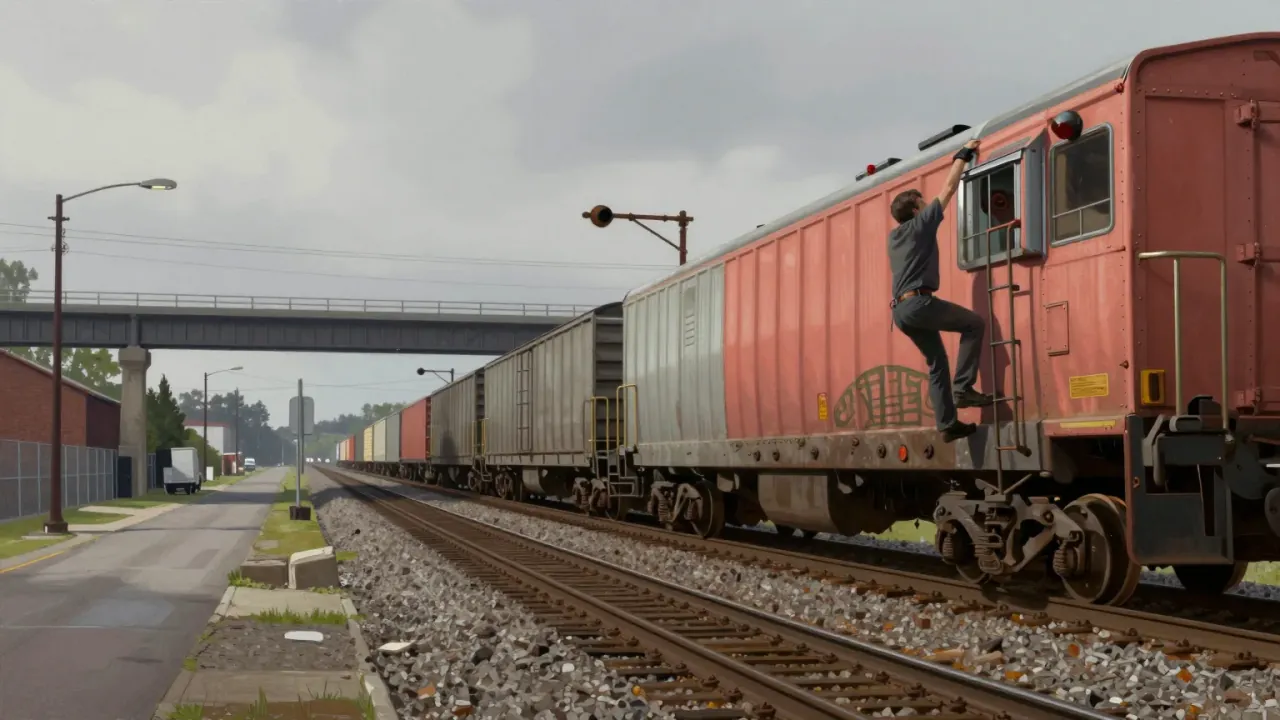
What lands is the visceral coherence of the train as antagonist. Its scale, speed and inertia are consistently legible — not through CGI spectacle, but through grounded framing, practical location shooting across Western Pennsylvania and Ohio, and repeated emphasis on mechanical failure points: an unsecured coupler, a jammed brake pipe, a failed derailer’s bent steel teeth. The B&O Viaduct sequence works because the geography is real, the bridge’s curve is steep, and the train’s approach is filmed from multiple fixed positions that establish spatial consequence. The coupling attempt succeeds as drama because the physical difficulty is shown, not told: Will’s crushed foot, Frank’s climb along swaying freight cars, the delayed engagement of the pin. The film earns its suspense by making each step of the solution contingent on something going slightly wrong — a radio crackle, a misjudged gap, a slipping grip — rather than relying on villainy or coincidence. Even the corporate obstruction feels plausible: Galvin’s cost-consciousness isn’t cartoonish, just bureaucratically inflexible.
The cost of silence
What does not land is any sense of lasting consequence beyond the immediate crisis. The phenol cargo — flagged early as catastrophic — vanishes narratively once the derailment threat shifts to Stanton; its toxicity becomes set-dressing, not pressure. The characters’ personal lives remain strictly functional: Will’s restraining order and Frank’s retirement loom only as shorthand for ‘stakes’, never as lived texture. No relationship deepens, no belief is tested, no institution is examined beyond its operational failure. The film’s refusal to pause for reflection means emotional payoffs arrive as relief, not resonance. When Frank and Will succeed, the moment carries weight because the mechanics worked — not because we understand what it cost them, or how it changes them. The supporting cast — Kevin Dunn’s Oscar Galvin, Ethan Suplee’s Dewey — function as plot nodes, not people. Even the real-world context — the 2008 rail safety debates, the CSX incident’s aftermath — is omitted entirely. The film’s discipline becomes its limitation: it has no room for irony, ambiguity or aftermath.
The duty of memory
The themes that matter are competence, duty and infrastructure as collective responsibility. Frank Barnes embodies institutional memory: his knowledge of brake dynamics, track gradients and coupling tolerances is not charisma but accumulated labour. Will Colson represents the next generation learning not from textbooks but from proximity to consequence. Their partnership asserts that expertise must be exercised, not archived — and that systems fail not from malice but from the erosion of shared vigilance. The film treats the railroad as a public good: its safety depends on overlapping layers — yardmasters, engineers, inspectors, dispatchers — none of whom can act alone. Corporate indifference (Galvin) and regulatory caution (Werner) are not caricatures but friction points in that system. The climax isn’t about heroism but calibration: timing the independent air brake, reading the grade, judging the coupler’s alignment. The theme isn’t ‘man vs machine’ but ‘human attention vs systemic drift’ — and the quiet insistence that keeping things running requires constant, unglamorous intervention.
Who hears the wheels
It is for viewers who value procedural clarity, physical cause-and-effect, and action rooted in real-world constraints — those who find tension in a correctly timed brake application or the geometry of a switch point. It is not for viewers seeking psychological depth, social critique or stylistic experimentation. Anyone expecting moral ambiguity, historical reckoning or character-driven arcs will find it thin. Those who dislike films where dialogue serves logistics over subtext, or where emotion arrives via pulse rate rather than confession, should pass. A viewer who values Tony Scott’s kinetic grammar — the rush of motion, the weight of steel, the urgency of radio chatter — will respond more readily than one who prefers contemplative pacing or layered irony. The film assumes familiarity with basic rail terminology; it does not explain ‘dynamic brakes’ or ‘independent air’ — that’s part of its contract with the audience.
The measure of motion
Yes, it is worth your evening if you accept its terms: a tightly wound, single-problem thriller executed with technical rigour and zero pretension. It delivers what it promises — sustained, intelligible tension — without overreaching. Its 98-minute runtime is disciplined, its pacing relentless but never confused. Those who dismiss it as ‘just another action film’ miss how precisely it calibrates risk, consequence and resolution within a narrow band of realism. Critics who found it emotionally hollow are right — but that hollowness is structural, not accidental. It chooses engineering over epiphany. To ask for more would be to misread its purpose. A viewer who wants catharsis through character transformation will leave unsatisfied; one who finds satisfaction in watching professionals solve a problem under pressure will leave energised. Its value lies in its fidelity to its own logic — and in doing one thing, well, without apology.