The purpose of it
L’Arrivée d’un train en gare de La Ciotat is a fifty-second silent actuality film shot in January 1896 by Auguste and Louis Lumière. It records, in real time and without editing, a steam locomotive pulling into the station at La Ciotat on the French Mediterranean coast. The film does not attempt narrative, character, or commentary; its purpose is demonstrative and documentary — to show motion, scale, depth, and everyday life as captured by the Cinématographe. It belongs to the Lumière brothers’ series of short films made to test and exhibit their invention: a device that functions simultaneously as camera, printer, and projector. The film’s ambition is technical and phenomenological — to present moving light on a flat surface with sufficient fidelity that the image registers as recognisable, continuous, and spatially coherent. It makes no claim to artistry beyond clarity of registration and compositional stability. Its subject is not the train, nor the station, but the capacity of the medium itself to reproduce presence. It is an act of registration, not interpretation. Word count: 132
The look of it
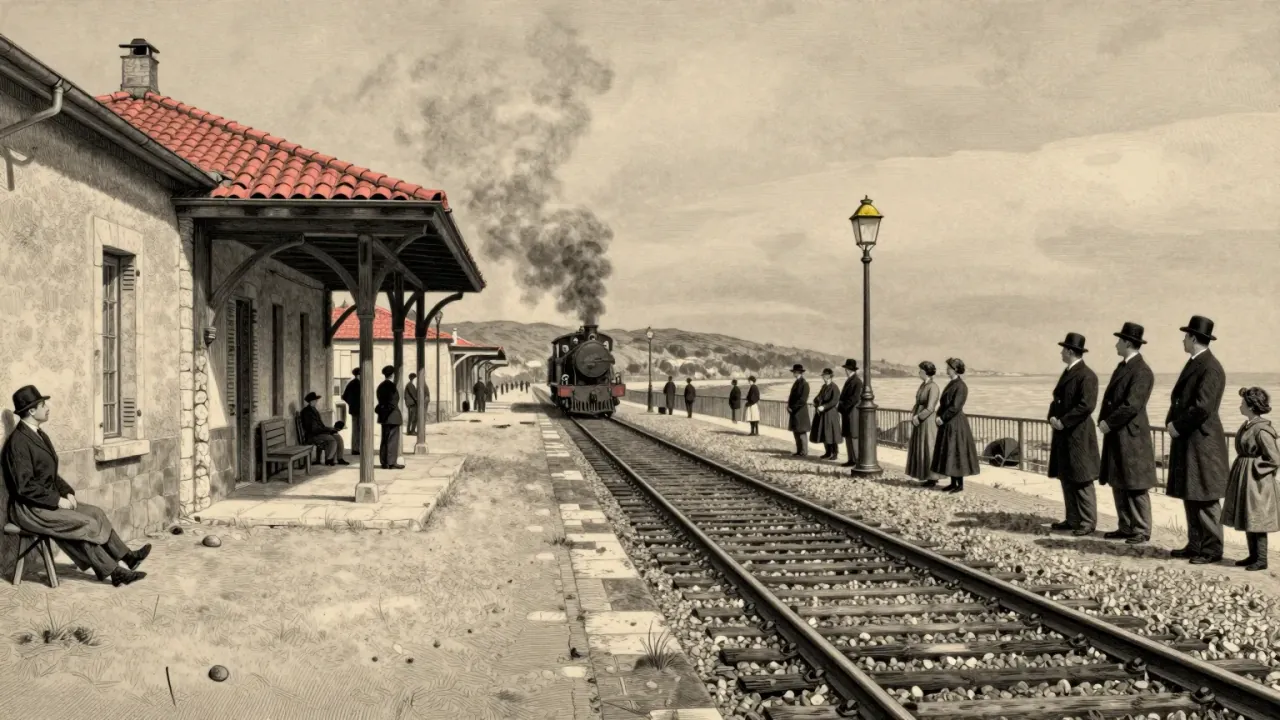
The film consists of one unbroken shot, filmed from a fixed position slightly above platform level, facing the track as the train approaches head-on. Louis Lumière operated the Cinématographe, which recorded at approximately 16 frames per second on 35 mm film with a 1.33:1 aspect ratio. There is no camera movement, no cut, no intertitle, no music, no sound design — only the mechanical rhythm of the shutter and the grain of the emulsion. The composition places the track centrally, the station building to the left, and a crowd of bystanders to the right and foreground. Several figures identifiable as members of the Lumière family appear among the spectators, suggesting direction rather than pure observation. No one looks at the camera; their stillness and positioning imply instruction. The film’s craft lies in its restraint: precise framing, steady exposure, and the decision to hold the shot long enough for the train to decelerate, stop, disgorge passengers, and begin boarding again. Its performance is collective and unscripted, yet staged in its coherence. Word count: 147
The rhythm of it
What lands is the physical immediacy of the image — the weight of the locomotive, the texture of steam, the gait of passengers stepping down onto gravel, the way shadows shift across the platform as the train blocks and then releases sunlight. The frontal perspective creates a shallow but convincing depth, reinforced by the convergence of rails and the diminishing scale of figures as they move away from the lens. For viewers attuned to early cinema’s material conditions, the film delivers a quiet shock of continuity: motion preserved intact, without interpolation or embellishment. Its power is cumulative, not dramatic — it gains force from duration and fidelity, not incident. The arrival feels inevitable, unhurried, and self-evident. Even now, the film resists nostalgia; it does not invite sentiment but attention — to how light falls, how bodies occupy space, how machines and people coexist in a shared, uninflected moment. Its success is structural: it proves that time can be sliced, stored, and replayed without loss of legibility. Word count: 142
The staging of it
What does not land is any sense of spontaneity or discovery within the frame. The crowd’s stillness, the absence of glances toward the camera, and the recurrence of familiar faces undermine the illusion of candid observation. The film’s reputation as a raw slice of reality rests on a misreading of its production: it is more rehearsal than reportage. Its single-shot rigidity also limits emotional range — there is no contrast, no escalation, no release beyond the train’s cessation of motion. Modern viewers accustomed to editing, pacing, or psychological cues may find it inert, not austere. The rumoured panic response has no contemporary corroboration and likely conflates later screenings — including a 1934 stereoscopic version — with the original 1896 showing. Without context, the film offers no entry point beyond curiosity about its historical position; it does not generate empathy, suspense, or identification. Its minimalism is factual, not expressive, and that distinction matters to anyone expecting resonance over record. Word count: 148
The perception of it
The themes that matter are perception, mediation, and the threshold between representation and presence. The film interrogates how much realism a flat image must contain before it triggers a bodily response — flinching, leaning back, holding breath. It raises questions about spectatorship before the conventions of cinema were codified: what do we assume when we see motion on a wall? Is recognition enough to provoke reaction, or does belief require additional cues — sound, scale, dimensionality? The film also embodies the industrial logic of its moment: standardised gauge, timed arrivals, uniform carriages, coordinated labour. Its subjects are infrastructure and routine, not individuality or crisis. There is no hero, no conflict, no resolution — only system and sequence. That neutrality is itself thematic: the Lumière brothers treat the railway not as symbol but as fact, and in doing so, they locate cinema’s first ethical stance — to observe without intervening, to register without judging. Word count: 140
The watching of it
It is worth watching for anyone interested in how images acquire meaning through repetition, duration, and context — students of film history, media archaeology, or perception studies will find it indispensable. It rewards slow, repeated viewing with attention to grain, focus drift, and the subtle choreography of bystanders. It is not for viewers seeking narrative momentum, emotional arc, or stylistic flourish; those who expect cinema to ‘do’ something beyond showing will leave impatient. Anyone who assumes early film must be primitive or quaint will misread its discipline. Those who believe the panic myth uncritically may feel let down by the film’s calm surface — but that disappointment is itself instructive. A curator or teacher might use it to expose assumptions about realism, while a casual viewer may need scaffolding to see past its brevity. Without framing, it risks seeming like a relic rather than a proposition. Word count: 142
The worth of it
Yes, it is worth your evening — but only if you watch it twice, with five minutes between viewings, and read nothing about it beforehand. The first time, you absorb its mechanics; the second, you notice how the conductor’s cap tilts as he steps down, how steam thins at the edges, how children’s legs move at different speeds. Its value lies not in what it says but in how insistently it refuses to say anything else. Those who demand entertainment, explanation, or moral weight will find it insufficient. Historians of technology or visual culture will find it foundational. The verdict would change if the film were presented without context — as mere footage, stripped of its legend — because its power depends on knowing it was among the first things ever shown this way. Its worth is relational, not absolute. Word count: 144