The look of it
Odd Man Out is a British drama set in Belfast, adapted from F. L. Green’s 1945 novel, and centred on Johnny McQueen, a wounded Irish nationalist leader fleeing after a botched robbery. It does not name the IRA or engage directly with political argument; instead, it narrows its focus to a single night of physical and moral disintegration. The film treats ideology as background noise — the cause is present only as habit, loyalty, and unspoken assumption — while foregrounding the body in pain, the mind fraying under shock and exhaustion, and the quiet complicity of ordinary people who recognise but do not act. Its ambition is not historical fidelity or polemic, but psychological realism within a tightly wound, almost ritualistic structure: a fugitive’s slow passage through urban space, observed by those who see him as threat, burden, curiosity, or commodity. It avoids exposition, trusts silence, and builds tension not through chase mechanics but through proximity — how close Johnny comes to safety, to betrayal, to grace, and how little any of it changes his trajectory. This is not a film about revolution, but about what remains when belief collapses into flesh.
The shape of the night
The story unfolds in real time across fragmented encounters: a shelter, a cab, a pub, a painter’s studio, a rectory. James Mason plays Johnny with minimal inflection — his voice flat, his movements laboured, his gaze often unfocused — a performance built on depletion rather than declaration. Robert Newton, as the drunken artist Lukey, brings volatile energy without caricature; Kathleen Ryan, in her first feature, conveys devotion without sentimentality. Robert Krasker’s cinematography uses deep shadow and tight framing — alleyways, low ceilings, cramped rooms — to compress space until it feels like confinement. Lighting is low and directional, faces half-lost in gloom, interiors lit as if by single bulbs. William Alwyn’s score is sparse, recurring motifs tethered to Johnny’s pulse rather than underscoring action. Fergus McDonell’s editing sustains rhythm without haste: cuts linger on hands, on eyes, on empty doorways. There are no flashbacks, no voiceover, no exposition beyond what dialogue and gesture supply. The script by R. C. Sherriff strips the novel’s interiority into external signifiers — a trembling hand, a delayed blink, a pause before answering — trusting the audience to infer collapse rather than be told it.
What stays with you
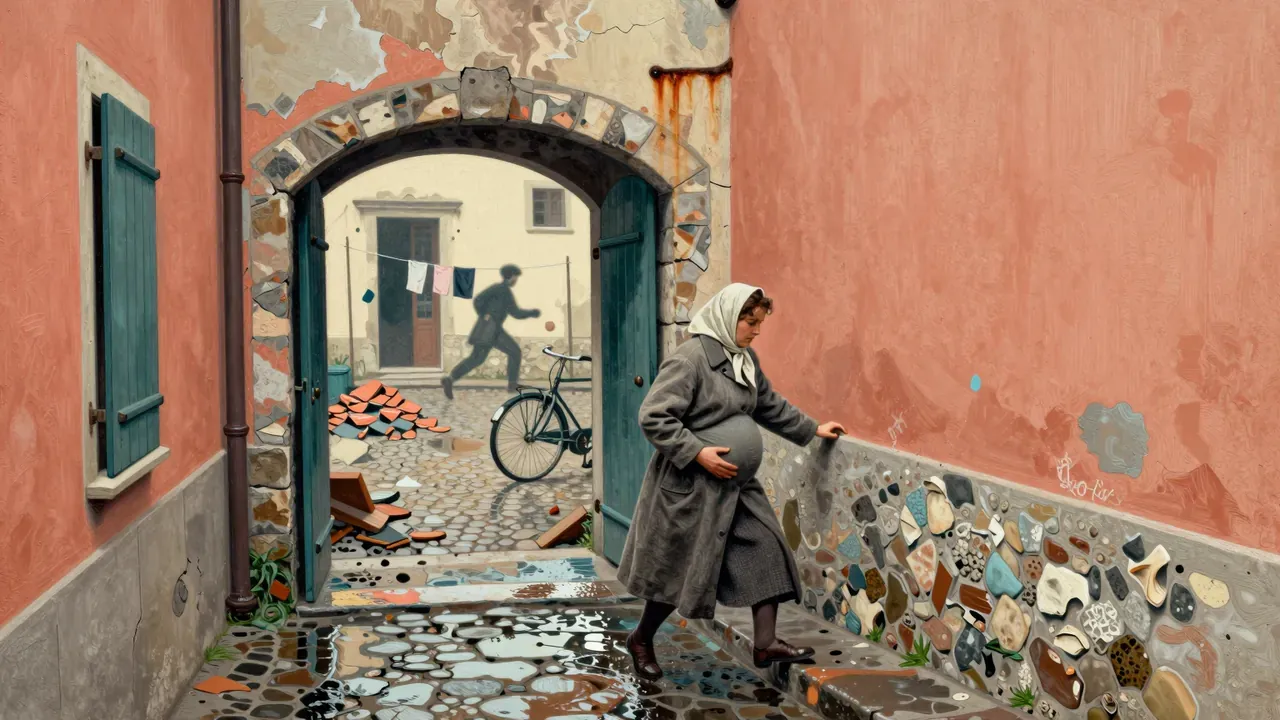
What lands is the cumulative weight of Johnny’s physical decline — not as spectacle, but as quiet accumulation. His stumble into the hansom cab, his slumped stillness while Gin Jimmy argues with Shell, his slow collapse in the pub snug: these moments register because they are underplayed and unvarnished. The film’s moral texture also holds: no character acts purely, and none is reduced to type. The barman hides Johnny not out of sympathy but calculation; the priest intervenes not with certainty but doubt; Kathleen’s final act is neither heroic nor despairing, but decisive in its futility. The location work grounds the film in tangible texture — wet cobblestones, peeling plaster, steam rising off tram rails — and Krasker’s use of available light gives even studio sets the grain of lived-in reality. The sound design — recorded mill machinery, hoofbeats echoing in narrow streets — avoids theatricality, anchoring each scene in acoustic specificity. Even the music’s restraint works: Alwyn’s leitmotif returns not as theme but as tremor, a pulse beneath the silence. These choices cohere into something rare for 1947: a film that trusts duration, ambiguity, and the unsaid.
Where it pulls back
What does not land is the film’s attempt to sidestep politics while remaining legible as an Irish story. The erasure of the IRA by name leaves Johnny’s motivation vague — he is a man with a cause, but the cause itself is never articulated, debated, or even glimpsed in action beyond the opening robbery. This flattens the stakes: his death feels tragic, but not consequential. Some supporting performances verge on caricature — F. J. McCormick’s opportunistic bird-fancier lacks the nuance of Newton or Ryan — and the Ulster accents, as noted in production records, are inconsistent, undercutting the Belfast setting’s authenticity. The theological framing — Johnny’s Christ-like posture at the end, the priest’s interventions — feels imposed rather than earned, especially given the film’s otherwise secular attention to bodily fact. The script avoids moralising, yet the ending’s religious resonance arrives without sufficient groundwork in Johnny’s inner life or prior faith. These are not flaws in execution, but in conception: the film’s refusal to name its subject leaves some emotional and ideological scaffolding missing, making certain gestures — sacrifice, redemption, martyrdom — feel borrowed rather than inhabited.
What it’s really about
The themes that matter are exhaustion, anonymity, and the limits of solidarity. Johnny is not undone by ideology but by physiology — blood loss, shock, fatigue — and the film treats his body as the sole reliable text. His identity dissolves not through betrayal but through incapacity: he cannot speak clearly, cannot stand, cannot remember names. The city responds not to his politics but to his visibility — a man bleeding in the street, a face on a poster, a rumour passed between strangers. Solidarity proves conditional and fleeting: Dennis risks himself but is captured; Kathleen chooses action over sanctuary; even Father Tom hesitates before acting. The film asks what remains when belief is stripped back to instinct — and answers with tenderness, cowardice, opportunism, and, finally, a shared, silent recognition of mortality. It is less about nationalism than about how quickly collective purpose unravels when confronted with individual fragility. The Belfast setting is not backdrop but pressure chamber: narrow streets, low light, communal spaces where privacy is impossible and every decision is witnessed, however briefly.
Who it’s for
This film is for viewers who value sustained mood over plot propulsion, who attend to gesture and silence as narrative tools, and who accept ambiguity as resolution. It rewards patience, familiarity with mid-century British cinema, and tolerance for slow, physically grounded storytelling. It is not for those who require clear moral positions, expository clarity, or narrative payoff — Johnny’s arc ends in death, not revelation, and the political context remains deliberately muted. Those expecting a thriller will find its pacing inert; those seeking historical insight will find its omissions frustrating. A viewer who values craft over message, or who finds power in restraint, will respond strongly. Someone who reads the film as politically evasive — as some contemporary critics did — may dismiss it as compromised. But its power lies precisely in that evasion: it treats ideology as atmosphere, not argument, and asks the audience to sit with consequence without explanation.
Is it worth your evening?
Yes, it is worth your evening — provided you approach it as a study in compression, not catharsis. Its 111 minutes move with deliberate slowness, but never waste a frame; every shot serves Johnny’s diminishing presence in the world. It repays attention to detail — the way light falls on Mason’s collarbone, the rhythm of footsteps on cobbles, the hesitation before a door opens — and its emotional impact accumulates quietly, not through climax but erosion. Those who prefer narrative efficiency or thematic directness may find it withholding. But for anyone willing to inhabit its narrowed perspective — to follow a man not as symbol but as stumbling, bleeding, fading body — it delivers a rare kind of gravity. Its endurance is not in grand statements but in accumulated truth: that endings are rarely decisive, and dignity often resides in how one falls, not why.