A curse, a castle, and a war closing in
Howl’s Moving Castle adapts Diana Wynne Jones’s 1986 novel about Sophie, a young milliner turned into an elderly woman by a witch’s curse, who ends up living in the walking castle of a wizard named Howl while a war between two kingdoms escalates around them. Hayao Miyazaki took over directing after Mamoru Hosoda departed the project when Studio Ghibli rejected his concept work, and Miyazaki has said his motivation for the finished film was shaped directly by his anger over the United States’ 2003 invasion of Iraq, which he expected would make the film poorly received in America.
A single unexplained detail solved with chicken legs
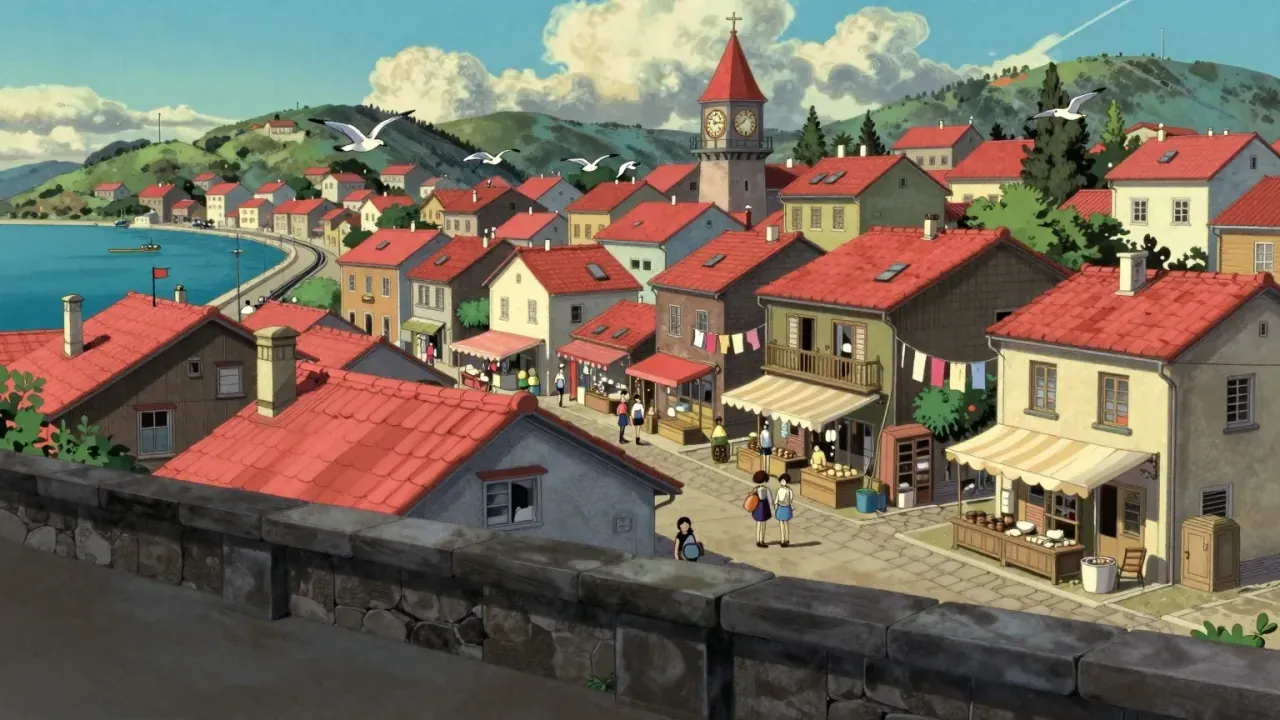
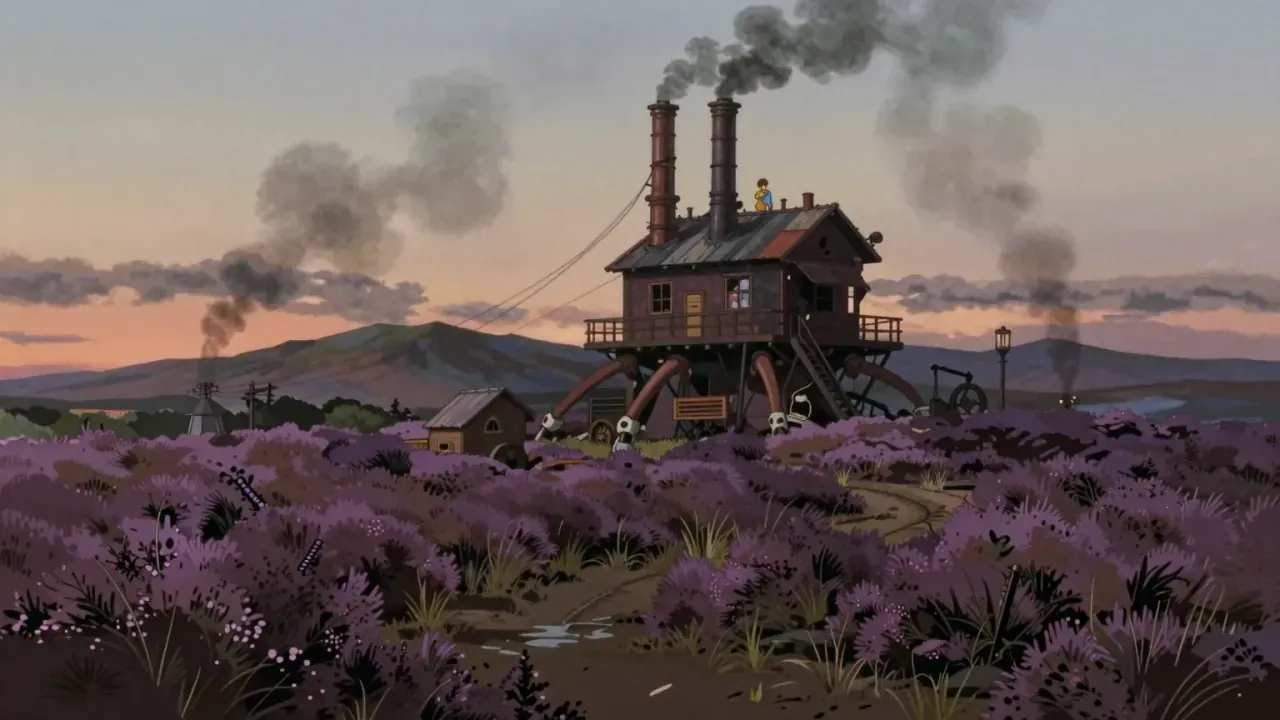
Miyazaki was drawn to the book by a single unexplained detail — Jones never says how the castle moves — and solved it by giving the structure a set of mechanical chicken legs, a decision that anchors the film’s visual identity more than any single character design. He traveled to Colmar and Riquewihr in France’s Alsace region to study half-timbered architecture for the setting, layering it with Albert Robida’s nineteenth-century illustrations of imagined future technology to produce a world where magic and early industrial machinery coexist without either dominating. Joe Hisaishi’s score, performed by the New Japan Philharmonic, was completed and released as a symphony suite even before the film itself premiered, suggesting how much weight the studio placed on the music carrying the story’s emotional register.
Old age as freedom, not decline
Sophie’s curse, which ages her decades in an instant, is treated less as a punishment than as an unexpected liberation: freed from the self-consciousness of youth, she becomes more direct and more capable, and the film frames old age as something closer to permission than decline. The war itself is depicted almost entirely through its effects rather than its causes — burning cities seen from a distance, soldiers boarding ships, a king more interested in appearances than consequences — which keeps the anti-war material from turning into a lecture. Howl’s refusal to fight for his king, despite enormous pressure and personal danger, gives the film’s pacifism a concrete stake rather than an abstract position.
Where the novel’s priorities get left behind
The film substantially departs from its source material’s focus on gender and class, and viewers who come to it expecting Jones’s novel will find a different set of priorities, particularly in how much screen time shifts toward the war plot at the expense of the book’s more domestic concerns. Some critics found the back half’s plotting looser than the visual craft supporting it, with the mechanics of Sophie’s curse and Howl’s own transformations resolved with less clarity than the film’s earlier scenes establish. The project’s own troubled history shows here too: an earlier director’s concept work was scrapped and Miyazaki inherited a shelved production, and a few plot threads feel like leftovers from that earlier version rather than choices made fresh for this one.
War with no side given the moral high ground
The film’s anti-war content is direct rather than allegorical for a Miyazaki production: he has described feeling genuine rage over the Iraq invasion during the film’s making, and that anger shows in a story where the war has no clear justification offered by either side, only leaders more concerned with power than consequence. Its treatment of aging as a source of freedom rather than loss runs alongside a broader argument about compassion as a form of resistance — Sophie’s insistence on caring for Howl, Calcifer and even her supposed enemy the Witch of the Waste undercuts the war-driven logic that treats people as expendable. The film’s feminist elements sit in how directly Sophie’s competence, once freed from vanity, drives every major plot turn.
Who the political fantasy and looser plotting suit
This suits viewers who want a Ghibli fantasy with genuine political content rather than atmosphere alone, and anyone drawn to a story that treats old age as narratively interesting rather than something to escape. It also rewards people who appreciate visual world-building where magic and mechanical invention share space convincingly, and anyone curious how a director’s real-world anger over a specific war found its way directly into a fairy tale aimed partly at children. It’s a less satisfying choice for readers of the original novel expecting a faithful adaptation, and for viewers who want a tightly resolved plot, since the back half prioritizes mood and theme over mechanical clarity.
Why two hours of mood pays off
At 119 minutes, Howl’s Moving Castle asks for real patience, and it repays that with a visual and emotional density that held up well enough to win a Nebula Award for Best Script, an unusual recognition for an animated screenplay. A $236 million worldwide gross against a $24 million budget made it one of the most commercially successful Japanese films ever released, even as it lost the Best Animated Feature Oscar to Wallace & Gromit: The Curse of the Were-Rabbit. Worth the evening for the film’s insistence that neither age nor war need be treated the way convention usually demands.