A debut built as a chase
Castle in the Sky was Hayao Miyazaki’s first film made under the newly formed Studio Ghibli banner, released in August 1986 after Nausicaä had established him as a director worth backing. He wrote and directed it himself, with Isao Takahata producing. The plot sends two orphans, Sheeta and Pazu, running from a government agent, the army and a band of air pirates, all chasing the crystal pendant that leads to Laputa, a legendary castle floating above the clouds. It is an adventure film built for children in the way Miyazaki meant the term seriously: fast, physical, and populated by machines that behave like living things rather than props.
Three pursuers, one settled visual grammar
The film runs on pursuit: three factions converging on the same two children across airships, mining towns and ruins, with Muska’s cold bureaucratic menace set against the pirates’ scavenging opportunism. Miyazaki drew the flying machines from nineteenth-century engineering rather than science-fiction chrome, and the production reused many of the collaborators who had worked on Nausicaä, giving the film a settled visual grammar from its first shots. Joe Hisaishi, scoring his second Miyazaki picture, leans on brass and choral swells for Laputa itself and quieter piano figures for the mining-town scenes. Editing, split between Takeshi Seyama and Miyazaki, keeps the chase sequences legible even when three groups are on screen at once.
Machines that behave like physics, not magic
The machinery is the film’s strongest asset: the flaptors, the robot sentinel that reactivates mid-siege, and Laputa’s overgrown architecture are drawn with enough mechanical logic that their motion reads as physics rather than magic. Sheeta and Pazu are given ordinary competence rather than chosen-one destiny, which keeps their scramble across gantries and airship hulls tense instead of foreordained. Miyazaki’s stated interest in showing children’s honesty and resourcefulness comes through in small choices, like Pazu’s instinct to keep working rather than panic when the adults around him are plotting or fighting.
A sagging middle and a flat villain
At 124 minutes the film sags in its middle stretch, where the pirate crew’s comic business repeats beats already established and slows a plot that otherwise moves briskly. Muska is a functional villain rather than a memorable one: his motives are explained rather than dramatised, and his final scenes lean on declaration more than the film’s craft usually allows. Miyazaki later attributed the picture’s soft opening in Japan partly to its unfashionable, unglamorous lead characters, and it is true that neither Sheeta nor Pazu is built for a poster in the way later Ghibli protagonists would be.
A civilisation that left only a tree behind
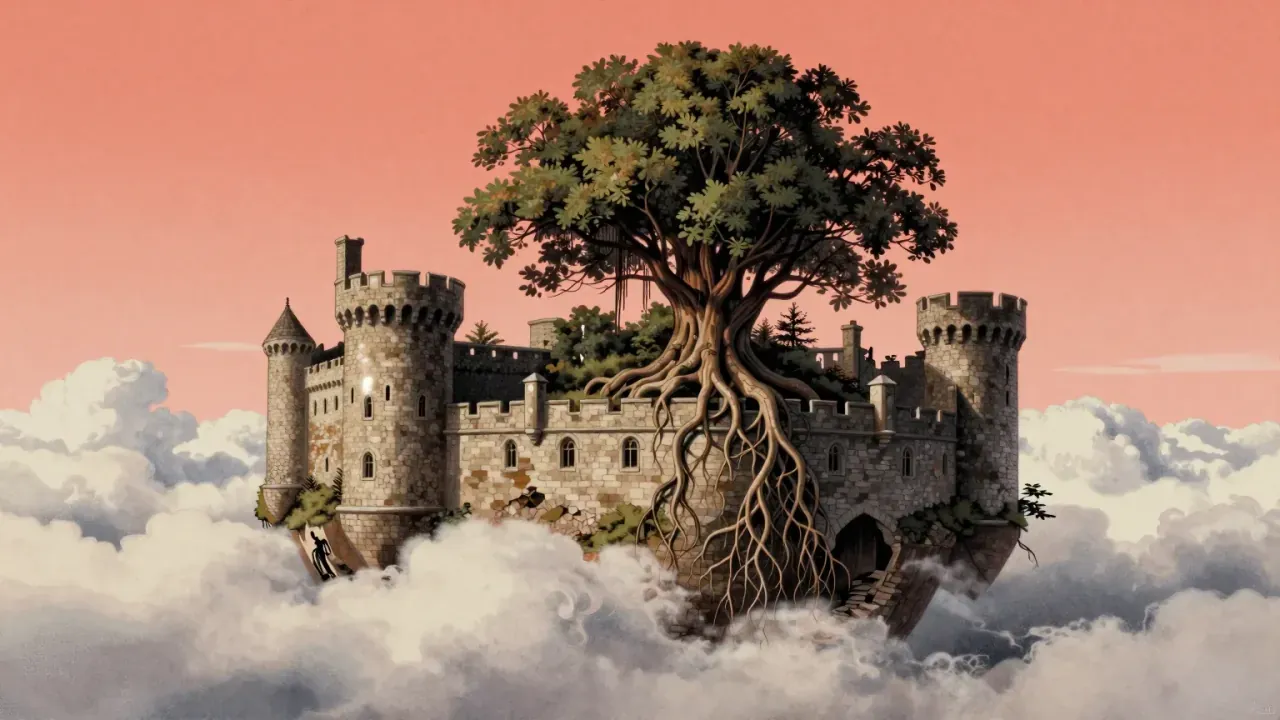
Laputa’s abandoned grandeur, reclaimed by roots and a single robot gardener, makes the film’s argument without dialogue: a civilisation that mastered flight and weaponry left nothing behind worth keeping except the tree it grew around. That image, sharpened by Miyazaki’s account of visiting Wales after the 1984-85 miners’ strike and watching a coal industry hollow out its own towns, sits underneath the chase plot as a comment on industry that consumes the ground it stands on. The film does not moralise about it directly; it simply lets the ruin sit there, overgrown, while Muska tries to seize its weapons for the army below.
Who the film is for
Older children and adults who want a hand-drawn adventure with real mechanical stakes are the audience: anyone who enjoys watching vehicles work, not just watching them explode. It rewards viewers patient with a slower, more European pace than contemporary studio animation, and with a villain who talks more than he acts until the very end. Viewers wanting the emotional density of Miyazaki’s later work, or expecting the visual polish Ghibli reached within a few more years, may find this one comparatively plain; the seams of a young studio, three years into existence, are visible in places.
A rough first draft of a great studio
It earned back only five times its budget on a first Japanese run that Miyazaki and producer Isao Takahata considered a disappointment, yet it has since sold in the millions on home video and sits at 96 percent on Rotten Tomatoes’ critic tally, a gap between initial reception and lasting reputation that the film itself explains: its pleasures are cumulative rather than immediate. As a Ghibli entry point it is uneven but honest about what it is, and the flying-machine sequences alone justify the running time for anyone curious where the studio’s visual language began.