The time of it
The Last Metro is a French drama set in Nazi-occupied Paris in 1942, centred on the Théâtre Montmartre — a working theatre whose staff sustain artistic life under censorship, antisemitism and curfew. François Truffaut co-wrote and directed it as part of an informal trilogy about entertainment worlds, following La Nuit américaine’s film industry portrait. It attempts something precise: to show cultural resistance not as heroic action but as daily, quiet persistence — rehearsing lines while hiding a Jewish director in the cellar, serving soup at midnight, adjusting lighting while Gestapo agents wait outside. The title refers literally to the last Métro train home, but also to the final, fragile passage of dignity through occupation. Truffaut avoids battlefield or partisan spectacle; instead, he treats the theatre as both sanctuary and stage for moral choices. The film does not reconstruct history but reanimates its texture — ration books, muffled arguments through heating vents, the weight of unspoken names. Its ambition is structural and ethical: to hold space for ambiguity, compromise and endurance without reducing them to allegory.
The look of it
The story unfolds across fifty-nine days of rehearsal and performance, anchored by Catherine Deneuve’s Marion — pragmatic, watchful, emotionally contained — and Gérard Depardieu’s Bernard, whose Resistance work remains offscreen until it ruptures his theatrical life. Heinz Bennent’s Lucas, confined to the cellar, speaks only in fragments heard through ducts or in hushed nocturnal meetings. Néstor Almendros’ cinematography uses natural light where possible, keeping interiors dim but legible, favouring medium shots that hold characters in relation rather than isolation. Martine Barraqué’s editing sustains rhythm without hurry: pauses between lines are left intact, scene transitions follow the logic of backstage movement rather than narrative urgency. Georges Delerue’s score is restrained, often absent — when present, it underscores mood without dictating it. Jean-Pierre Kohut-Svelko’s production design renders the theatre as lived-in: paint peels, props are repurposed, costumes bear visible mending. Performances avoid grand declarations; tension builds in glances, in the way Marion adjusts her gloves before confronting Daxiat, or how Bernard hesitates before stepping into the cellar for the first time.
The weight of it
What lands most firmly is the film’s refusal to simplify moral positions. Marion’s leadership is neither saintly nor strategic — she lies, withholds, improvises, and chooses survival over purity. Bernard’s idealism is undercut by his obliviousness to Marion’s feelings and his own complicity in using the theatre as cover. Even the collaborationist critic Daxiat is given motive and voice, not caricature. The theatre itself functions as a character: its creaking floorboards, dusty fly tower and cramped dressing rooms register time and pressure more vividly than exposition. Scenes set during rehearsals — particularly those involving Jean Poiret’s gay director and Andréa Ferréol’s lesbian designer — feel grounded, not illustrative; their identities are woven into professional dynamics, not flagged for thematic emphasis. The final image — three hands joined in applause — carries weight because it follows months of withheld touch, suppressed confession and deferred resolution. The film earns its quiet catharsis by refusing to resolve contradictions: love persists alongside betrayal, art endures alongside erasure, and resistance includes both bomb-making and remembering a line correctly under duress.
The gaps in it
What does not land is the film’s occasional drift into schematic symmetry. The love triangle between Marion, Lucas and Bernard echoes earlier Truffaut structures too closely, and its emotional logic weakens in the second half: Bernard’s sudden shift from infatuation to detachment feels abrupt, not earned, and his final admission of non-love arrives without sufficient interior preparation. The Resistance subplot remains deliberately vague — a choice that serves atmosphere but undermines stakes. We never see Bernard’s comrades, his methods or his risk beyond one offscreen bombing; this abstraction makes his later withdrawal from the theatre feel less like sacrifice and more like narrative convenience. Some supporting characters — particularly Richard Bohringer’s nervous actor and Paulette Dubost’s stage manager — are sketched with affection but little development, their arcs subsumed by the central trio. The film’s restraint occasionally tips into withholding: Lucas’s confinement is physically credible but emotionally muted, and his return to the stage lacks the visceral release it might have carried had his absence been rendered with greater psychological texture. These are not failures of craft but of calibration — moments where the film’s commitment to understatement outpaces its investment in consequence.
The texture of it
The themes that matter are those embedded in practice, not pronouncement: tolerance as routine accommodation rather than ideological stance, resistance as maintenance rather than rupture, and art as labour before it is statement. Truffaut treats antisemitism not as exceptional cruelty but as one strand of a broader intolerance — visible in Daxiat’s attacks on ‘Jewish’ theatre, in the casual exclusion of certain actors from casting lists, and in the silence surrounding Lucas’s absence. Sexuality appears in the same unemphatic register: Poiret’s director gives notes on blocking, Ferréol’s designer sketches sets — their identities inform their presence but do not define their function. The film links film-making and theatre-making not through metaphor but through shared constraints: budgets, schedules, egos, technical limits. Its most persistent theme is the weight of ordinary time under extraordinary conditions — how people measure days not in victories but in whether the lights stayed on, whether the script was memorised, whether the last Métro still ran. This is not a film about heroes or villains, but about the cumulative ethics of showing up, night after night, in a space you refuse to let go of.
The audience for it
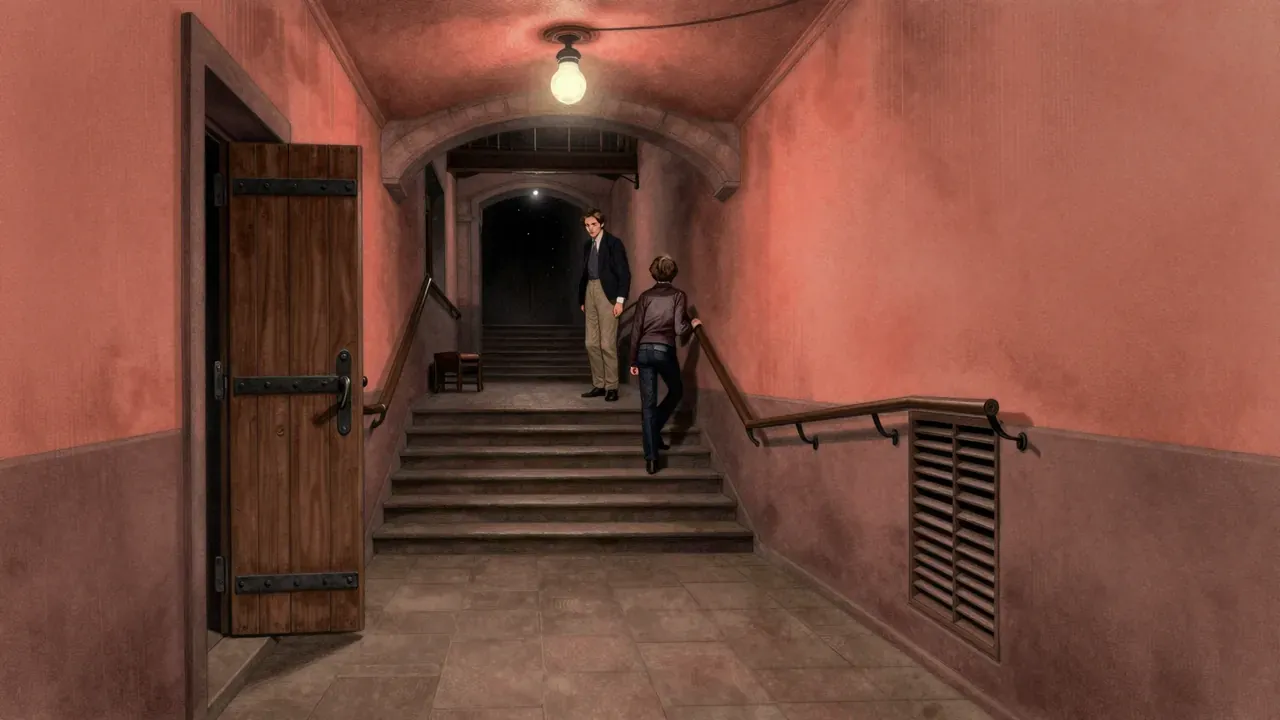
This film is for viewers who value sustained mood over plot propulsion, who find tension in silence and significance in gesture, and who trust that historical weight can settle in a glance or a pause. It suits those familiar with Truffaut’s pacing and with French post-war cinema’s preference for psychological realism over exposition. It is not for viewers who require clear moral binaries, rapid narrative escalation or explicit exposition of political context — the film assumes knowledge of the Vichy regime, Je suis partout’s role and the mechanics of German occupation. Those expecting a war film will find little combat; those seeking romantic closure will find its ending bittersweet and unresolved. A viewer who values narrative efficiency over atmospheric accumulation may find its 131 minutes dilatory. Someone who prefers documentary clarity on historical detail may chafe at the film’s selective focus. But for those willing to sit with its rhythms — to notice how light falls on a staircase at 10 p.m., or how a single prop recurs across scenes — it offers a rare density of implication, built not through speech but through sustained attention to what people do when they think no one is watching.
The time it takes
Yes, it is worth your evening — not as escapism but as immersion in a carefully calibrated world where every object, line and silence has accrued meaning across decades of cinematic thought. Its 131 minutes unfold without haste, yet never waste time: each scene advances character, deepens setting or reframes earlier choices. The performances, especially Deneuve’s controlled reserve and Depardieu’s restless physicality, reward close attention. Its historical setting is neither backdrop nor lesson but lived environment — fuel shortages shape dialogue, curfews dictate scene length, censorship alters rehearsal dynamics. Those who dislike slow-burn dramas or find Truffaut’s style overly literary may prefer something more direct. But for anyone willing to meet the film on its own terms — to accept that resistance can be quiet, love ambiguous and endings open — it repays attention with quiet precision. It does not shout its importance; it earns it, scene by scene, in the space between words.