The story it tells
The Right Stuff is a historical epic about American aviation and spaceflight in the 1940s and 1950s, centred on test pilots at Edwards Air Force Base and the Mercury Seven astronauts. It adapts Tom Wolfe’s 1979 book not as strict biography but as myth-making: it treats courage, competition, and celebrity as forces that shape institutions as much as engineering does. Philip Kaufman structures the film around two parallel lines — Chuck Yeager’s solitary, physical mastery of speed, and the seven astronauts’ collective, media-managed ascent into orbit — to ask how heroism changes when it becomes public property. The film does not aim for documentary fidelity; instead, it uses stylised realism to dramatise the shift from individual daring to bureaucratic spectacle. Its ambition is structural and tonal: to hold Yeager’s taciturn integrity against Glenn’s polished ambition without declaring either superior. It tries to show what ‘the right stuff’ meant before NASA codified it — not just skill or bravery, but a particular kind of unspoken agreement between men, machines, and mortality. That agreement dissolves as the programme grows, and the film charts that dissolution with deliberate gravity.
The look of it
The story unfolds in three movements: the desert years of test flying, the astronaut selection and training, and the Mercury launches themselves. Caleb Deschanel’s cinematography favours wide, sun-bleached compositions for the Mojave sequences and tighter, cooler frames for Cape Canaveral, reinforcing the shift from open sky to controlled theatre. Bill Conti’s score alternates brassy fanfares with sparse, percussive motifs — never sentimental, always propulsive. Performances are calibrated to type without caricature: Sam Shepard’s Yeager is all stillness and dry wit; Ed Harris’s Glenn is tightly wound, precise in gesture and speech; Fred Ward’s Gordo Cooper carries a loose-limbed charm that masks calculation. The editing by Glenn Farr sustains rhythm across 184 minutes by cutting on motion — a spinning centrifuge, a rolling aircraft tyre, a rising rocket — rather than dialogue. Sound design is unusually dense: the press corps’ locust chatter, the hiss of oxygen lines, the metallic groan of capsule hatches. These elements do not ornament the story; they constitute its texture, making bureaucracy feel tactile and heroism feel heavy.
The places it lives
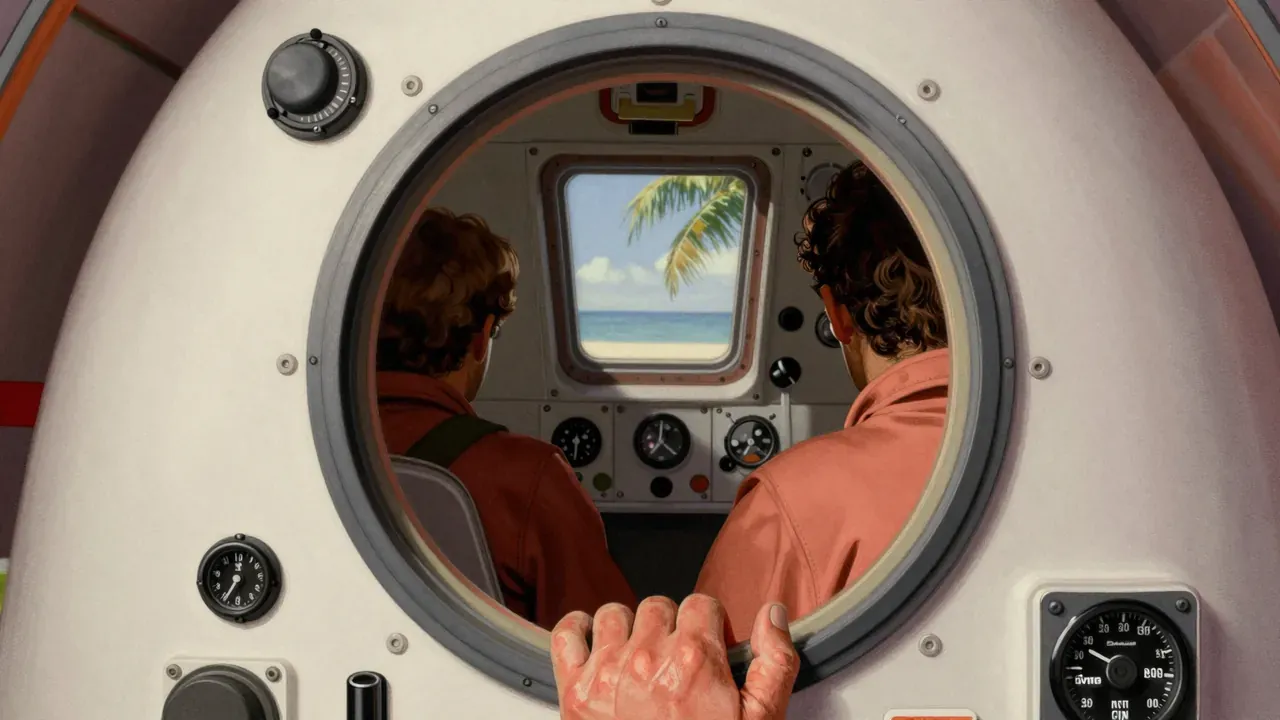
What lands most firmly is the film’s sense of place and hierarchy. The Mojave sequences — shot on location at Edwards and Hamilton AFB — convey scale and isolation with minimal exposition: a single C-47 taxiing across cracked salt flats says more about postwar aerospace than any voiceover could. The contrast between Yeager’s X-1 cockpit and the Mercury capsule is rendered physically: one is a pilot’s extension of self, the other a passenger seat bolted inside a machine he cannot control. Barbara Hershey’s Annie Glenn emerges not as a symbol but as a quiet counterweight — her anxiety during launch broadcasts is grounded in specific, unshowy detail: the way she grips a coffee cup, the pause before answering a reporter’s question. The film’s pacing also works where it trusts silence: Yeager’s walk back to base after ejecting, the long take of the wives watching television in Novato, the slow pan across the Mercury control room during countdown. These moments do not explain feeling; they allow it to settle. The craft choices cohere because they serve the same idea: that institutional progress depends on erasing the very qualities that made it possible.
The facts it bends
What does not land is the film’s handling of Gus Grissom’s Liberty Bell 7 incident. The sequence implies panic and poor judgment, contradicting both the official investigation and later scholarship, and reduces a complex technical failure to moral shorthand. The portrayal misrepresents Grissom’s character without narrative payoff — it adds no thematic weight, only confusion. Similarly, the compression of recruitment timelines — showing Cooper, Grissom, and Slayton together at Edwards years before their actual postings — undermines the film’s own emphasis on authenticity of environment. These are not minor inaccuracies; they distort cause and consequence. The film’s decision to keep Jack Ridley alive past his real 1957 death also weakens the logic of its central contrast: if Yeager’s world is defined by loss and risk, Ridley’s continued presence blurs the boundary between lived experience and legend. The film’s tone occasionally falters too — a few speeches about patriotism land with the stiffness of studio-era prologues, and the framing device of Levon Helm’s narration, while evocative, sometimes overstates what the images already convey. These missteps do not derail the film, but they interrupt its otherwise steady immersion.
The questions it asks
The themes that matter are endurance, visibility, and the cost of translation — from airman to astronaut, from man to icon, from private act to public event. The film treats fame not as reward but as a form of containment: once the astronauts sign with Life magazine, their personal lives become contractual obligations, their marriages subject to editorial review. This is clearest in the wives’ subplot, where domesticity is reframed as national duty — not through polemic, but through repeated shots of identical houses, matching dresses, rehearsed smiles. Another theme is institutional memory: NASA absorbs the test pilots’ language, rituals, and hierarchies, then discards the individuals who created them. Yeager remains outside not because he lacks ability, but because he refuses the performance required to enter. The film also interrogates masculinity as a set of behaviours under pressure — stoicism, competitiveness, aversion to explanation — and shows how those behaviours succeed in one context (breaking the sound barrier) and fail in another (negotiating press conferences). None of this is stated outright; it accrues through repetition, contrast, and withheld information.
Who it speaks to
This film is for viewers who value sustained atmosphere over plot propulsion, who find meaning in composition and duration, and who accept that historical films are arguments about the past, not transcripts of it. It rewards attention to background detail: the way uniforms change between scenes, how lighting shifts from natural to fluorescent as the story moves from desert to Cape, the subtle differences in how each astronaut stands during group photos. It is not for viewers who require clear moral alignment, rapid pacing, or narrative closure — the film ends not with triumph but with ambiguity, as Yeager flies alone while Glenn orbits overhead. Those who expect biographical precision will be frustrated by its selective chronology and composite characters. Viewers seeking straightforward inspiration may find its tone too dry, its heroes too flawed. But anyone willing to sit with its rhythms — to notice how often men look away from the camera, how silence functions as resistance — will find its portrait of ambition and obsolescence quietly devastating.
How it asks for your time
Yes, it is worth your evening — provided you watch it whole, in one sitting, without interruption. Its length is structural, not indulgent: the 184 minutes let the viewer feel the weight of waiting — for test flights, for selection boards, for launch windows — and that patience is part of its argument. The film’s power lies in accumulation: small details gain resonance across hours, and its final image — Yeager flying solo while Glenn circles Earth — only lands because the preceding three hours have made both men legible on their own terms. Anyone who watches it expecting brisk entertainment will leave dissatisfied; those who approach it as a study in tone, texture, and transition will find it richly repaid. Its box-office failure was not a verdict on quality but on mismatched expectations: it is not a crowd-pleaser, but a slow-burn institution-builder. To skip it is to miss one of the last American epics built on craft rather than franchise logic.