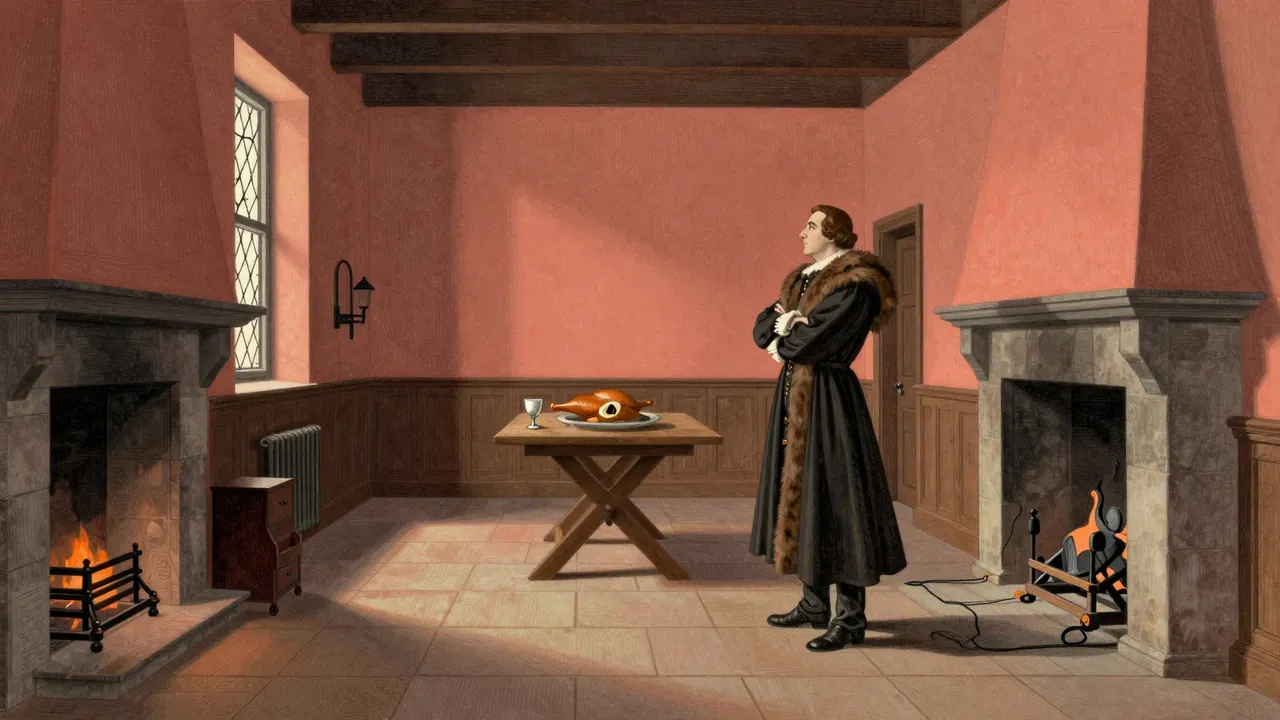
The weight of the name
The Private Life of Don Juan is a 1934 British comedy-drama produced and directed by Alexander Korda, adapting Henry Bataille’s 1920 play L’homme à la Rose via Frederick Lonsdale’s screenplay. It attempts something rare for its moment: a self-aware, late-life reckoning with myth, reputation, and sexual legend — not as farce nor tragedy, but as gently ironic social theatre. Douglas Fairbanks, aged fifty-one and nearing the end of his career, plays Don Juan not as a libertine but as a man whose name has outlived his agency, whose exploits have been transcribed into fiction while he remains quietly unrecognised. The film does not seek to rekindle swashbuckling energy but to let it settle, like dust on a sword rack. Its ambition lies in tonal precision — sustaining a mood of wry melancholy beneath light dialogue and ornate sets — and in asking whether identity can survive its own caricature. It is neither a satire of heroism nor a defence of it, but an inventory of what remains when the applause stops and the door closes.
The look of it
The story follows Don Juan’s return to Seville after twenty years’ exile, his evasion of legal and marital consequences, and his gradual erasure by a public that prefers the legend to the man. Georges Périnal’s cinematography favours soft focus and shallow depth, keeping interiors warm but indistinct, as if memory itself were slightly blurred. Ernst Toch’s score is restrained, leaning on piano and strings without thematic insistence. Fairbanks moves with deliberate economy — less acrobatic than attentive — while Merle Oberon’s Antonita and Benita Hume’s Dolores anchor the emotional register with quiet resolve rather than theatrical heat. Athene Seyler’s Theresa and Melville Cooper’s Leporello offer grounded counterpoints: one pragmatic, the other weary. Barry MacKay’s Rodrigo is played with earnest mimicry, not mockery, making his death feel less like plot necessity than structural irony. The production design, though uncredited in the sheet, reads as interwar British studio craft: polished, stage-adjacent, with painted backdrops visible in long shots and costumes that signal class more than character.
The logic of the legend
What lands is the film’s central conceit: that fame can become a kind of burial. When Don Juan attends his own funeral — seated among mourners who quote lines from the play about him — the scene works not as slapstick but as quiet disorientation, a visual paradox made legible by Fairbanks’s stillness and the crowd’s unselfconscious reverence. The repeated motif of mistaken identity gains weight because no one questions the fiction; they simply absorb it. Oberon’s Antonita, though given little backstory, registers as a presence who sees Don Juan clearly — not as myth or relic, but as a man who forgets to eat and misplaces his gloves. The final reunion, breaking glass to enter a bedroom, avoids sentimentality by refusing resolution: it is physical, impulsive, and slightly absurd, a gesture that acknowledges desire without pretending it solves anything. The pacing, at 87 minutes, allows scenes to breathe without lingering — a rare discipline in studio-era British film, where exposition often overruns intention.
The story that writes itself
What does not land is the framing device of the play-within-the-film. Cardona’s dramatisation of Don Juan’s life is presented as both popular success and artistic failure, yet the script never clarifies why it succeeds or how it distorts — we see only its reception, not its content. The subplot involving Rodrigo’s impersonation collapses too neatly into coincidence, lacking the moral or psychological friction that would make his death consequential beyond plot mechanics. Some supporting performances drift into caricature: Binnie Barnes’s Rosita and Gibson Gowland’s Don Alfredo operate at a higher pitch than the film’s prevailing tone, creating brief dissonances rather than contrast. The café scenes, meant to evoke Sevillian bustle, feel stage-bound and underpopulated, their dialogue functional rather than revealing. There is also a persistent vagueness around Dolores’s motives: her threat of imprisonment is stated but never contextualised, leaving her authority unexamined and her eventual reconciliation unearned. These are not flaws of execution but of selective omission — gaps the script chooses not to fill.
The shape of time
The themes that matter are ageing as discontinuity, reputation as a second self, and performance as habit rather than choice. Don Juan does not pretend to be someone else; he has simply stopped correcting people. His body betrays him — he tires easily, needs a masseur, avoids stairs — yet his name still carries weight, not because he commands it, but because others invest in it. The film treats romance not as passion but as ritual: the dances, the declarations, the window-breaking are repetitions of form, stripped of first-time urgency. Class operates quietly but insistently: the innkeeper, the cook, the maid all move through the same spaces as Don Juan but occupy different grammars of speech and deference. There is no critique of empire or colonialism here, but a subtle awareness of how British studio craft — with its Elstree sets, its expatriate cast, its French source material filtered through English wit — rehearses its own version of cultural translation: elegant, partial, and always slightly removed from the soil it pretends to depict.
The star who steps aside
This film is for viewers who value tonal consistency over narrative propulsion, who find interest in the gap between public image and private exhaustion, and who appreciate Fairbanks not as the star of The Mark of Zorro but as an actor calibrating late-career presence. It rewards attention to gesture, silence, and costume detail — the way Oberon adjusts a shawl before speaking, or how Seyler’s Theresa wipes her hands on her apron mid-conversation. It is not for those who require clear moral stakes, escalating conflict, or psychological exposition; viewers expecting either broad comedy or romantic catharsis will find the film withholding. Those who dislike studio-era artifice — painted skies, unmoving crowds, dialogue that favours rhythm over realism — may find its textures alienating. A viewer who values historical context over emotional immediacy might prefer the 1920s silent Don Juans; one who seeks feminist revisionism will not find it here. The verdict changes only if you believe irony must be sharp to be meaningful — this irony is blunt, worn smooth by time.
The window that opens inward
Yes, it is worth your evening — provided you watch it without expectation of momentum or revelation, and with willingness to sit inside its mild, measured irony. It occupies a narrow but distinct place in British cinema: not a prestige drama, not a vehicle for Fairbanks’s athleticism, but a coda written in pastel tones. Its value lies in what it refuses: no last-minute redemption, no grand pronouncement on love or mortality, no attempt to reconcile myth and man. Instead, it offers a portrait of quiet persistence — of a man who keeps moving, even when no one is watching, even when they think he is dead. That restraint is uncommon, and increasingly rare. It demands nothing but attention, and repays it with precision. Anyone who has ever felt out of step with their own biography will recognise something here. Those who need affirmation, escalation, or closure will leave unsatisfied — not because the film fails, but because it declines to offer what it knows cannot be delivered honestly.