The shape of the plan
The Moon Has Risen is a domestic comedy-drama set in postwar Nara, built around matchmaking, sisterly loyalty, and quiet resistance to social expectation. It does not aim for satire or farce but for gentle, observant orchestration of character-driven tension: the pressure on an unmarried woman in her late twenties, the unspoken weight of filial duty, and the small, deliberate acts by which a younger sister tries to steer her sibling toward self-determined happiness. Kinuyo Tanaka’s direction treats this material with restraint — no broad gestures, no moralising, no narrative shortcuts. The film works within the conventions of Japanese middle-class realism of the mid-1950s, yet departs from them by centring a young woman’s agency not as rebellion but as careful, iterative intervention. It is not a critique of tradition so much as a demonstration of how tradition can be navigated without surrender — through timing, tact, and the quiet authority of shared space. Its ambition is modest in scale but precise in focus: to show how love might be coaxed into being, not declared, not seized, but gently arranged like flowers in a low vase. (158 words)
The look of it
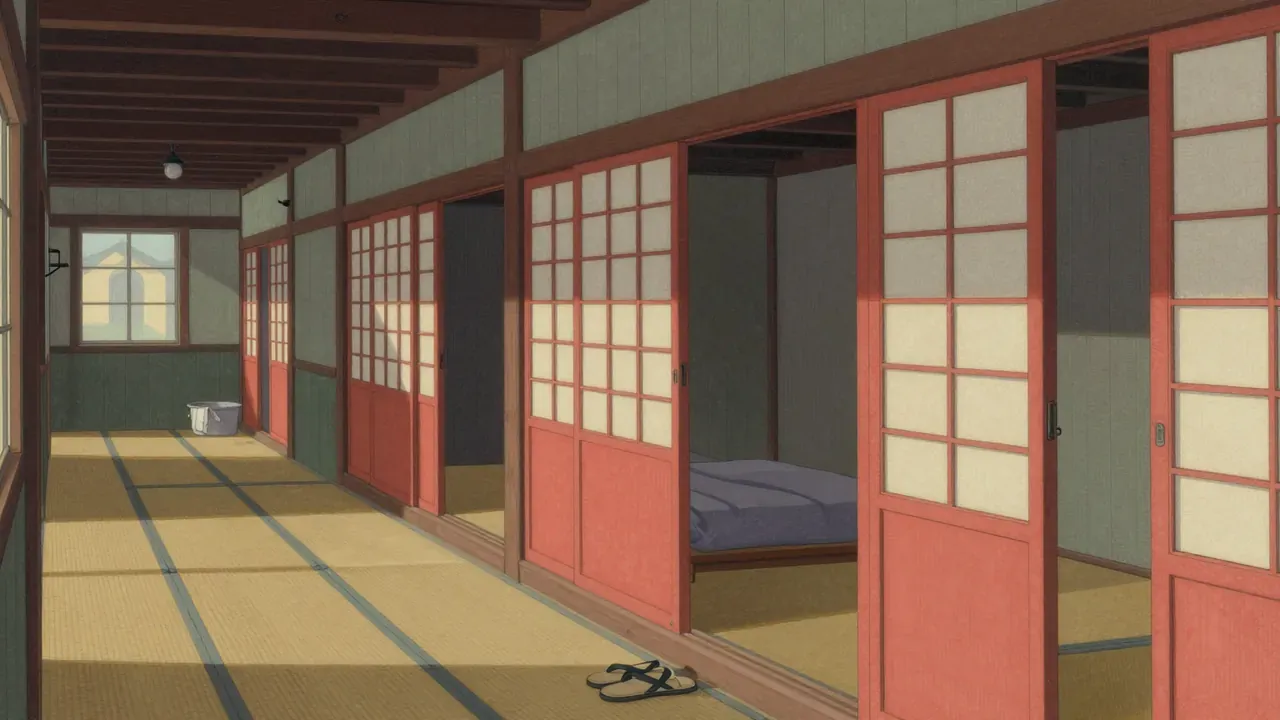
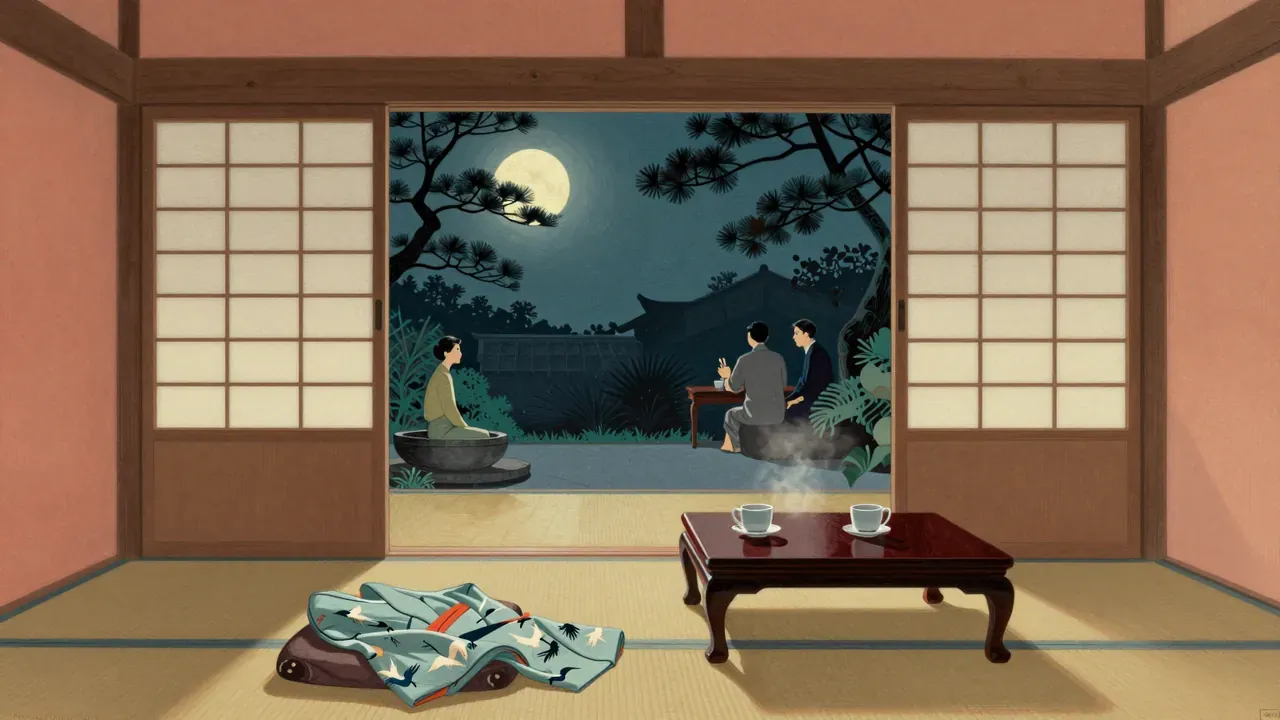
The story unfolds across a few days and rooms — a veranda, a garden, a sitting room — its rhythm governed by pauses, glances, and the measured pace of Shigeyoshi Mine’s cinematography, which favours medium shots and steady compositions over movement. Chishū Ryū plays Mokichi Asai with his customary stillness, a presence more felt than heard; Yōko Sugi’s Ayako carries resignation in her posture before softening into tentative hope; Mie Kitahara’s Setsuko moves with purposeful lightness, her schemes never cruel, never rushed. Takanobu Saitō’s score is sparse, mostly piano and koto, used only to underline transitions, never to explain emotion. Mitsuo Kondo’s editing avoids cross-cutting or urgency: scenes end when their emotional weight has settled, not when plot demands it. Yasujirō Ozu’s script — unused by him, gifted to Tanaka — bears his hallmarks: low-angle framing, recurring motifs (the moon, teacups, sliding doors), and dialogue that implies more than it states. But Tanaka’s hand is distinct: warmer, less austere, more willing to let characters speak plainly when they need to. (159 words)
What holds the air
What lands is the film’s fidelity to emotional gradation — the way a glance shifts from doubt to amusement, how silence thickens before a decision is voiced, how a walk taken at dusk becomes charged not by what is said but by who walks beside whom and how close they keep to the path’s edge. Setsuko’s interventions feel credible because they are small: she rearranges seating, delays a departure, asks a question just once and waits. The performances avoid caricature — even the aunt, played with brisk efficiency by Hisako Yamane, is not a villain but a woman operating within narrow parameters of social logic. The moonlit walk itself arrives not as climax but as quiet culmination: no confession, no kiss, just two people walking, shoulders almost touching, under a sky that has risen exactly as promised. The film trusts the audience to register the significance of that nearness, the relief in Ayako’s breathing, the slight lift in Setsuko’s step as she watches from a distance. This restraint gives the film its cumulative weight — it accumulates meaning like dew, not thunder. (157 words)
Where the frame thins
What does not land is the structural looseness around Shōji Yasui’s character. Introduced as a confidant and sounding board, he remains under-defined — his motivations, his history with the family, even his profession, go unexplained. His presence feels functional rather than organic, a device to voice Setsuko’s thoughts rather than a fully realised participant in the household’s rhythms. Similarly, Kō Mishima’s Amamiya, though charming, lacks sufficient backstory to make his re-entry into Ayako’s life feel consequential beyond plot necessity. The film assumes familiarity with the social codes it depicts — the weight of a bank manager’s son as a suitor, the stigma of delayed marriage — without dramatising those pressures beyond the aunt’s fretting. A viewer unfamiliar with mid-century Japanese courtship norms may miss why certain choices carry such quiet gravity. The pacing, while deliberate, occasionally drifts into stasis: one extended scene in the garden, though beautifully lit, adds little forward motion or new insight. These are not flaws of craft but of calibration — moments where the film’s patience outpaces its narrative urgency. (159 words)
The weight of small things
The themes that matter are agency within constraint, the labour of care as quiet strategy, and the temporality of choice — how decisions made slowly, over days and conversations, can hold more weight than declarations made in crisis. The film treats marriage not as destiny or transaction but as a site of negotiation between individual desire and collective expectation. Setsuko’s role is not to choose for her sister but to widen the field of possibility, to make visible alternatives that had been obscured by routine. Ageing is present not as decline but as shifting social positioning: Ayako’s ‘lateness’ is measured not by biology but by custom, and the film registers how that measurement bends perception — making her seem both fragile and formidable. The moon, recurring but never symbolic in a heavy-handed way, functions as a marker of time’s passage and of natural rhythm — a counterpoint to the artificial timelines imposed by matchmakers and banks. There is no grand statement about freedom, only the daily work of preserving dignity within inherited structures. (156 words)
Who walks with it
This film is for viewers who value attention to gesture over exposition, who find resonance in understatement, and who are comfortable with endings that settle rather than resolve. It suits those familiar with Ozu’s aesthetic but curious about how Tanaka adapts it — less architectural, more tactile, with greater emphasis on female subjectivity as active rather than reactive. It is not for viewers seeking narrative propulsion, psychological revelation, or stylistic flourish: there are no tracking shots, no voiceover, no flashbacks, no music swells. Those who expect romantic comedy to pivot on misunderstanding or farcical escalation will find its tempo too measured, its stakes too muted. A viewer who values thematic clarity over ambiguity may grow impatient with the film’s refusal to name its positions outright. Its pleasures are cumulative and subtle — they require sustained attention, not passive reception. Without that willingness, the film risks seeming inert rather than intentional. (158 words)
The length of the evening
Yes, it is worth your evening — provided you approach it as a study in tone and texture rather than plot. Its 102 minutes unfold with the unhurried certainty of a well-tended garden: nothing is wasted, nothing is forced, and every detail serves the atmosphere of quiet possibility. It rewards patience not with payoff but with precision — the exact angle of a teacup held, the pause before a sentence is completed, the way light falls across a tatami mat at 7.12 p.m. Those who find pleasure in such specificity will leave with a sense of having witnessed something tenderly calibrated and deeply humane. Others may find it thin — and they would not be wrong, if their priority is momentum or catharsis. What would change the verdict? A tighter focus on Shōji’s function, or a clearer dramatisation of the social stakes for Ayako. But as it stands, its modesty is its integrity. (159 words)