What it is
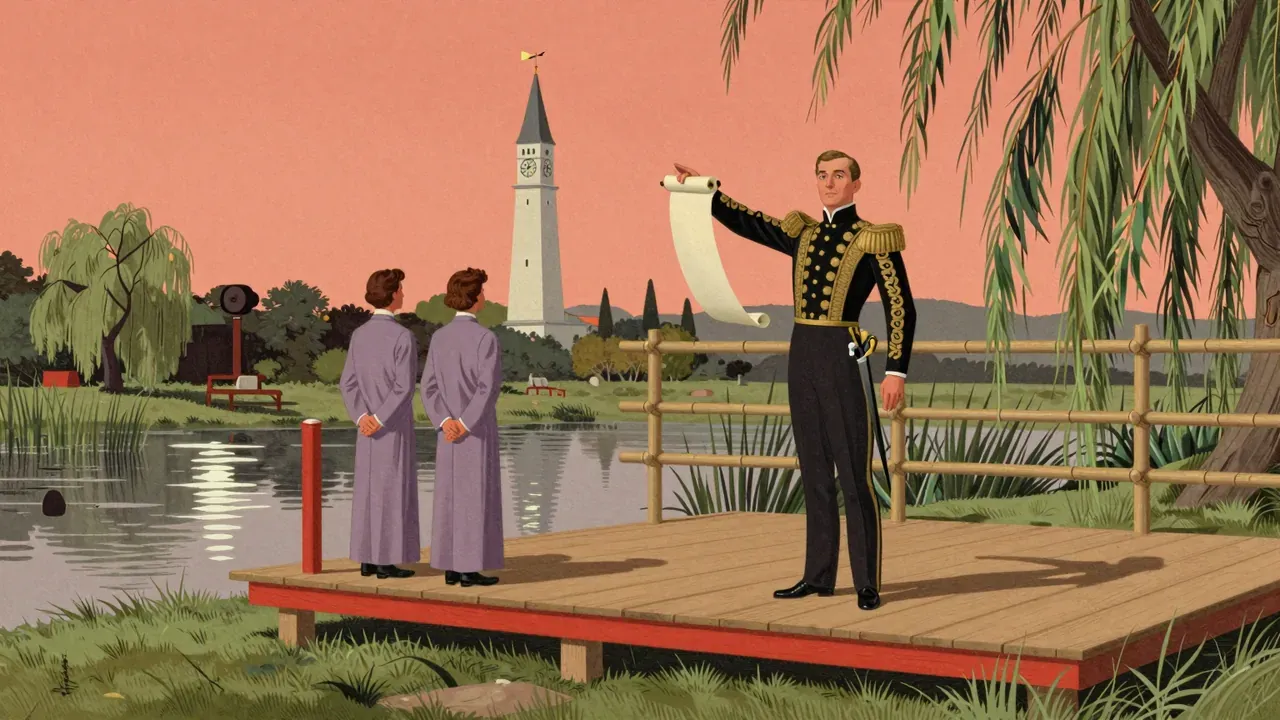
The Mikado is a 1939 British Technicolor film adaptation of Gilbert and Sullivan’s 1885 comic opera, produced by Geoffrey Toye and directed by Victor Schertzinger. It attempts to transpose the stage work — with its intricate patter songs, satirical bureaucracy, and stylised Japanese setting — into a cinematic form without abandoning the integrity of the original score or libretto. The film does not seek realism: its Japan is a painted, pastel-coloured fiction, drawn from Victorian theatrical convention rather than geography. Its ambition lies in fidelity — not to history or ethnography, but to the D’Oyly Carte tradition, preserving vocal phrasing, rhythmic precision and ensemble timing as performed by company veterans. It treats the opera as a complete musical architecture, not raw material for reinvention. The adaptation trims scenes and rearranges some numbers, but never substitutes Sullivan’s music or Gilbert’s words. This is not a reinterpretation; it is a documentation of a particular performance practice at a particular moment — one that happens to be shot on film, in colour, with orchestral backing from the London Symphony Orchestra. Word count: 148.
How it works
The film works through disciplined ensemble acting and musical continuity. Martyn Green’s Ko-Ko retains his stage timing and vocal clarity, his physical comedy calibrated to the camera’s fixed mid-shots. Sydney Granville’s Pooh-Bah moves with bureaucratic gravity, his layered authority conveyed through posture and diction rather than close-ups. Kenny Baker sings Nanki-Poo with lyrical ease but limited dramatic shading; Jean Colin’s Yum-Yum is light-voiced and poised, though her line readings lack the irony the role invites. William V. Skall and Bernard Knowles keep the lighting even and the sets legible, favouring full-stage compositions over fragmentation. Marcel Vertès’s costumes and art direction are lush but unobtrusive — the colours pop in Technicolor without overwhelming the performers. Editing by Gene Milford follows musical phrases rather than narrative beats, cutting on cadences. The orchestra remains audible and balanced throughout, never buried under dialogue. There is no attempt at psychological realism or spatial logic: characters enter and exit as they would on stage, and the town of Titipu exists as a single, coherent playing space. Word count: 156.
What lands
What lands is the music, delivered with unbroken professionalism. Every principal singer was drawn from the D’Oyly Carte Opera Company, and their collective muscle — in breath control, vowel alignment, and rhythmic unanimity — carries the film through static passages. The ‘Three Little Maids’ number, filmed in soft-focus pastel light, achieves both visual charm and vocal precision. Ko-Ko’s ‘I’ve Got a Little List’ retains its satirical bite because Green delivers it with deadpan specificity, not caricature. The ensemble finales — especially the Act I curtain — hold their momentum across cuts, sustained by Geoffrey Toye’s conducting and the LSO’s crisp articulation. The film’s most successful moments occur when it stops pretending to be cinema and embraces its nature as a recorded performance: the chorus enters in unison, the camera holds steady, and the music fills the frame. There is no illusion of spontaneity, but there is authority — the kind earned over decades of nightly repetition. That authority is palpable, and it is the film’s strongest asset. Word count: 152.
What does not
What does not land is the attempt at cinematic expansion beyond the stage template. The film adds no new subtext, no visual metaphor, no psychological dimension to the characters — and makes no effort to justify its Japanese setting beyond decorative shorthand. The casting of white actors in stylised ‘Japanese’ makeup and costumes feels neither ironic nor interrogative; it is simply unexamined convention, rendered more conspicuous by Technicolor’s fidelity. Scenes meant to convey intimacy — such as Nanki-Poo and Yum-Yum’s exchanges — remain stiff, their blocking inherited from the Savoy Theatre rather than recalibrated for the medium. The film’s pacing suffers in dialogue passages, where delivery remains declamatory and the camera offers no compensating rhythm. Some cuts feel arbitrary: the omission of Pitti-Sing’s ‘Poor Wand’ring One’ weakens her character arc. And while the satire of bureaucracy remains sharp, the film does nothing to update or contextualise Gilbert’s jabs at imperial administration — they sit inert, like museum pieces behind glass. Word count: 154.
The themes that matter
The themes that matter are those embedded in Gilbert’s text: the absurdity of legal literalism, the elasticity of official truth, and the performative nature of power. Ko-Ko’s appointment as Lord High Executioner — a man spared death so he can avoid executing others — is a sustained joke about institutional self-preservation. The Mikado’s justice system operates on paper, not principle: if a certificate says someone is dead, then legally, he is. The film does not foreground these ideas visually, but it does not obscure them either — they emerge cleanly from the libretto and staging. Class is treated with dry precision: Pooh-Bah’s accumulation of offices is less satire of greed than of administrative inertia, and his willingness to serve under an ex-tailor only when paid proves that hierarchy is transactional, not inherent. There is no theme of cultural appropriation here — the film does not engage with Japan as a place or people — but there is a consistent theme of theatrical artifice as social lubricant: everyone wears masks, sings in tune, and agrees to the fiction so the machinery keeps turning. Word count: 150.
Who should watch it
This film is for viewers who already know and value the D’Oyly Carte tradition — those who recognise Martyn Green’s Ko-Ko as definitive, or who have heard Geoffrey Toye conduct Sullivan live. It is also for students of early Technicolor musicals, or of interwar British studio craft, particularly those interested in how stage repertoire was translated to film before the era of the integrated musical. It is not for viewers seeking narrative innovation, psychological depth, or cultural critique — the film offers none. Nor is it for those unsettled by unreflective Orientalist design: the ‘Japanese’ aesthetic is decorative, not interpretive, and remains uninterrogated. A viewer expecting the tonal complexity of later G&S adaptations — say, the 1967 BBC version — will find this too reverent, too static. Those who prefer musicals driven by character development over ensemble precision will leave unmoved. Word count: 152.
Is it worth your evening
Yes, it is worth your evening — but only if you approach it as a primary source, not entertainment. It preserves a specific performance style at a historical hinge: the last major G&S film before wartime disruption, made by people who had sung these roles on stage for years. Its value lies in archival clarity, not emotional immediacy. You will not laugh harder here than at a live production, but you will hear every syllable of ‘A More Humane Mikado’ with unusual fidelity. Those who dismiss it as dated miss its purpose: it is not trying to feel new, but to endure. Detractors — including some modern G&S scholars — argue that its reverence stifles the opera’s subversive energy; they would prefer a version that questions the text as well as sings it. But for what it sets out to do — document a tradition — it succeeds without compromise. Word count: 152.