The premise
Destry Rides Again is a Western comedy made by Universal Pictures in 1939, written by Henry Myers and Gertrude Purcell, and directed by George Marshall. It sets out to subvert the genre’s conventions—not by discarding them, but by holding them up to gentle, rhythmic ridicule: a sheriff who refuses to wear a gun; a saloon girl who sings cabaret numbers between bouts of moral recalibration; a town where law arrives not with gunfire but with bureaucratic sleight-of-hand and a well-timed mop. It does not aim for satire in the brittle, modern sense, nor for parody as pastiche. Instead, it treats the Western’s tropes—corruption, vengeance, frontier justice—as shared language, then speaks that language with deliberate, unhurried wrongness: pauses where action should erupt, courtesy where menace is expected, song where silence would be safer. Its ambition is structural irony, not thematic deconstruction. It asks the audience to recognise the shape of the Western while watching its seams come undone—not violently, but with the quiet inevitability of a rope fraying under steady tension. The film’s tone is fixed early: dry, unflustered, lightly amused at its own premises.
The look of it
The story moves with the logic of a vaudeville sketch: exposition lands cleanly, reversals are signposted but never telegraphed, and every plot turn serves either character revelation or comic timing. James Stewart plays Tom Destry Jr. with low-key precision—his stillness reads as thoughtfulness, not vacancy; his politeness as strategy, not weakness. Marlene Dietrich’s Frenchy is calibrated across registers: world-weary but not cynical, performative but not hollow, capable of both slapstick and sorrow without shifting key. Hal Mohr’s cinematography avoids the high-contrast chiaroscuro common to Westerns of the period; interiors are evenly lit, faces clear, shadows soft—this is a town where nothing needs to hide, at least not yet. Frank Skinner’s score underlines rather than announces; the music swells only when the narrative permits it, never when the emotion demands it. Editing by Milton Carruth maintains a steady, unhurried pace—no cross-cutting urgency, no frantic montages. Even the cat-fight between Dietrich and Una Merkel is shot in medium long take, letting the physical comedy breathe rather than punch.
The sound of it
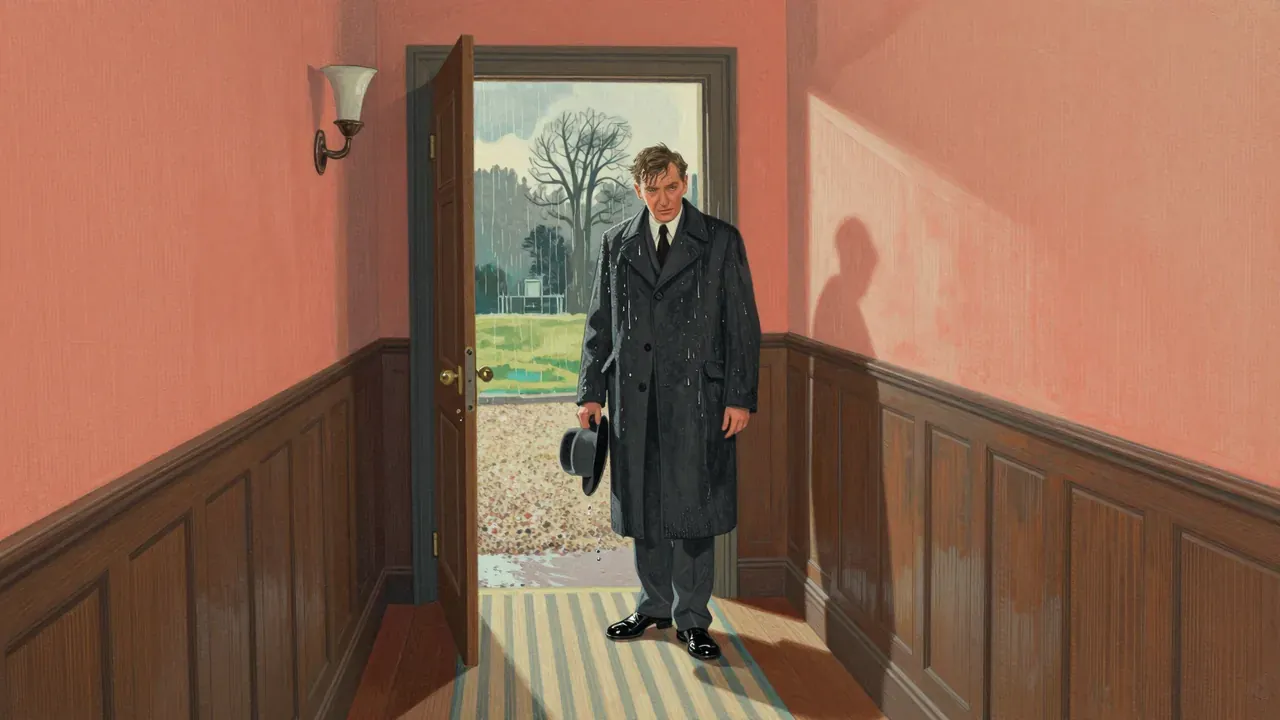
What lands most firmly is the film’s refusal to resolve contradiction. Frenchy remains both manipulator and redeemer, Kent both cartoon villain and plausible local powerbroker, Destry both pacifist and pragmatist—none of these are reconciled, and none need to be. The townspeople’s shift from mockery to allegiance feels earned because it is gradual, unspoken, and rooted in observation rather than speech: they watch Destry disarm a threat without drawing, then watch him deputise a Russian immigrant no one else would trust, then watch him let Frenchy choose her own path. The songs—‘See What the Boys in the Back Room Will Have’ and ‘You’ve Got That Look’—land not as interludes but as extensions of character: Dietrich sings them with the same wry detachment she applies to every line of dialogue. The courtroom sequence, though structurally thin, works because its absurdity is treated seriously—the mayor’s self-appointment as judge is not mocked outright, but allowed to expose itself through sheer procedural wrongness. Even the rooftop entrance, which could veer into silliness, holds weight because it follows a full minute of silent preparation: Destry buckling his belt, checking his revolver, pausing at the window.
The people in it
What does not land is the framing device—the opening and closing narration about Bottleneck’s history. It adds neither irony nor insight, and its folksy cadence sits uneasily beside the film’s otherwise dry tone. The subplot involving Jack Tyndall and his sister Janice functions only as scaffolding for the final implication of romance, and their presence dissipates whenever the central quartet—Destry, Frenchy, Kent, Dimsdale—is on screen. Brian Donlevy’s Kent, though physically imposing, lacks psychological texture: his cruelty is declarative, not accumulative, and his defeat feels less like consequence than convenience. The Russian immigrant Boris is granted agency only in service to Destry’s plan, and his motivation remains opaque beyond generalised grievance. Some supporting performances—particularly Mischa Auer’s comic relief—rely on ethnic caricature that has not aged well, and the film offers no counterweight or perspective. The ending, though tidy, resolves too much: Frenchy’s death is emotionally legible but narratively abrupt, and Destry’s assumption of office feels less like earned authority than narrative default.
The law in it
The themes that matter are civility as tactic, performance as identity, and institutional memory as both burden and tool. Destry’s nonviolence is not moral absolutism but calibrated restraint—a choice made possible only because he understands the town’s rhythms better than its residents do. Frenchy’s singing, her flirtation, her betrayal and return are all roles she inhabits with equal fluency; the film never asks whether any is ‘real’, only whether it serves the moment. The town’s collective amnesia about Sheriff Keogh’s murder is not ignorance but complicity—and Destry’s method is not to punish that silence, but to make it unsustainable by reintroducing facts as objects of public attention. The film treats law not as abstract principle but as habit: what changes Bottleneck is not a single arrest, but the repeated act of seeing justice applied, however imperfectly. Even the saloon’s transformation—from site of corruption to site of communal reckoning—is achieved not by demolition but by occupation: the women march in, not to destroy, but to reclaim space already theirs.
The fight in it
This film is for viewers who value tonal consistency over narrative velocity, who find humour in understatement rather than escalation, and who are comfortable with characters whose motives remain partially withheld. It rewards attention to gesture, pause, and inflection—not just what is said, but how long it takes to say it. It is not for those who require psychological realism in supporting roles, or who expect genre revision to announce itself with stylistic rupture. Anyone seeking moral clarity will find its ambiguities frustrating; anyone needing historical authenticity will note the anachronistic jazz piano in a 1890s saloon and disengage. The film assumes familiarity with Western conventions—not to mock them from outside, but to rewire them from within. A viewer who dislikes Dietrich’s mid-Atlantic delivery or Stewart’s relaxed diction may mistake their rhythm for lethargy. Those who prefer tightly plotted thrillers will find the pacing slack; those who demand thematic explicitness will find its ideas embedded, not declared.
The end of it
Yes, it is worth your evening—if you approach it as a piece of sustained tonal craft rather than a story-driven diversion. Its ninety-four minutes unfold with the deliberation of a well-rehearsed stage play: every scene earns its duration, every silence has weight, every reversal is prepared long before it arrives. It does not ask for emotional investment in the way a drama does, but for intellectual alignment with its method: watching civility function as both shield and weapon, watching performance become substance. Those who dislike it tend to cite its lack of urgency or its dated supporting turns—but those are features, not bugs, of its design. Change the pacing, sharpen the villains, or clarify the secondary relationships, and the film loses its defining quality: the quiet confidence of its own slowness. It remains watchable not because it improves with time, but because its rhythm resists acceleration. It is a film that works best when watched once, slowly, then remembered not for plot but for posture.