The look of it
The Maltese Falcon is a crime film adapted from Dashiell Hammett’s 1930 novel, directed by John Huston as his debut feature. It sets out to translate the terse, morally unmoored world of hard-boiled fiction into cinema without softening its edges: no redemption arcs, no explanatory voiceover, no moral pivot for the protagonist. The film treats San Francisco not as backdrop but as a pressure chamber where greed and deception operate with procedural precision. It avoids exposition in favour of implication — motives are withheld, alliances shift mid-scene, and dialogue functions less as revelation than as misdirection. Huston’s script retains nearly all of Hammett’s original lines, pruning only the Flitcraft anecdote and excising references to homosexuality and overt sexuality to comply with the Production Code. Its ambition is structural as much as tonal: to sustain narrative tension through accumulation of detail rather than escalation of action, and to anchor that tension in character behaviour rather than plot mechanics. It does not seek to explain why people lie, only to show how they do it — and how often they get away with it.
The sound of it
The film works through tight control of pace, performance economy, and compositional restraint. Arthur Edeson’s cinematography uses low-key lighting and deep focus not for mood alone but to fix attention on faces during exchanges — Bogart’s stillness opposite Greenstreet’s voluble bulk, Lorre’s nervous glances measured against Astor’s controlled ambiguity. Performances avoid broad strokes: Bogart’s Spade is neither cynical nor noble, but methodical, observant, and physically unhurried; Astor’s Brigid never pleads, only recalibrates; Greenstreet’s Gutman speaks in paragraphs but never loses command of the room. Editing by Thomas Richards maintains continuity without emphasis — cuts land where the eye expects them, never to startle. Adolph Deutsch’s score is sparse, functional, rarely underlining emotion. The script’s fidelity to Hammett means dialogue carries weight without flourish: characters speak in clipped sentences, interrupt each other, pause to light cigarettes or pour drinks. Even the reshoots ordered by Jack Warner — tightening the opening — reinforce the film’s commitment to narrative efficiency over exposition. There are no establishing shots of San Francisco skyline; the city enters only through fogged windows, rain-slicked pavement, and the sound of distant sirens.
The rules of it
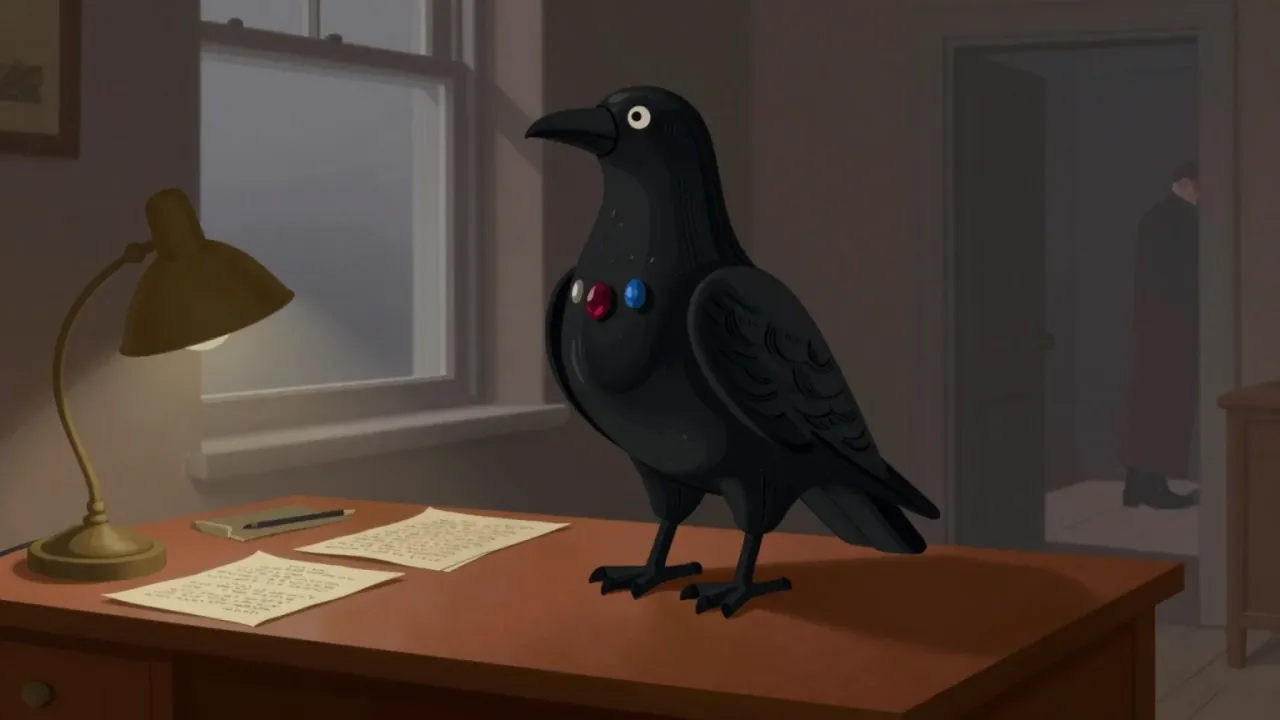
What lands is the cumulative weight of moral exhaustion. The falcon itself — a prop encrusted with garnets and sapphires, sculpted by Fred Sexton — remains inert, silent, and ultimately worthless, yet every major character kills, betrays, or lies for it. That irony holds firm across eighty years because the film never winks at it. Spade’s final dismissal of Brigid is not cathartic but procedural: he hands her over not out of justice but because the alternative would compromise his own terms of operation. The performances land because they refuse psychology — Greenstreet’s laugh is not ‘sinister’ but simply loud and unapologetic; Lorre’s Cairo does not tremble from fear but from calculation gone slightly awry. The long take in Gutman’s apartment — seven minutes of uninterrupted movement through rooms and hallways — lands not as technical showmanship but as spatial logic: the camera follows the negotiation because the power dynamic shifts with every doorway crossed. Even minor roles register: Elisha Cook Jr.’s Wilmer is not a thug but a man whose pride outruns his competence, and his exit line — delivered flatly, without inflection — lingers precisely because it offers no release.
The weight of it
What does not land is the attempt to render Spade’s inner life legible. The film gives him no soliloquy, no flashback, no moment of doubt — and that austerity, while faithful to Hammett, leaves little room for empathy beyond professional respect. Some viewers may find the emotional temperature too low, the stakes too abstract once the falcon’s futility becomes clear. The supporting characters’ motivations narrow as the plot tightens: Gutman’s obsession, Cairo’s loyalty, Brigid’s duplicity all resolve into variations on the same transactional logic, which risks flattening their individuality. The Hays Office edits also remove texture: the original novel’s references to homosexuality and the more explicit physicality between characters (including Spade’s strip-search of Wonderly) were cut, leaving some interactions without their full subtextual charge. The film’s refusal to explain — admirable in principle — can feel withholding when applied to character history rather than plot. A viewer expecting moral reckoning or psychological closure will find neither. The ending does not resolve feeling; it closes a file.
The law of it
The themes that matter are not loyalty or justice but the architecture of trust — how it is built, exploited, and discarded. The film treats deception as a craft, not a flaw: Brigid constructs identities like garments; Gutman narrates his own legend as if auditioning for it; Spade reads lies the way others read weather. Money appears only as a medium of exchange, never as aspiration — no character wants wealth for comfort, only for leverage. The city operates as a system of nested obligations: police, clients, partners, lovers — all bound by informal contracts that expire the moment advantage shifts. Time is linear but not progressive: characters repeat patterns (Spade’s relationship with Iva, Brigid’s with Thursby), suggesting no learning, only recalibration. The falcon stands not for desire but for the idea of value as consensus — something believed in until belief collapses. There is no metaphysical dimension, no spiritual consequence; consequences are administrative, legal, or physical. The film’s quietest theme is endurance: Spade endures not because he is strong, but because he refuses to mistake persistence for virtue.
The cost of it
It is for viewers who value precision over persuasion, implication over explanation, and moral ambiguity over resolution. It suits those accustomed to dialogue that does not serve the audience but the speaker — where pauses carry meaning and silences are tactical. It is not for those who require emotional payoff, narrative symmetry, or protagonists with interior lives laid bare. Viewers who expect genre signposts — chases, shootouts, romantic catharsis — will find little here beyond two fistfights and one arrest. Those who associate ‘film noir’ with stylised shadows and fatalism may miss how dry and procedural this film is: there are no voiceovers, no chiaroscuro glamour, no doomed romance. A viewer who prefers character-driven drama with psychological depth — say, Kazan or Bergman — may find Huston’s approach too detached. What would change the verdict? A longer runtime allowing for the Flitcraft story or deeper exploration of Spade’s past might soften the austerity — but that would also dilute the film’s central discipline.
The end of it
Yes, it is worth your evening — not as escapism but as calibration. Watching it resets expectations of what a crime film can withhold and still deliver: tension without chase, stakes without sentiment, authority without heroism. Its 101 minutes pass without strain because nothing is wasted — no scene establishes mood, no line explains motive, no shot flatters the actor. It rewards attention to gesture: how Bogart leans back before answering, how Astor blinks twice before lying, how Greenstreet’s stomach fills the frame not for ridicule but as gravitational centre. It is not ‘entertaining’ in the conventional sense, but it is rigorously coherent, and coherence of this order is rare. Those who dislike it usually object to its emotional reserve or its refusal to judge — objections that misunderstand the film’s purpose. It does not ask you to like Spade, only to follow his logic. To watch it is to accept its terms: no hand-holding, no mercy, no summary. That is its value — and its demand.