The premise of return
The Inland Sea is a fifty-six-minute American documentary that retraces Donald Richie’s 1971 journey across the islands of Japan’s Seto Inland Sea. It does not seek to update, correct or contest Richie’s original travelogue but to hold it in quiet dialogue with the landscape twenty years later — observing continuity and erosion, not as data points but as felt presence. The film treats geography as memory: each island visited is both a location and a citation. Its aim is neither journalistic reportage nor ethnographic survey, but a measured, non-interventionist witness to places where population decline, ageing infrastructure and seasonal rhythms have slowed time without stopping it. There is no thesis about modernisation or loss; instead, the film sustains attention on small acts — a fisherman mending nets, an old woman sweeping a stone step — as indices of endurance. It assumes no prior knowledge of Richie’s book, yet gains resonance if the viewer knows that this is not a first encounter but a second reading, written in light and silence rather than prose.
The voice and the view
The film unfolds as a sequence of unobtrusive vignettes, linked by Donald Richie’s narration — calm, unhurried, lightly self-aware — which quotes sparingly from his own 1971 text while also offering new observations. Hiro Narita’s cinematography avoids contrast extremes: he uses natural light to flatten hierarchy between subject and setting, keeping faces softly lit and water surfaces matte, never glossy. There are no interviews, no explanatory titles, no score beyond ambient sound and occasional koto phrases recorded on location. Editing is rhythmic but not insistent: shots hold long enough for the eye to settle, then shift without emphasis. Performances are incidental — villagers go about daily tasks with no awareness of being filmed, and their unselfconsciousness is central to the film’s texture. The craft is restrained to the point of invisibility: no zooms, no pans that call attention to themselves, no music cues that prompt emotion. What registers is duration, not drama; proximity, not intimacy.
The weight of stillness
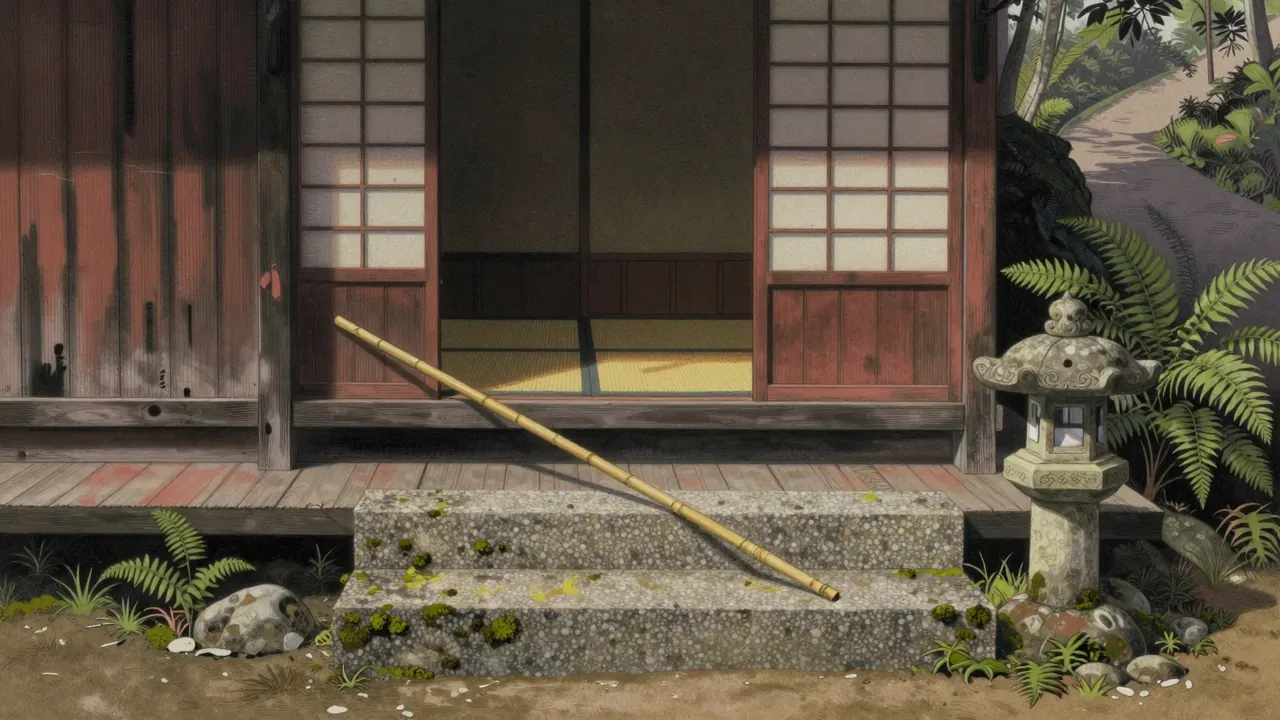
What lands is the cumulative weight of stillness. The film’s refusal to explain, interpret or accelerate creates space for the viewer to register subtle shifts — in light across a tatami mat, in the angle of a boat’s hull at low tide, in the way an elderly man’s hands move when folding laundry. These are not ‘moments’ in the conventional sense but accumulations: over time, the repetition of quiet gestures builds a grammar of resilience. The narration works because it does not dominate; Richie’s voice is a steady current beneath the images, occasionally surfacing with a dry observation or a wry aside, never insisting on meaning. The decision to shoot only in daylight hours, and almost entirely outdoors or in open-door interiors, gives the film a consistent tonal key — neither nostalgic nor clinical, but attentive. This consistency allows the smallest deviations — a child’s laugh off-frame, a sudden gust lifting laundry — to carry emotional weight without melodrama. The film earns its slowness by making every held shot feel necessary, not indulgent.
What is left unsaid
What does not land is any attempt to imply narrative progression or thematic resolution. There is no arc, no rising action, no concluding insight — and while this aligns with the film’s ethos, it can frustrate viewers expecting coherence beyond atmosphere. The absence of context — no maps, no dates, no statistics on depopulation — leaves some sequences feeling adrift, especially early on, before the rhythm establishes itself. A few transitions between islands lack visual or sonic logic, making geography hard to track. The reliance on Richie’s narration, though elegant, occasionally slips into abstraction — phrases like ‘the sea remembers what the land forgets’ land more as poetic licence than earned observation. Some viewers may find the pacing monotonous rather than meditative, particularly those accustomed to documentary conventions of argument or exposition. The film assumes patience as a precondition, not a virtue to be cultivated — and that assumption excludes as much as it invites.
Time as sediment
The themes that matter are time as sediment, not sequence; place as palimpsest, not backdrop; and attention as ethical practice. The film treats the Inland Sea not as a region to be surveyed but as a surface on which decades accumulate — in the weathering of wood, the thinning of village rosters, the persistence of ritual amid practical decline. It resists framing these changes as tragedy or triumph, instead holding them in equipoise: an abandoned schoolhouse appears beside a still-functioning shrine, neither mourned nor celebrated. Ageing is present not as crisis but as condition — visible in faces, in architecture, in the pace of movement — yet never isolated as subject. The film’s quiet insistence on the dignity of routine, even when stripped of audience or future, becomes its most sustained idea. It asks not what is being lost, but what remains active in the gaps — the work of maintenance, the habit of greeting, the act of looking out to sea and seeing not emptiness but continuity.
Who the film presumes
This film is for viewers who value duration over revelation, who find clarity in restraint, and who trust silence as a carrier of meaning. It suits those already familiar with Japanese documentary traditions — such as the work of Kazuo Hara or Nobuhiro Suwa — or with essay films that privilege observation over argument. It is not for viewers who require narrative scaffolding, contextual signposting or emotional payoff within conventional intervals. Those who associate documentaries with advocacy, investigation or instruction will likely find it underpowered. A viewer expecting cultural analysis or historical framing will leave unsatisfied; the film offers no glossary, no timeline, no comparative data. Its value lies in its refusal to translate — and that refusal is deliberate, not negligent. Change the narration to a younger voice, add subtitles explaining local customs, or insert a single statistic about island populations, and the film’s balance would tip from contemplation to commentary — altering its purpose entirely.
The evening’s residue
Yes, it is worth your evening — provided you set aside the expectation of event and accept the film on its own terms: as a fifty-six-minute act of sustained attention. It repays close viewing not with information or catharsis but with recalibration — a slight shift in how one notices light on water, or the weight of a pause between sentences. It is not demanding, but it is exacting: it asks for stillness, not passivity. Those who watch while distracted, or who measure a film’s success by how much it tells them, will find it thin. But for anyone willing to let the film’s tempo settle into their own, it lingers — not as memory of plot or character, but as a residue of tone and texture. Its value is cumulative, not immediate; its reward is not understanding, but alignment. That alignment takes time to achieve, and the film grants it without hurry — which is precisely why it earns its length, and why it remains coherent long after the final frame fades.