What the film is
Mysterious Object at Noon is a documentary film that does not seek to document facts, events or individuals in the conventional sense. Instead, it uses the structure of the exquisite corpse game — where each contributor adds to a story without knowing what came before — as both method and subject. The film travels across Thailand, stopping in villages, towns and cities to invite strangers to continue a narrative begun by the crew. What emerges is not a coherent plot but a cumulative, unstable chain of oral contributions: fragments of myth, memory, desire and evasion, passed from person to person like a rumour. It attempts no exposition, no argument, no resolution. Its aim is to register how language moves through bodies and places; how stories accrue meaning not from authorship but from transmission; and how the act of speaking into a camera — even briefly, even reluctantly — becomes a kind of civic gesture. It treats documentary not as a record of reality but as a field for listening, repetition and drift.
How it works
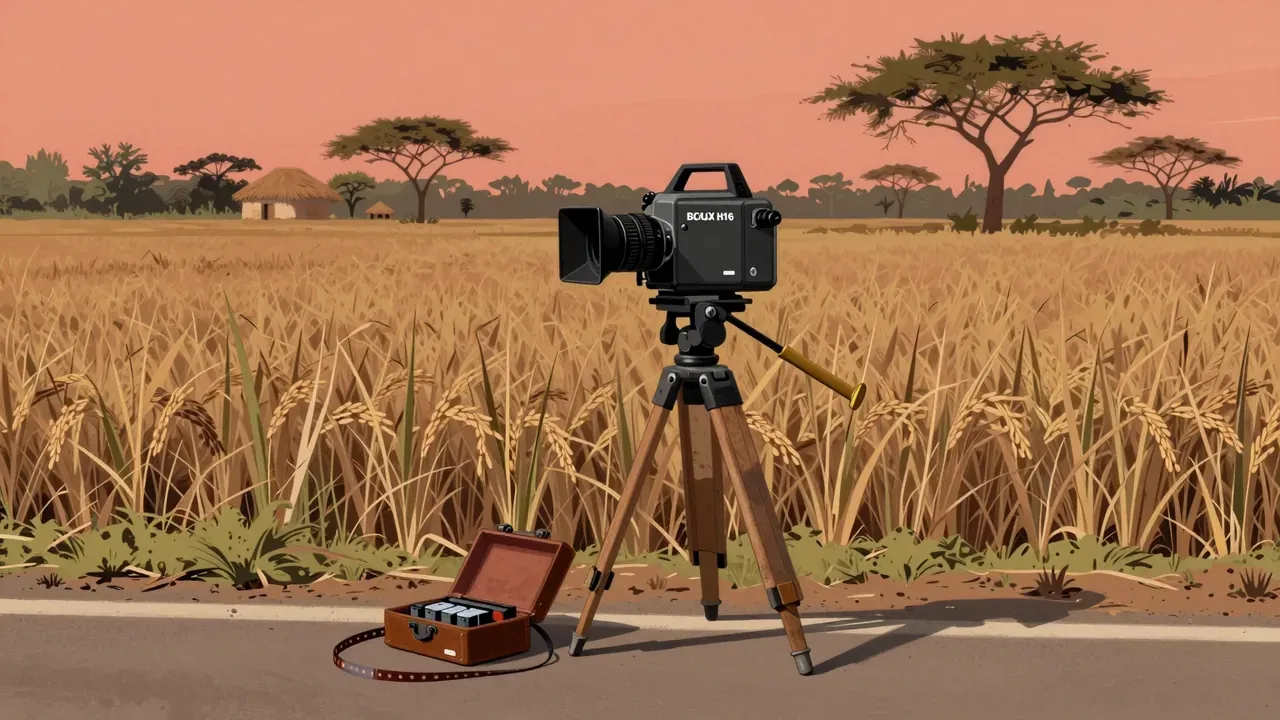
The film works by alternating between two registers: interviews with non-actors speaking Thai in their own voices and settings, and staged re-enactments of the evolving story. Sayombhu Mukdeepprom’s 16mm cinematography holds these moments with equal weight — unvarnished, uninflected, often static, favouring natural light and ambient sound. There are no voiceovers, no captions identifying locations or speakers, no musical score beyond diegetic noise: wind, traffic, children playing, radio static. Editing by Apichatpong Weerasethakul and Mingmongkol Sonakul proceeds by association rather than chronology, letting pauses linger and transitions feel accidental. Performances are not performed: participants speak haltingly, laugh, correct themselves, look away. The re-enactments are deliberately crude — bare sets, visible props, actors who seem unsure whether they are being filmed or watched. This refusal of polish is structural: the film’s craft lies in its restraint, its willingness to let uncertainty remain unresolved, its trust in the texture of ordinary speech over the authority of narrative closure.
What lands
What lands is the quiet accumulation of presence — the way a woman in a market pauses before adding a sentence about a girl who turns into a bird, or how a schoolboy’s offhand remark about a devil holding a flower shifts the tone of the whole chain. The film’s rhythm, built on repetition and slight deviation, produces a hypnotic effect not through spectacle but through patience: watching someone fold laundry while telling part of a story feels as consequential as the story itself. The lack of explanation allows regional inflections, class markers and generational cadences to register without mediation. The 16mm grain, enlarged but not cleaned up, preserves the tactility of surfaces — skin, cloth, dust, corrugated iron — so that place becomes legible not through geography but through material residue. Most successfully, the film makes listening a physical act: you lean in not for plot but for timbre, hesitation, breath. It rewards attention not with revelation but with recalibration — a slow shift in how one hears speech, sees faces, reads silence.
What does not
What does not land is any expectation of coherence, momentum or emotional payoff tied to character or event. Viewers accustomed to documentary as advocacy, testimony or historical account will find little to grasp: there is no thesis, no subject position declared, no editorial stance made explicit. The re-enactments, while conceptually necessary, sometimes falter in execution — their theatricality feels under-rehearsed not in an intentional way but in a way that breaks immersion rather than deepens it. A few interview segments run long without sufficient variation in framing or pacing, risking monotony when the film’s logic depends on subtle shifts in tone or emphasis. The refusal of context — no subtitles for dialects, no translation notes, no on-screen identification of speakers — may alienate without inviting re-engagement. And because the film’s method relies on chance encounters, some contributions feel inert or opaque, not as gaps to be contemplated but as dead air that the structure cannot absorb.
The themes that matter
The themes that matter are oral transmission as cultural survival, the instability of authorship, and the politics of listening. The film treats storytelling not as property but as circulation — a practice that changes with every mouth it passes through. It quietly questions who gets to speak for whom, and how power operates in the simple act of asking a question on camera. There is also a persistent meditation on translation: not just linguistic, but across generations, classes and regions within Thailand — a country whose official culture often marginalises rural and northern voices. The recurring image of the ‘flower in the devil’s hand’ functions less as symbol than as placeholder: something beautiful held in contradiction, something inherited without understanding, something repeated until its meaning becomes inseparable from the act of repetition itself. These are not themes argued but embedded — felt in the duration of a glance, the weight of a pause, the grain of a voice.
Who should watch it
This film is for viewers who value process over product, listening over interpretation, and ambiguity over exposition. It suits those already familiar with essay films, structuralist documentary or Southeast Asian experimental cinema — or those willing to meet such work on its own terms. It is not for viewers seeking narrative propulsion, biographical insight, social analysis with clear stakes, or aesthetic polish. Those who require context, explanation or emotional signposting will likely feel adrift. Disagreement would come from documentary practitioners who see the form as inherently ethical or evidentiary — for whom opacity risks complicity or indifference. A different verdict would follow if the film had included minimal framing (a map, a date stamp, a brief spoken introduction), but its rigour lies precisely in withholding those anchors. Its audience is narrow by design, not oversight.
Is it worth your evening
Yes, it is worth your evening — provided you watch it as you would a piece of weather: not to master it, but to be in it. Its ninety-six minutes unfold at the pace of conversation between strangers, and its value lies in how it recalibrates attention: away from what is said toward how it is said, who says it, and what surrounds the saying. It does not demand investment in characters or outcomes, only in duration and texture. You will not leave with answers, but with a heightened awareness of vocal rhythm, of the space between sentences, of how light falls on a wall behind a speaker. It is not ‘difficult’ in a forbidding way, but it refuses convenience — no subtitles for dialects, no cues for emphasis, no music to tell you how to feel. That refusal is its integrity. To call it ‘slow’ mistakes stillness for slowness. It is, instead, attentive — and rewards the same from its viewer.