The premise as physics
The Incredible Shrinking Man is a science fiction film that uses bodily diminution as a literal premise to explore scale, perception, and human fragility. It does not aim for spectacle or allegory by default, but for a sustained, incremental recalibration of what constitutes threat, agency, and dignity. Its central project is ontological: to ask what remains of a man when his physical presence recedes past social recognition, past utility, past visibility. The film treats shrinking not as a metaphor first, but as a condition with mechanical consequences — furniture looms, floorboards gape, raindrops become tidal waves — and only gradually allows those consequences to accrue philosophical weight. It avoids Cold War paranoia as backdrop, choosing instead domestic space as its sole terrain of crisis. There are no villains, no conspiracies, no external antagonists beyond physics and time. What it attempts is rare for mid-1950s genre cinema: a quiet, unembellished descent into insignificance, anchored in the rhythms of marriage, routine, and incremental loss. It assumes the audience will follow Scott Carey’s shrinking not as a gimmick, but as a slow erosion of selfhood measured in inches and seconds. (158 words)
The look of it
The story unfolds linearly after Richard Alan Simmons’ restructuring of Richard Matheson’s original flashback draft, grounding Scott Carey’s condition in cause (radioactive fog), progression (measured in doctor visits and tailor notes), and consequence (a basement rendered vast). Grant Williams carries the arc with restraint: his performance tightens rather than broadens as he shrinks, avoiding histrionics in favour of precise physical adjustment — posture, eye-line, breath control. Randy Stuart’s Louise is neither idealised nor diminished; her frustration and care coexist without resolution. Ellis W. Carter’s cinematography uses deep focus and low angles on oversized sets to enforce disorientation, while Albrecht Joseph’s editing sustains tension through duration — a single shot of Scott climbing a rug pile lasts longer than expected, making effort visible. The special effects rely on forced perspective, matte work, and scaled props rather than illusionism; they are functional, not dazzling. The cat sequence is choreographed, not improvised; the spider scene is lit for clarity, not horror. Sound design is sparse, with diegetic amplification — dripping water, scuttling insects — used sparingly and without musical cue. Every craft choice serves the premise’s internal logic, not its marketability. (159 words)
The weight of smallness
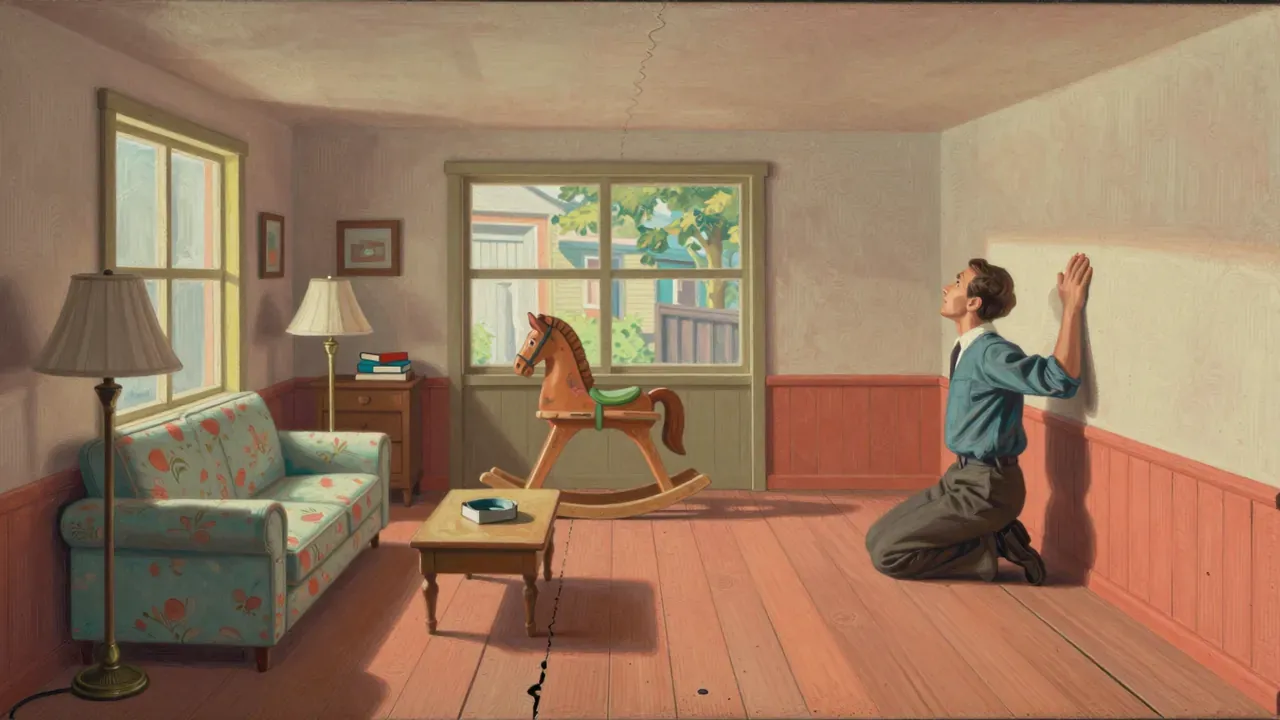
What lands is the cumulative weight of smallness. The film’s power builds not in set pieces but in transitions: from Scott standing at a kitchen counter to needing a stool, then a book, then a matchbox; from arguing with his wife across a table to shouting up at her ankle. The dollhouse sequence works because its proportions are exact — the miniature furniture is not quaint but oppressive, its corridors claustrophobic in inverse proportion to Scott’s size. The basement scenes succeed not through suspense but through spatial honesty: dust motes hang like boulders, cobwebs stretch like suspension bridges, and the cat’s paw fills the frame not as monster but as indifferent geography. The final monologue — delivered not to camera but into darkness — lands because it follows thirty minutes of near-silence, and because the script refuses to resolve Scott’s fate with rescue or revelation. It lands as an act of attention: the film watches him shrink, and asks the viewer to do the same. That attentiveness, sustained over eighty-one minutes, is its quiet achievement. It does not persuade through argument but through accretion — each inch lost recalibrates the terms of survival. (157 words)
Where the scale slips
What does not land is the early domestic exposition. The opening scenes between Scott and Louise, though performed with naturalism, lack dramatic urgency; their marital rhythm feels rehearsed rather than lived-in, and the dialogue often serves exposition over character. Raymond Bailey and William Schallert appear as doctors whose diagnoses function as plot markers rather than people — their scenes are efficient but hollow. The film’s middle third, covering Scott’s public exposure and media circus, feels perfunctory: newspaper headlines flash without consequence, and the press conference scene is staged flatly, its satire muted. Some effects shots betray their construction — particularly the rear-projection boat sequence, where the mismatch between foreground and background undermines immersion. The score, though unobtrusive, rarely deepens mood; it marks time rather than meaning. And while the cat attack is physically convincing, its emotional stakes are undercut by the earlier, more intimate confrontation with the spider — the cat feels like a repetition, not an escalation. These are not failures of ambition, but of pacing and emphasis: the film’s strongest moments are solitary, silent, and slow, while its most conventional ones — the medical consultation, the news report, the family dinner — sit awkwardly beside them. (159 words)
The world remeasured
The themes that matter are scale, solitude, and the instability of human centrality. The film treats the body not as vessel or symbol, but as measure — and when that measure changes, all relationships shift: to space, to time, to other beings. Scott’s shrinking dismantles anthropocentrism not through rhetoric but through logistics: he cannot open a door, so the door becomes a wall; he cannot cross a floor, so the floor becomes a landscape. His marriage dissolves not from betrayal but from asymmetry — Louise remains the same height, the same voice, the same world, while his diminishes in every dimension. The basement is not hell but neutral territory: indifferent, unjudging, governed by physics not morality. Mortality here is not sudden but dilated — a process measured in millimetres and missed meals. There is no triumph, no reversal, no lesson learned. What endures is not hope but observation: the film insists that to be small is not to be less real, only differently located in a universe that does not pivot on human stature. That quiet insistence — that significance is not inherent but relational — is its enduring, unsentimental core. (156 words)
Who stands inside the frame
This film is for viewers who value precision over pace, implication over explanation, and physical logic over narrative convenience. It suits those accustomed to mid-century American studio craft — the economy of Universal’s backlot sets, the discipline of black-and-white cinematography, the unshowy intelligence of Matheson’s writing. It rewards patience with texture: the grain of a rug, the weight of a dust mote, the sound of a dropped pin. It is not for those who require clear moral framing, escalating stakes, or cathartic resolution. Viewers expecting satire, camp, or allegory will find its tone too steady, its irony too dry. Those who dislike prolonged stillness or resist films that withhold emotional cues may feel adrift in its second half. A viewer who values thematic density over plot mechanics, or who finds existential unease more compelling than danger, will respond strongly. Someone who prefers action-driven science fiction or character arcs with decisive turning points would likely leave unmoved — not because the film fails, but because its aims lie elsewhere. Its demands are narrow but specific: attention, tolerance for ambiguity, and willingness to sit with diminishing returns. (158 words)
What remains after the credits
Yes, it is worth your evening — not as diversion, but as calibration. Its eighty-one minutes recalibrate how you register scale, threat, and consequence in everyday space. It works best viewed alone, without interruption, in a room where the ceiling feels ordinary and the floor solid — because its power depends on contrast. Those who watch it expecting thrills or commentary may feel short-changed; those who come prepared for a slow, tactile meditation on fragility will find it unusually resonant. Its age shows in pacing and production limits, but not in conception: the questions it poses about human position in the material world remain current. A viewer who dislikes long takes or resists films without clear protagonists may revise this verdict — but the film does not ask to be liked, only witnessed. Its value lies not in what it resolves, but in how thoroughly it refuses resolution. To spend an evening with it is to accept a temporary shift in perspective — one that lingers after the credits, in the way light falls across a floorboard or dust hangs in a sunbeam. (159 words)