The look of it
The Fabulous Baron Munchausen is a Czechoslovak fantasy film that adapts the tall tales of Baron Munchausen not as biography or satire but as a self-aware, tactile dream logic — one where narrative continuity yields to visual and tonal association. It attempts something precise: to translate the engraved linearity and baroque exuberance of Gustave Doré’s illustrations into moving image, using live-action figures placed inside hand-drawn, lithographic, and animated backdrops. Karel Zeman does not seek realism, nor even consistent internal rules, but a sustained stylistic hallucination — a world where physics bends to ornament, where historical periods overlap like layers of tracing paper, and where the Moon is both a destination and a drawing-room. The film’s ambition lies in its method: it treats cinema as a collage medium before digital tools existed, stitching together stop-motion, cut-out animation, rear projection, and painted glass shots with the discipline of a book illustrator. Its fidelity is not to source text but to graphic texture, to the weight of ink on paper made kinetic.
How it tells time
The story begins on the Moon and moves backward in time, landing Tonik — the cosmonaut — in an Ottoman Constantinople that never existed outside a Doré engraving. Miloš Kopecký’s Baron is affable, unflustered, and theatrically precise; Jana Brejchová’s Princess Bianca speaks little but anchors scenes with stillness and clarity. Jiří Tarantík’s cinematography keeps focus shallow and lighting theatrical, often flattening depth to mimic etching. Zdeněk Liška’s score uses harpsichord, brass fanfares, and sudden silences to punctuate transitions rather than underscore emotion. Věra Kutilová’s editing avoids cross-cutting in favour of sequential tableaux — each adventure (the fish, the airship, the duel) arrives as a discrete set-piece, linked by visual rhyme more than cause. The craft is unified: every frame is composed as if for reproduction in a nineteenth-century illustrated almanac, with borders implied, perspective skewed, and gravity optional. There are no digital effects, no hidden wires — just painstaking physical layering, visible in the grain and slight misalignments between foreground and background.
The honesty of its craft
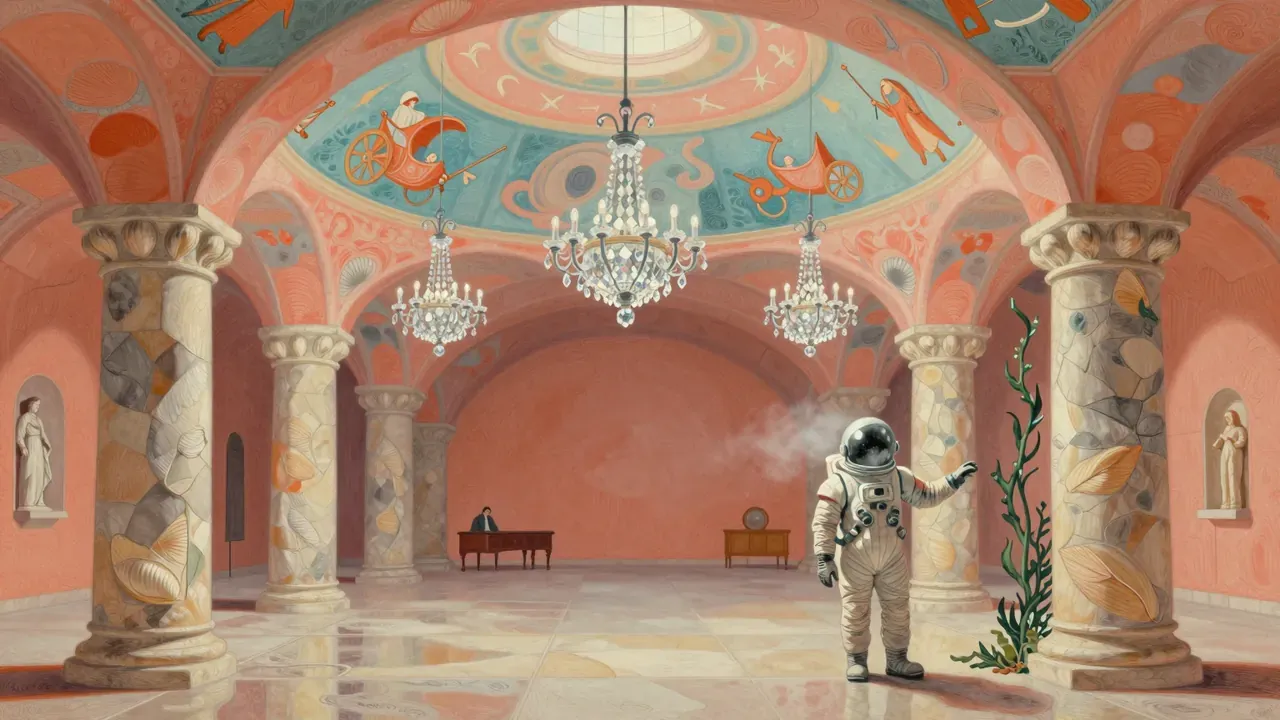
What lands is the film’s tone: a steady, unironic delight in invention. Its humour arises from mismatch — a rocket ship docked beside a rococo fountain, a modern man trying to bow correctly in powdered wig and breeches, a sword fight staged on a map that folds and unfolds mid-scene. The winged horses pulling the Baron’s airship are stop-motion, jerky and earnest, and their charm comes from their obvious artifice, not their realism. The Ottoman court is all patterned tiles and stylised gestures, never caricatured — the satire is structural, not ethnic. Even the Sultan’s menace feels like part of the décor, a figure drawn in thick black line. The film trusts its audience to follow visual logic over narrative logic: when Tonik is swallowed by a fish, the interior is a Baroque grotto with frescoed ceilings and floating chandeliers — absurd, yes, but internally coherent in its own grammar. This consistency of style gives the film a rare kind of confidence: it does not ask you to believe, only to attend.
Where it holds feeling at arm’s length
What does not land is the emotional through-line. Tonik’s transformation from bewildered astronaut to romantic hero feels perfunctory, not earned — his affection for Bianca is signalled by glances and a single shared glance at a star chart, but never deepened. The supporting characters, though vividly performed, remain archetypes: the Sultan as pompous obstacle, the Grand Vizier as flustered foil, the Baron as perpetual catalyst. There is no psychological friction, no doubt, no cost to any action — consequences are always reversible, wounds vanish with the next cut. The film’s refusal of stakes works for spectacle but weakens investment: we admire the airship, but do not fear its crash. Some viewers may find the pacing too deliberate, the repetitions too literal — the same musical phrase returns for each new location, the same camera tilt upward opens each sequence. The 1962 original runs 83 minutes, but its rhythm is that of a picture book read aloud, not a thriller or romance. Those expecting character arcs or thematic resolution will leave unsatisfied — the film offers wonder, not argument.
What it believes about stories
The themes that matter are not those of Enlightenment reason or colonial hubris, but of storytelling as world-building, and of technique as ethics. The Baron does not lie to deceive but to expand possibility — his fabrications are invitations, not manipulations. The film treats imagination not as escape but as infrastructure: the airship exists because it must, the winged horses because they look right against the sky. Time is non-linear and porous — Verne, Cyrano, and Munchausen share a dinner table not as anachronism but as inevitability. The Moon is not a scientific frontier but a literary meeting place, a shared stage for human fable. There is also quiet commentary on diplomacy as performance: Tonik’s ‘language of diplomacy’ is gibberish, yet it functions perfectly until sincerity intrudes. The film values craft over message — Liška’s music does not interpret mood but marks transition; Tarantík’s lens does not reveal psychology but frames composition. Its central idea is that form can carry meaning without explanation — that a Doré-style cloud, drawn in ink and lit from below, says more about aspiration than any monologue could.
Who it is speaking to
This film is for viewers who value material intelligence in cinema — those who notice how a painted backdrop meets a live actor’s shoulder, or how a stop-motion horse’s joint articulation affects its dignity. It suits fans of Méliès, early Soviet animation, or contemporary illustrators like Shaun Tan. It is not for those who require narrative propulsion, psychological realism, or thematic exposition — viewers who need motivation clarified, stakes raised, or endings resolved will find it thin. Those accustomed to seamless VFX may mistake its handmade seams for amateurism; others may read its lack of irony as naivety, missing its deliberate, almost scholarly commitment to surface. A viewer who loves Terry Gilliam’s Brazil but finds The Adventures of Baron Munchausen too diffuse may prefer Zeman’s tighter control. It rewards patience, not attention span — the pleasure is cumulative, built across repeated visual motifs and rhythmic returns, not sudden revelations.
Why it stays with you
Yes, it is worth your evening — provided you approach it as a designed object, not a story engine. Its 83 minutes pass with the quiet insistence of turning pages in a rare book: each scene is a plate to be studied, not a beat to be tracked. You will not forget the airship’s silhouette against a copper-plate sky, or the way light falls across Bianca’s lace collar as if through stained glass. It demands nothing but presence, and repays it with density of craft. Those who dislike it tend to expect narrative momentum or emotional escalation — critics who called it ‘charming but slight’ missed that its slightness is structural, not accidental. A different verdict would follow if the film tried to be something else: if it added voiceover exposition, tightened the love story, or smoothed its edges. But it does not — and that is its integrity. To watch it is to accept its terms: that wonder is sufficient, and that a well-drawn line is as persuasive as a well-argued point.