The middle chapter
Samurai II: Duel at Ichijoji Temple is the second instalment in Hiroshi Inagaki’s Samurai Trilogy, adapting Eiji Yoshikawa’s serialised novel Musashi. It is not a standalone story but a deliberate middle movement — structurally and thematically suspended between Musashi’s raw ambition and his eventual mastery. The film attempts to chart moral maturation through repeated confrontation: not just with rivals, but with impatience, pride, misrecognition, and the social weight of reputation. It treats swordsmanship as inseparable from conduct, discipline from self-knowledge, and victory from restraint. Unlike the first film’s origin focus or the third’s mythic resolution, this one dwells in the unglamorous labour of becoming — the long walk between duels, the refusal of easy vengeance, the quiet recalibration after public shame. Its pacing, its recurring motifs of wells, inscriptions, and unfinished gestures, all serve that aim: to make ethical growth visible in gesture, silence, and withheld action. It assumes familiarity with the prior film and expects patience with narrative digression as character development.
The rhythm of the blade
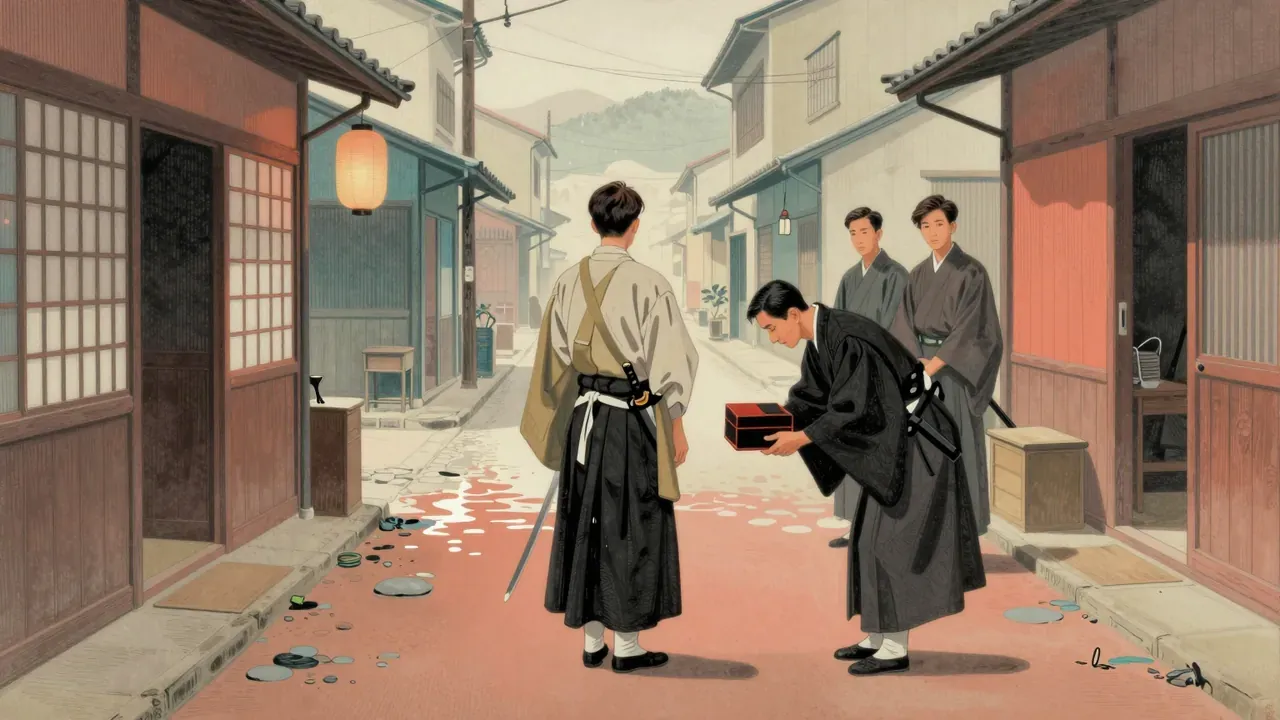
The story unfolds across Kyoto’s streets, temple grounds, riverbanks, and hillside clearings, with Hiroshi Inagaki’s script anchoring each episode in concrete cause and consequence — a rejected sword-polishing request leads to Honami’s shop; a stolen diploma leads to Matahachi’s delusion; a note left at Sanjo Bridge triggers a cascade of ambushes and betrayals. Toshirō Mifune’s Musashi moves with contained physicality: shoulders low, gaze steady, speech sparse. Mariko Okada’s Otsu conveys longing without melodrama; Kaoru Yachigusa’s Akemi sustains ambiguity — neither victim nor schemer, but a woman whose agency is circumscribed by men’s violence and her own calculations. Ikuma Dan’s score avoids flourish, using restrained strings and koto to underline tension rather than announce it. Kisaku Itō’s production design favours weathered wood, uneven stone, and uncluttered space; Shigeru Mori’s lighting keeps faces half in shadow, especially indoors. Choreography by Tokuho Azuma and Yoshio Sugino treats combat as rhythm and timing, not speed — pauses matter more than strikes.
What sticks to the skin
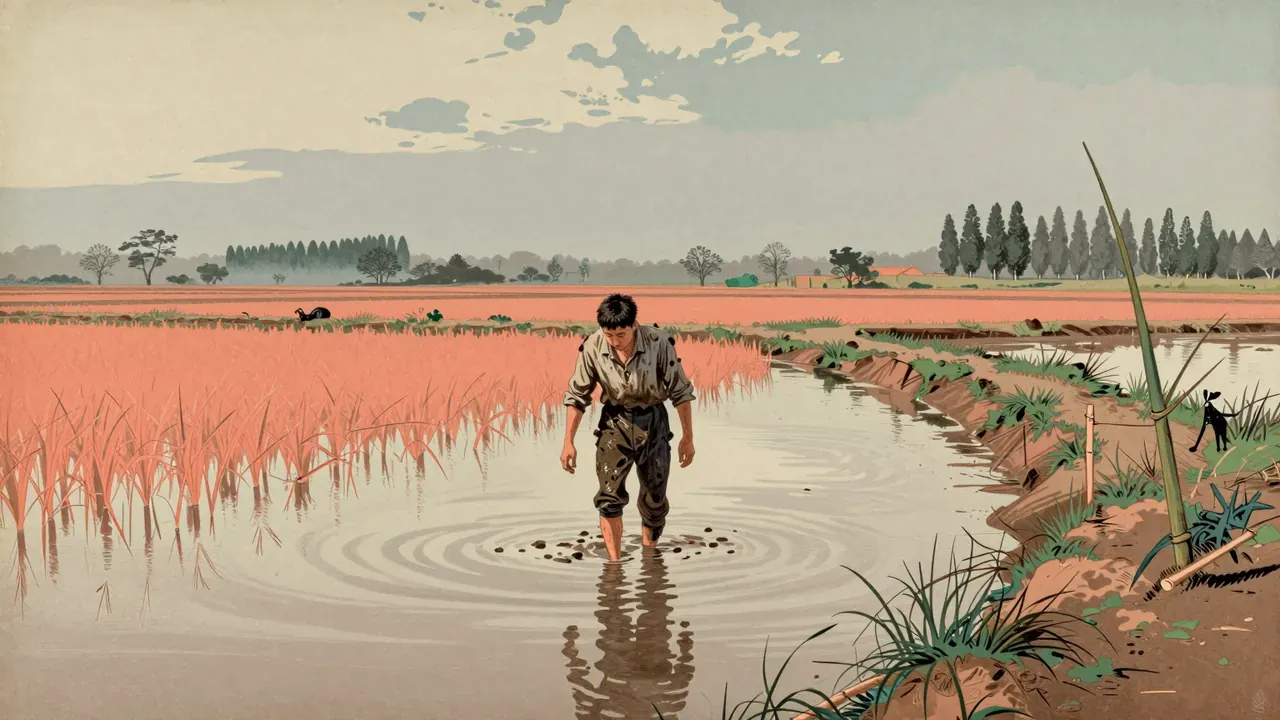
What lands most firmly is the film’s insistence on consequence. Every decision echoes: Musashi’s early duel with Baiken earns him scorn, not acclaim; his refusal to fight Seijuro Yoshioka directly provokes not respect but conspiracy; even his humility at the swordsmith’s shop becomes a pivot point, redirecting him toward Sasaki. The sequence at Rengein Temple — Denschichiro’s fatal challenge, followed immediately by Seijuro’s grief — works because it refuses catharsis: the brother’s death is abrupt, the master’s sorrow muted, the camera holding on his face without music or cutaway. The rice paddy retreat is another anchor: Musashi sinks, stumbles, slips, and escapes not through superiority but endurance — mud clinging to his legs, breath ragged, arrows falling short not from skill but from terrain. These moments land because they are specific, unvarnished, and physically legible. They do not ask the viewer to feel awe, only to register cause, resistance, and cost.
The scaffolding
What does not land is the subplot involving Matahachi’s imposture and Osugi’s vendetta. It is introduced with narrative weight — the dying samurai’s package, the Chujo School diploma — but resolves in hurried exposition and unearned transformation: Matahachi’s claim to be Sasaki is treated as farce, yet his subsequent disappearance leaves no thematic residue. The rape of Akemi occurs off-screen but is narrated as motivation, not explored; its emotional aftermath is reduced to a glare and a lie told to Otsu, which then dissolves into pastoral resolution. Similarly, Takuan’s guidance to Otsu feels perfunctory — a single conversation replaces sustained spiritual inquiry. These elements are structurally necessary to move characters into position for the final duel, but they lack the textural care given to Musashi’s solitude, his exchanges with smiths or priests, or the weight of a signature on a summons. They function as plot scaffolding, not lived experience.
The weight of restraint
The themes that matter are restraint as discipline, reputation as social entanglement, and mastery as deferred. Musashi’s journey is not upward but inward: he learns to wait, to withdraw, to spare — not because he lacks capacity to kill, but because killing no longer serves the shape he is trying to become. The film treats honour not as fixed status but as earned credibility — something eroded by ambush, restored by fairness, tested by mercy. It also insists on the material conditions of virtue: a dull blade matters; a muddy field matters; a well’s inscription matters. These are not metaphors but facts that constrain and clarify action. The contrast between Musashi’s solitary walks and the Yoshioka school’s hierarchical bustle underlines how institutional power distorts both perception and response. Even Sasaki — elegant, precise, contemptuous — functions less as antagonist than as a mirror: his ‘Swallow Turn’ is technically flawless, but his presence at Ichijoji Temple reveals he recognises the difference between witnessing and enabling dishonour.
The terms of watching
This film rewards viewers who accept slow accumulation over revelation, who value moral ambiguity over moral certainty, and who find tension in stillness. It suits those familiar with Japanese historical context or the conventions of jidaigeki, though it does not require specialist knowledge — its ethics are legible through behaviour, not exposition. It is not for viewers who expect linear momentum, psychological exposition, or climactic symmetry: the duel at Ichijoji Temple itself is brief, interrupted, and resolved off-screen in favour of Musashi’s exhaustion and Otsu’s quiet return to washing clothes. Those who dislike unresolved threads — Matahachi’s fate, Akemi’s final disposition, the Yoshioka school’s future — will find the ending unsatisfying. A viewer who values tight plotting over atmospheric continuity, or who reads restraint as passivity, would likely dismiss the film as inert. That verdict would change only if the film were recut to foreground incident over implication — but that would sacrifice its central argument.
The walk home
Yes, it is worth your evening — provided you watch it without expectation of resolution or reward. Its 104 minutes unfold like a scroll: unspooling slowly, demanding attention to texture, light, and pause. It repays rewatching not for hidden clues but for shifts in emphasis — how a glance lingers longer on a hand adjusting a bandana, how a sound cue drops before a cut, how the same temple gate appears differently at dawn and dusk. It is not entertainment in the sense of diversion, but in the older sense of engagement: it asks you to hold multiple possibilities — Otsu’s devotion, Akemi’s calculation, Sasaki’s detachment — without forcing reconciliation. Those who prefer narrative propulsion or emotional catharsis may leave restless. But for anyone willing to sit with uncertainty, to notice what is withheld as much as what is shown, the film offers a rare kind of clarity: not about what happens next, but about what it costs to remain human amid violence, ambition, and time’s slow pressure.