The places it moves through
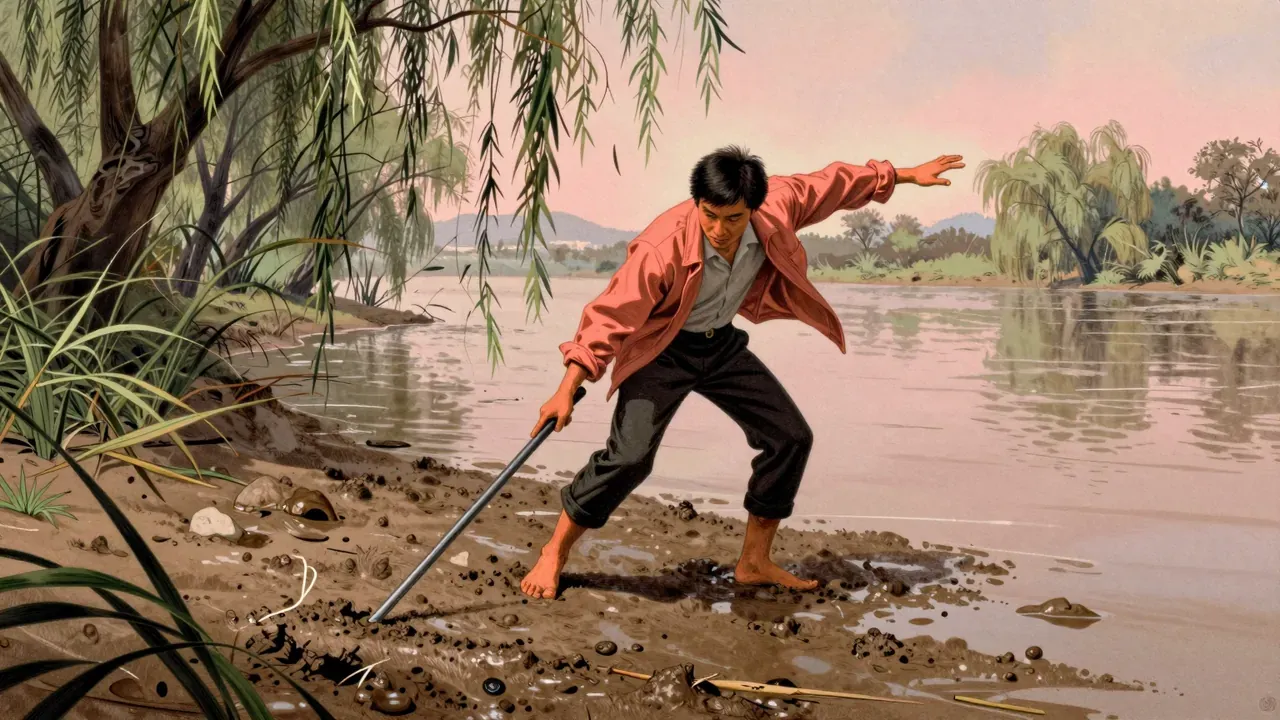
Police Story is a Hong Kong action comedy built around Jackie Chan’s physical authority and his insistence on staging stunts as narrative events, not spectacle interludes. It does not try to disguise its mechanics: the plot exists to justify movement through space — a shantytown, a bus, a shopping mall — and to create stakes for repeated bodily risk. The film treats police procedure as scaffolding, not subject; its interest lies in how a man negotiates gravity, glass, electricity and momentum while wearing a regulation shirt and tie. It is not an origin story, nor a character study in the Western sense, but a demonstration of continuity between intention and impact: every chase, fall or collision follows from a decision made two scenes earlier. Chan co-wrote the script with Edward Tang by listing locations and props first, then building dialogue and motivation around them. This is cinema organised by physics before psychology, where cause and effect are measured in metres fallen, panes shattered, and burns sustained. The film’s ambition is singular: to make the audience feel the weight of each landing, the heat of each lightbulb, the delay between impulse and consequence.
The look of it
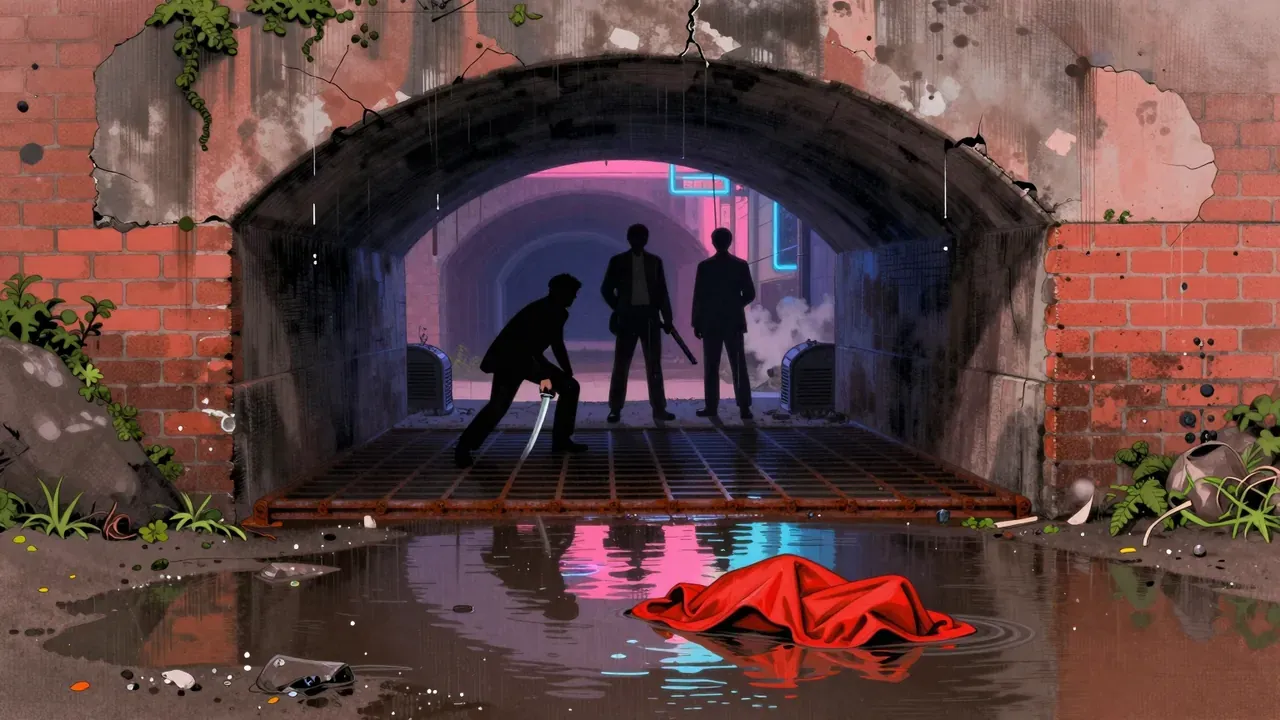
The story moves in clean, functional arcs: sting, betrayal, fugitive status, final confrontation. Jackie Chan plays Sergeant Chan Ka-Kui with minimal inflection but precise timing — his reactions land because they are delayed just long enough to register disbelief before pivoting into action. Brigitte Lin’s Salina Fong is written as a pivot point rather than a full character, yet she holds the frame with stillness that contrasts Chan’s kineticism. Maggie Cheung’s May has little to do beyond registering jealousy and concern, but her presence grounds the domestic interruptions in the chase logic. Yiu-Tsou Cheung’s cinematography stays wide and uncluttered, favouring long takes during stunts so the body’s trajectory remains legible. Peter Cheung’s editing avoids cutting away from impact — we see Chan hit the ground, hear the thud, hold the pause before he moves again. J. Peter Robinson’s score underlines rhythm without dictating emotion. There are no slow-motion inserts, no heroic close-ups mid-fall: the craft serves duration, not enhancement.
The way it falls
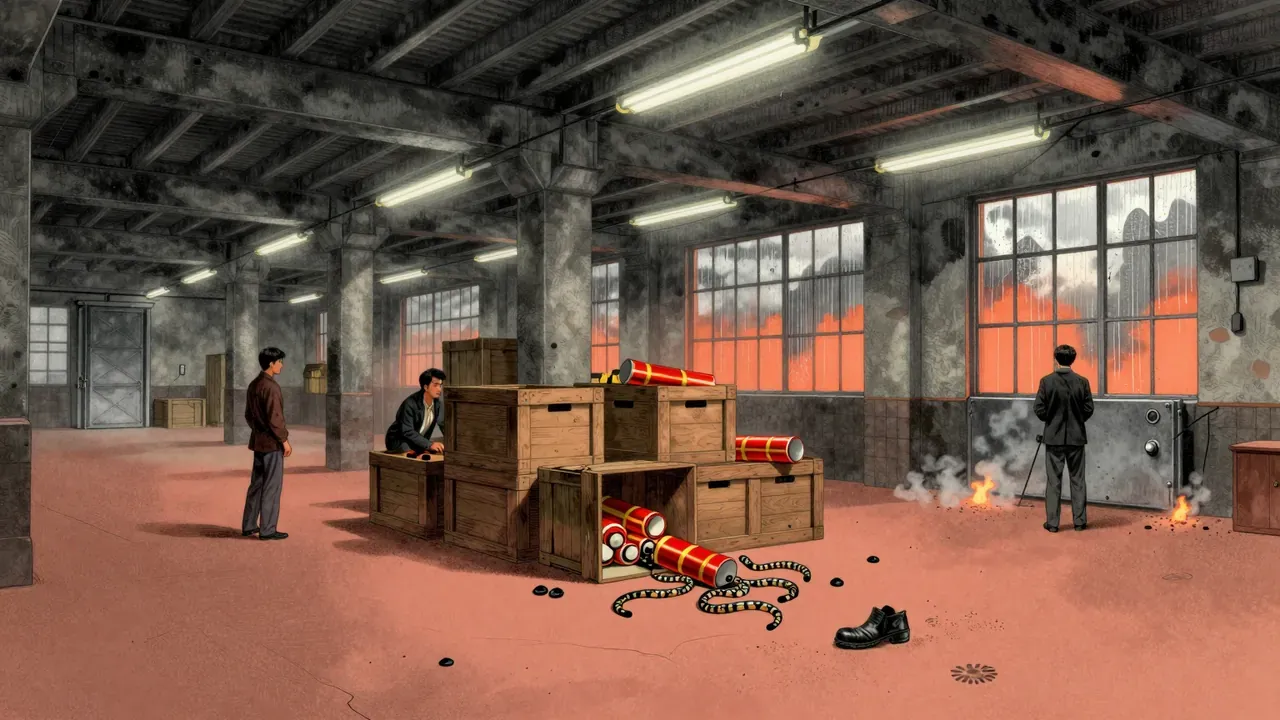
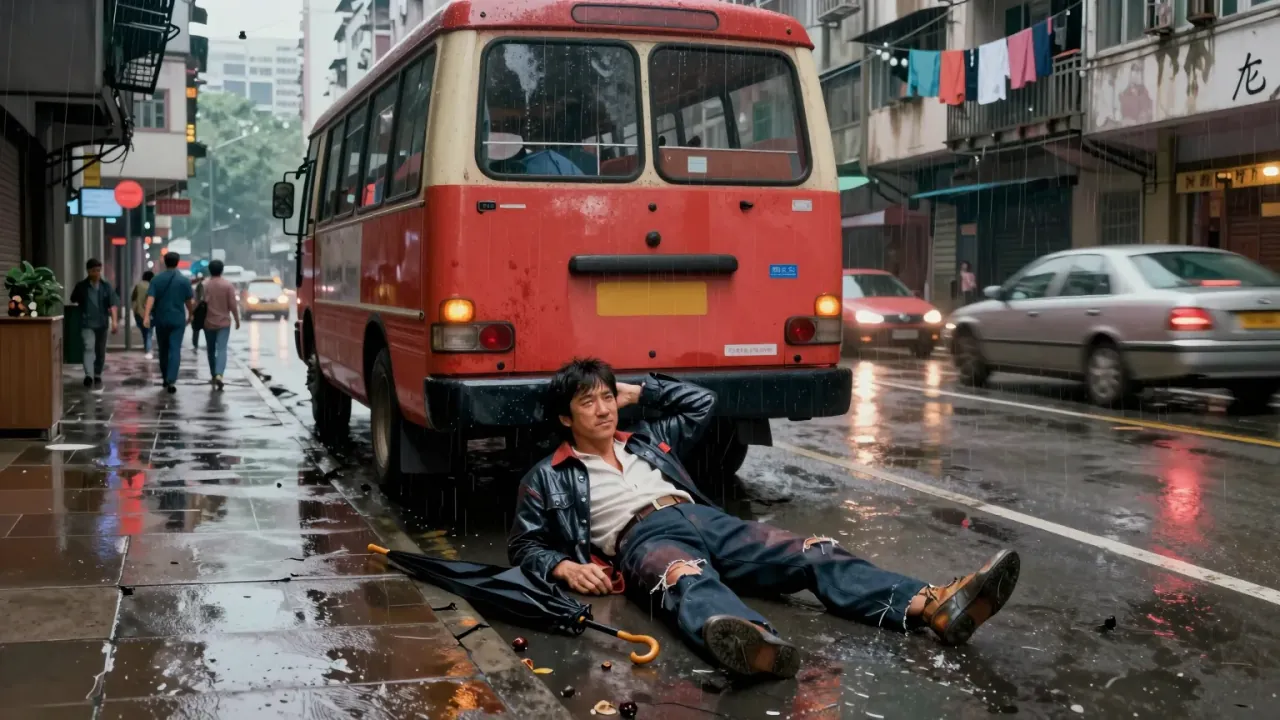
What lands is the cumulative weight of commitment. The opening shantytown chase establishes scale and consequence — bullets strike walls near civilians, vehicles skid unpredictably, and the camera stays at street level, refusing to aestheticise chaos. The double-decker bus sequence works because it hinges on a single, absurdly specific solution: Chan stops the bus not with force, but with threat — and then with an umbrella, metal not wood, because the wooden one slipped. That detail anchors the stunt in problem-solving, not invincibility. The shopping mall climax earns its nickname ‘Glass Story’ not just for volume of breakage, but for how each pane is broken at a different angle, at a different time, as part of a choreographed descent. The pole slide is not impressive because it looks dangerous, but because the burns and dislocation were real, and the film does not cut away from the aftermath. These sequences land because they are built on cause, repetition, and visible consequence — not because they dazzle, but because they exhaust.
The things it skips
What does not land is the dramatic scaffolding between stunts. The courtroom scene collapses without Salina present, but the film gives no sense of legal process beyond a judge’s gavel and a lawyer’s offhand objection. Inspector Man’s betrayal arrives without foreshadowing or motive beyond convenience, making his final appearance feel like a plot device rather than a character turn. The romantic subplot between Ka-Kui and May resolves in a single line after the mall fight, with no emotional accounting for her earlier anger or his exhaustion. Bill Tung’s Uncle Bill appears only to deliver exposition and vanish. The English dubs further flatten nuance: names shift across versions, motivations blur, and the bureaucratic friction within the police force — hinted at in Li’s reprimand — dissolves into generic authority figures. These elements do not fail because they are poorly acted, but because the film’s architecture leaves no room for them to breathe: they exist only to set up the next physical proposition.
The cost of being seen
The themes that matter are accountability, labour, and the cost of visibility. Ka-Kui is punished not for failing, but for succeeding too visibly — his bus stop makes headlines, not promotions. His body becomes evidence: the burns, the limp, the torn uniform all testify to effort the system neither requested nor rewards. The film treats policing as manual work, not moral abstraction: Ka-Kui cleans his gun, checks his belt, adjusts his collar, and sweats through his shirt — all before any fight begins. Corruption is not ideological but logistical: Man betrays not for ideology but because Chu Tao pays him, and the system offers no oversight. The shopping mall — a site of consumption, surveillance, and controlled movement — becomes the arena where Ka-Kui reclaims agency not through speech or rank, but through vertical motion: sliding down, not climbing up. This is a film about what happens when institutional logic breaks, and the only remaining metric is whether your hands still grip, your spine still aligns, and your feet still find purchase.
Who it is for
It is for viewers who value choreography over exposition, endurance over exposition, and cause-and-effect over coincidence. It rewards attention to how a stunt is built — the umbrella, the pole, the sugar glass — not just how it ends. It is not for those who need psychological consistency, moral ambiguity, or narrative symmetry: the film’s ethics are procedural, not philosophical, and its justice is physical, not legal. Those who expect character arcs will find Ka-Kui unchanged by the end — he wins not by evolving, but by persisting. Viewers who dislike extended practical effects, or who require emotional payoff beyond relief and exhaustion, will find the final ten minutes repetitive. A viewer who values tight plotting over kinetic logic may reject the film’s structure as arbitrary. But for anyone who has ever watched a stunt and asked, ‘How did they do that — and why did they have to?’, this remains essential viewing.
Why it holds time
Yes, it is worth your evening — not as background noise, but as a focused, ninety-six-minute engagement with motion as meaning. Its pacing is unhurried by Hollywood standards: there are pauses after impacts, silences before decisions, and long shots that let you track the path of a falling lightbulb. You do not need prior knowledge of the franchise or Hong Kong cinema to follow it, though familiarity with Chan’s working method deepens appreciation of the injuries listed in the fact sheet. It is not for viewers seeking irony, satire, or subtextual layering — the film states its terms plainly and keeps them. Anyone expecting a modern action film’s rapid cuts or digital augmentation will misread its tempo. But if you accept its premise — that a man’s body is both instrument and archive — then every frame delivers. It asks for your attention, not your suspension of disbelief.