A war refought with the people who lived it
The Battle of Algiers is Gillo Pontecorvo’s 1966 reconstruction of the Algerian War’s urban phase, made with the backing of the newly independent Algerian government and based on the memoir of FLN commander Saadi Yacef, who also produced the film and plays a version of himself in it. It tracks the years 1954 to 1957, when the FLN’s guerrilla campaign in Algiers’s Casbah was met by French paratroopers under a composite colonel drawn largely from the real officer Marcel Bigeard, and it stops just short of adjudicating who was right, choosing instead to show method: how an occupying force tries to break a resistance movement, and how that movement survives.
Non-actors, Morricone and a fake newsreel
Ali La Pointe, a former petty criminal turned FLN operative, rises through the organization as French authorities escalate from surveillance to mass arrest to systematic torture under Colonel Mathieu. Pontecorvo and cinematographer Marcello Gatti shot in black and white with handheld cameras and documentary-style editing to the point that American distributors felt obliged to state that not one foot of actual newsreel appears in the film. The cast, aside from Jean Martin as Mathieu, is made up of non-professionals, many of them Algerians who had lived through the events being restaged, and Ennio Morricone collaborated with Pontecorvo on the score, using a solo military drum as a recurring motif.
The bombing sequence intercut with the checkpoints
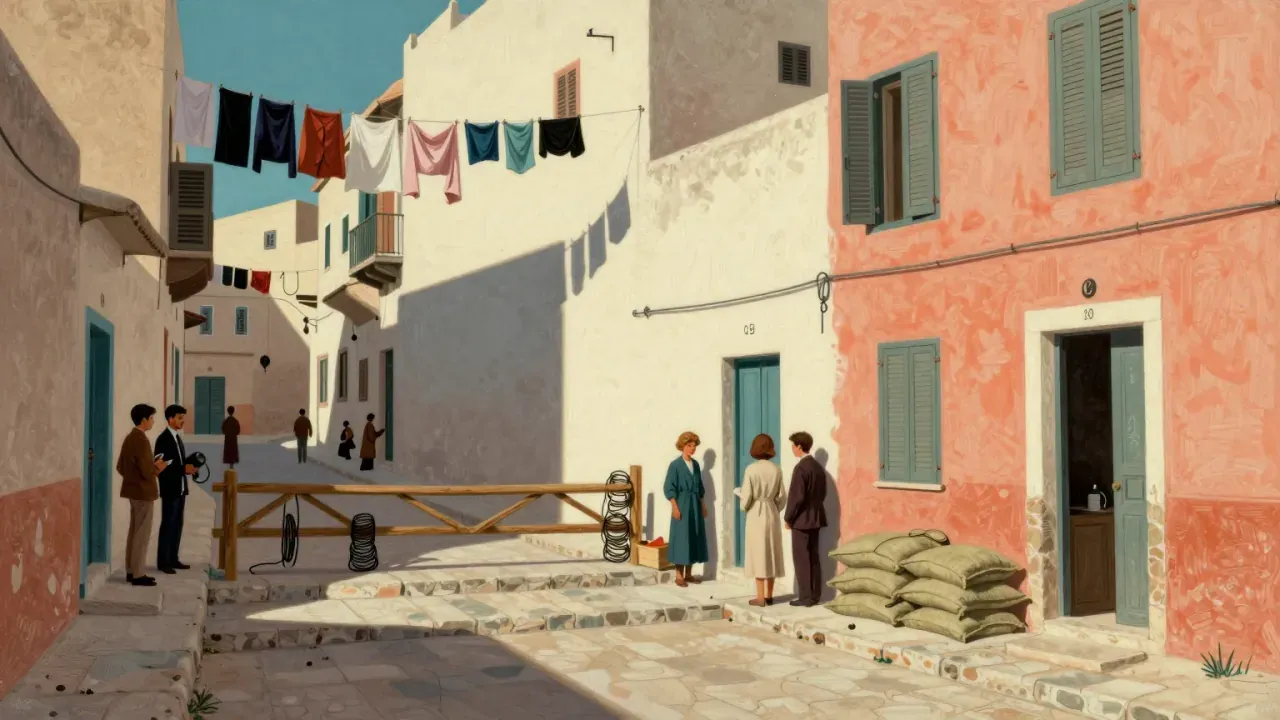
The film’s clearest achievement is its refusal to simplify either side into caricature: Mathieu is written as coldly rational rather than sadistic, arguing for torture as an unfortunate necessity in language the film lets stand without rebuttal, which makes the French position more unsettling than a cruder villain would. The bombing sequence, in which three women disguise themselves to carry explosives past checkpoints into cafés full of ordinary people, is intercut so precisely between the women’s preparation and their targets’ daily lives that it withholds any comfortable moral distance from the audience.
A colonel who is never made simple
Because the film is structured around movement, organization and consequence rather than individual arcs, few characters receive the kind of interior development that would let a viewer form a strong personal attachment to any single figure, including Ali La Pointe himself, who remains more a function of the resistance’s structure than a fully drawn person. Some sequences, particularly the film’s compressed final act detailing Algeria’s path to independence, move quickly enough that viewers unfamiliar with the history may need to do some reading alongside it. The reliance on dubbing for many of the non-professional performers, necessary given how the cast was assembled, also occasionally flattens line readings in ways a fully synchronized professional cast would likely have avoided.
Insurgency as structure, not sentiment
The film is concerned with insurgency as a system rather than a cause: how a movement absorbs the arrest of its leaders, how an occupying power’s tactics escalate once conventional policing fails, and how both sides come to use civilian spaces as battlegrounds. Its lasting relevance, cited by insurgent groups and government security services alike in later decades, comes from this structural honesty rather than from any editorial position it takes on Algerian independence itself. Pontecorvo insisted he had made a politically neutral account of events, a claim the French government of the time firmly disputed, and that unresolved argument over the film’s neutrality is itself evidence of how precisely it captures the mechanics rather than the morality of the conflict.
Who should watch it
It suits anyone with a serious interest in colonial history, urban warfare, or the neorealist tradition of casting untrained performers for authenticity, and it rewards viewers willing to sit with moral discomfort rather than resolution. It is less suited to anyone who wants the emotional clarity of a single hero to follow, since the film’s structure actively resists that kind of attachment, and it will also test viewers who find newsreel-style handheld camerawork and dubbed dialogue harder to settle into than more polished studio filmmaking. It is, in short, closer to essential viewing for the historically curious than to an easy recommendation for a casual evening in front of a screen.
Is two hours the right ask
At 117 minutes, the film moves briskly through several years of conflict without padding, which keeps it demanding rather than exhausting. It is not an easy evening’s viewing given its subject matter, but it remains one of the clearest and most influential films made about how occupation and resistance actually function, and that makes the two hours worth spending. Its five-year ban from French cinemas and its continuing use as a teaching text for both military strategists and historians are further evidence that its portrait of urban conflict has not dated.