The plan
The Asphalt Jungle is a heist film that treats crime as a mechanical process governed by timing, skill and contingency, not glamour or moral reckoning. It adapts W. R. Burnett’s 1949 novel with fidelity to its structural logic: the planning, execution and collapse of a single jewel robbery in an unnamed Midwestern city. John Huston and Ben Maddow strip away police procedural framing and romantic subplots to fix attention on the crew — their expertise, debts, loyalties and physical limits. The film does not ask whether theft is wrong but how it fails when human frailty interrupts precision. Its ambition is forensic: to show the heist not as a triumph of cunning but as a brittle system, vulnerable to a misfired revolver, a delayed taxi, a crumpled suicide note. It avoids caricature even in corruption — Emmerich’s self-destruction is agitated, unheroic, unexplained. This is not noir as mood piece but noir as cause-and-effect diagram, where every decision propagates outward until the whole structure buckles. The studio resisted it; Louis B. Mayer called it ‘trash’ — not because it was lurid, but because it refused to flatter its characters or its audience. (158 words)
The people
The story unfolds with procedural patience: Doc’s recruitment, the wall-hammering, the nitro blast, the wound, the cover-ups, the slow tightening of police pressure. Performances are grounded in vocal rhythm and physical habit — Calhern’s lawyer sweats through his collar before his suicide; Hayden’s Dix speaks in clipped sentences, his body leaning forward as if already straining toward Kentucky. Harold Rosson’s cinematography uses deep focus and restrained lighting: interiors are neither shadow-drenched nor overexposed, but dimly legible, like rooms seen at 3 a.m. Miklós Rózsa’s score is sparse, mostly strings and piano, entering only where silence would feel hollow. Editing by George Boemler sustains duration without slackness — the getaway drive lasts long enough for Gus to cough, shift gears, glance in the mirror. There are no flashbacks, no voiceover justification. Even Marilyn Monroe’s early appearance as Angela Phinlay is brief and uninflected: she enters frame, sits, answers questions, leaves. The craft serves the premise without embellishment — no flourish distracts from the arithmetic of failure. (159 words)
The fall
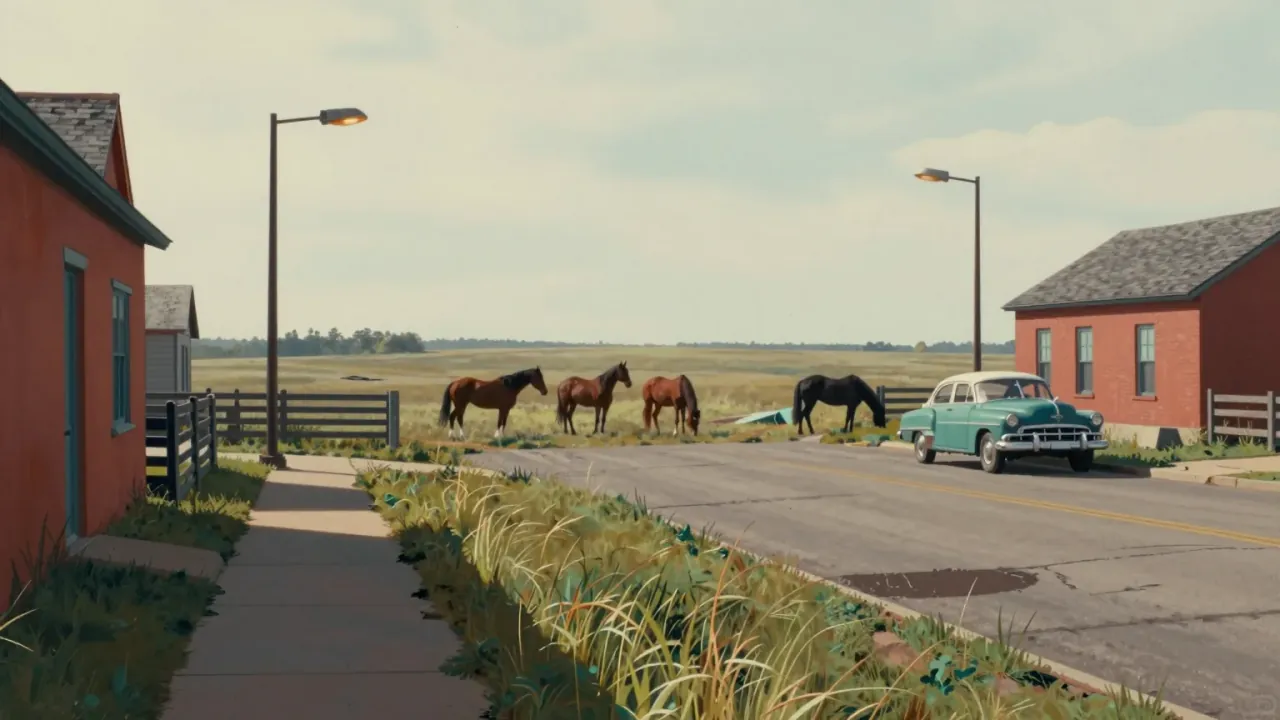
What lands is the cumulative weight of small, irreversible choices. The moment Ciavelli insists on being taken home instead of hospital; the pause before Emmerich crumples his suicide note; the way Doll drives while Dix bleeds silently beside her — these register not as drama but as consequence. The film’s restraint makes its fatalism credible: no one is betrayed by fate, only by their own assumptions — that the alarm won’t trigger elsewhere, that Brannom won’t draw first, that a taxi driver will wait while Doc watches a girl dance. The final stretch — Dix’s delirium, the green fields, the horses gathering — works because it follows logically from his earlier line about the farm, and because the camera holds on him without music or cutaway. Even the casting lands precisely: Whitmore’s Gus has the weary pragmatism of a man who’s driven too many men to too many bad ends; Jaffe’s Doc moves with the quiet authority of someone who knows safes better than people. Nothing feels imposed; everything feels earned by the script’s internal consistency. (157 words)
The hunt
What does not land is the police investigation, which remains schematic and underdeveloped. Commissioner Hardy appears late, delivers exposition, and vanishes; Ditrich’s beating of Cobby is reported, not shown, and lacks emotional or procedural texture. The film’s refusal to dramatise law enforcement leaves the manhunt feeling like background noise rather than counter-pressure — a structural weakness, not a stylistic choice. Similarly, the character of Doll Conovan, though well-acted by Jean Hagen, is given little interiority beyond devotion; her decision to drive Dix is narratively necessary but psychologically unexplored. The film also struggles with its own geography: Cincinnati bookends are vivid, but the unnamed city in between reads as generic Los Angeles studio backlot, undermining the novel’s regional specificity. And while the heist sequence is technically precise, its pacing risks monotony — the wall-hammering and safe-cracking stretch longer than tension sustains, relying on audience investment in process over suspense. These are not flaws of intent but of balance: the film trusts its mechanics so thoroughly it forgets to vary their rhythm. (159 words)
The cost
The themes that matter are professionalism undermined by biology, aspiration corroded by circumstance, and capital as both motive and trap. Doc plans the job like a surgeon, yet dies because he pauses for a jukebox. Dix dreams of land, but his body fails him before he reaches it. Emmerich seeks social redemption through wealth, then kills himself when money proves insufficient. The film treats class not as backdrop but as physics: Gus owns a diner but cannot afford a hospital; Ciavelli’s wife speaks Italian at home but must hide her husband’s wound from authorities; Emmerich wears tailored suits but keeps cash in a shoebox. There is no ideological critique — no mention of unions, strikes or policy — but the economic architecture is inescapable: every character is leveraged, every decision priced. Even the fence is absent, replaced by insurance company negotiations. The Asphalt Jungle is less about crime than about what happens when people with nothing to lose try to operate inside systems built to exclude them — not as rebels, but as contractors. (156 words)
The audience
This film is for viewers who value narrative economy, actors who listen before they speak, and stories where consequences arrive without fanfare. It rewards attention to gesture — a tightened jaw, a delayed blink, a hand resting on a gun — and patience with scenes that build weight through repetition rather than revelation. It is not for those who require moral clarity, catharsis or character arcs; Dix does not change, Doc does not repent, Emmerich does not explain. Anyone expecting stylised violence, witty banter or psychological excavation will find it austere. Those who dislike films where protagonists die offscreen or motivations remain unspoken may reject its withholding. A viewer who values thematic density over emotional payoff, or who finds dignity in failure rather than triumph, will sit with it willingly. Someone who needs closure, explanation or uplift will leave unsatisfied — not because the film fails, but because it refuses the conventions that supply those things. (159 words)
The end
Yes, it is worth your evening — provided you watch it as a study in causality, not as entertainment. Its 112 minutes unfold with the inevitability of a clockwork mechanism winding down: each scene sets up the next with minimal waste. You do not need to love crime films to appreciate its structural rigour, nor be familiar with noir to feel the gravity of its silences. It repays rewatching not for hidden clues but for shifts in emphasis — how a line delivered flat on first viewing carries irony on the second, how a background extra’s glance gains meaning once the plot unravels. Those who dismiss it as ‘slow’ or ‘cold’ are not wrong, but they mistake its temperature for indifference. Its power lies in refusing to warm the material — and in doing so, making the chill feel earned. If you want a film that asks you to follow logic rather than emotion, this earns its place. (158 words)