The purpose of it
The Big Boss is Bruce Lee’s first Hong Kong lead role and Golden Harvest’s inaugural production, made to capitalise on his unexpected local fame after The Green Hornet reruns. It aims to establish Lee as a martial arts star by anchoring him in a straightforward revenge narrative set among Chinese migrant labourers in Thailand — a context chosen for budgetary pragmatism and regional market appeal. The film does not attempt psychological realism or social commentary as ends in themselves; its structure follows the conventions of late-1960s Cantonese action cinema: clear moral lines, escalating physical stakes, and fight sequences that function as both climax and exposition. Lo Wei directs with functional efficiency rather than stylistic ambition, prioritising visibility of movement over spatial coherence or tonal nuance. The script, rewritten mid-production without Lee’s knowledge, simplifies Ni Kuang’s original draft into a vehicle for choreographed confrontation. Its goal is singular: to present Lee’s body, discipline and charisma as the irreplaceable centre of a genre film. It makes no claim to innovation in form, only in force of presence. (158 words)
The body of it
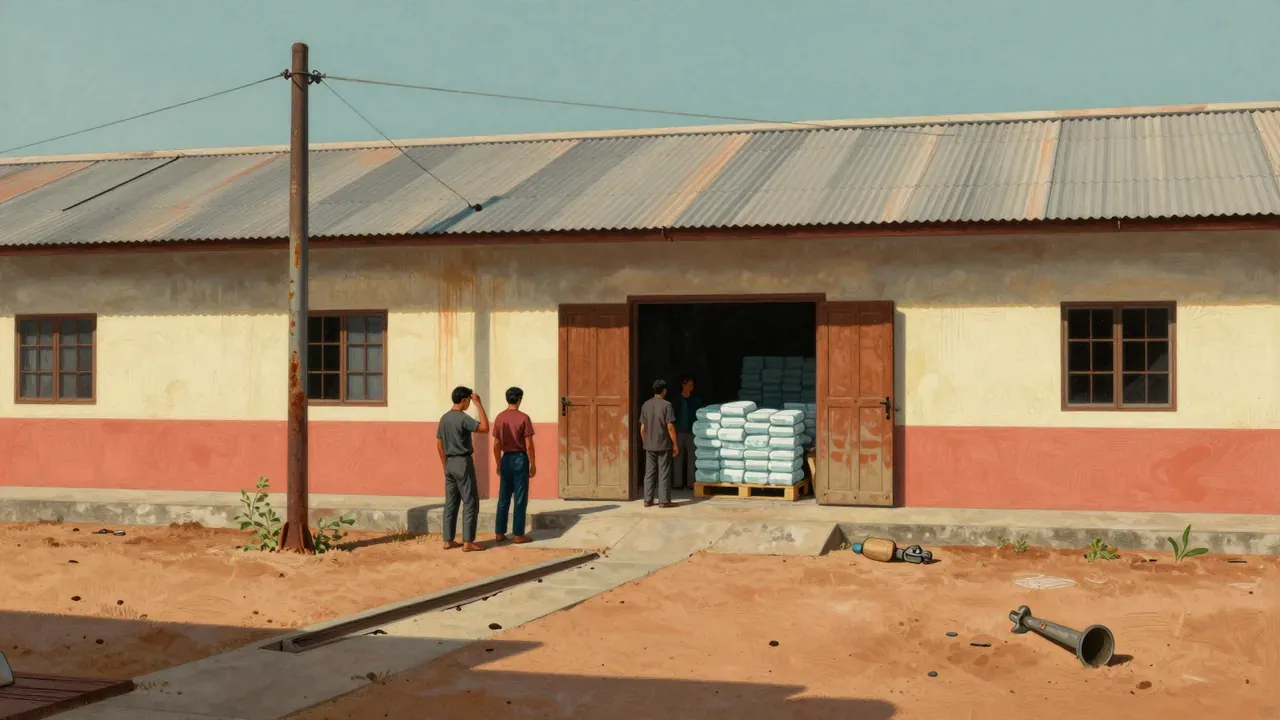
The story follows Cheng Chao-an, a young man sent from China to work in a Thai ice factory run by a syndicate masquerading as legitimate business. When his cousins disappear and are later found dead, he uncovers a narcotics operation and confronts the boss in a protracted, sweat-soaked brawl. Bruce Lee’s performance is physically committed but emotionally restrained: he speaks little, reacts minimally, and lets his stance, timing and precision carry meaning. Maria Yi and Nora Miao offer quiet dignity as women caught in the periphery of male violence; James Tien, originally written for the lead, appears briefly as a rival whose defeat is implied rather than shown. Ching-Chu Chen’s cinematography keeps shots wide and static during dialogue, then tightens during fights — no slow motion, no cutaways, just unbroken takes that emphasise endurance over flash. Peter Thomas’s score, imported from Europe, underlines tension with brass stabs and theremin wails, clashing gently with the setting but never overwhelming it. The craft serves clarity above all: every punch lands where the camera says it will. (159 words)
The weight of it
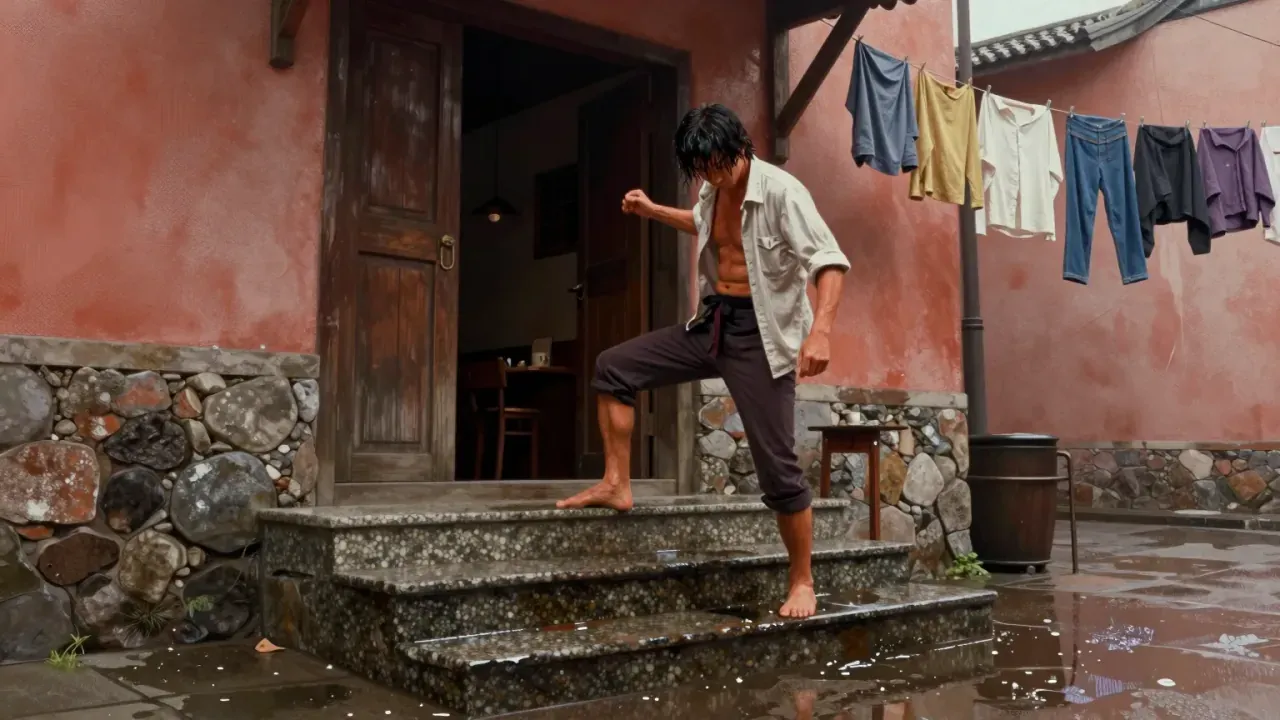
What lands is Bruce Lee’s physical authority. His movements are economical, decisive, and grounded — no wirework, no doubles, no editing tricks to conceal effort. The final ice-factory fight, shot over several days in stifling heat with visible exhaustion on Lee’s face, conveys real cost: breath rasps, knuckles split, sweat pools in collarbones. That sequence alone reshapes audience expectations of what a martial arts hero endures and how long a single confrontation can hold attention. The film also lands its sense of place: Pak Chong’s dusty roads, yellow tap water, and makeshift brothel interiors feel unvarnished, not stylised — a consequence of low budget and logistical constraint, but one that lends authenticity to the migrant experience it sketches. Even the jade necklace, a prop with no symbolic payoff beyond its initial presentation, gains weight through repetition: it is worn, touched, almost forgotten, then remembered at the moment of moral choice. These are not flourishes but anchors — small, repeated gestures that root the myth in something tactile and unglamorous. The film’s success lies in making inevitability feel earned, not preordained. (157 words)
The limits of it
What does not land is the script’s moral scaffolding. Characters outside Lee’s immediate circle remain schematic: the villains speak in monologues about power and weakness without interiority; the syndicate’s drug trade is named but never visualised or contextualised beyond its utility as motive. The factory setting, though used extensively, is never integrated into the plot’s logic — its machinery, layout and workforce serve only as backdrops for combat, not as obstacles or tools. Dialogue scenes suffer from flat delivery and minimal blocking; conversations happen front-on, with little variation in framing or rhythm, making exposition feel like recitation. Lo Wei’s rewrites stripped away Ni Kuang’s historical grounding in early-20th-century Thai-Chinese society, leaving a generic ‘corrupt boss’ figure with no cultural specificity or political dimension. The film avoids ambiguity, but mistakes absence of complexity for clarity. When Cheng Chao-an chooses vengeance over restraint, the decision carries no weight because the film has not established what restraint would cost him — nor what justice might look like beyond broken bones. The emotional arc is linear, not argued. (159 words)
The language of it
The themes that matter are migration as erasure, discipline as inheritance, and violence as language. Cheng Chao-an arrives in Thailand stripped of name, history and kinship — his identity reduced to labour and obedience. The jade necklace is not a talisman but a reminder of what he was told to forget: filial duty, non-violence, belonging. His transformation is not into a hero but into a conduit — for grief, for communal grievance, for the physical memory of his father’s death. Lee’s training regimen, glimpsed in brief interludes, is less about skill acquisition than ritual maintenance: breath control, posture, repetition. This is not self-improvement but self-preservation — a way to hold shape when everything else dissolves. The film treats violence not as catharsis but as translation: the only vocabulary left when speech fails, when law is absent, when loyalty is transactional. There is no glorification here, only demonstration — of limits, of endurance, of what the body remembers when the mind cannot process loss. The ice factory, cold and industrial, becomes a metaphor not for purity but for suspension: time slowed, feeling numbed, consequence deferred until the final thaw. (159 words)
The audience for it
It is worth watching for anyone interested in how star personas are forged in material constraint — not as myth-making but as daily negotiation between health, heat, budget and belief. Film students will find value in its unadorned staging and fight choreography that privileges duration over spectacle. Those seeking character-driven drama or sociological depth should look elsewhere: the film offers neither psychological insight nor structural critique. Viewers expecting the thematic density of Lee’s later films — or the formal daring of contemporaneous Shaw Brothers productions — will find this thin by comparison. Its pleasures are kinetic and historical, not literary or philosophical. A viewer who values narrative economy over emotional resonance, or who wants to see how a genre resets itself around a single performer, will find it essential. Anyone requiring moral complexity, linguistic texture or visual invention will leave unsatisfied — and rightly so. This is not a failure of execution but of scope: it achieves exactly what it sets out to do, and nothing more. (158 words)
The place of it
Yes, it is worth your evening — but only if you watch it as a pivot point, not a peak. It is not Lee’s most refined work, nor Lo Wei’s most assured, but it is the first time his physical intelligence is given uninterrupted screen time, unmediated by Hollywood framing or television pacing. You need no prior knowledge of Hong Kong cinema to feel its shift in gravity: the camera stops waiting for explanation and starts following consequence. Those who dislike dubbed dialogue or static compositions may struggle, but the dubbing is consistent and the stillness deliberate — a refusal to flatter the eye at the expense of the body’s truth. Someone who prefers tightly plotted thrillers or emotionally layered performances will find it rudimentary. What changes the verdict is context: seen in isolation, it is competent but narrow; seen as the first link in a chain that reshaped global action cinema, it is indispensable. Its value lies not in perfection but in precedent. (159 words)